
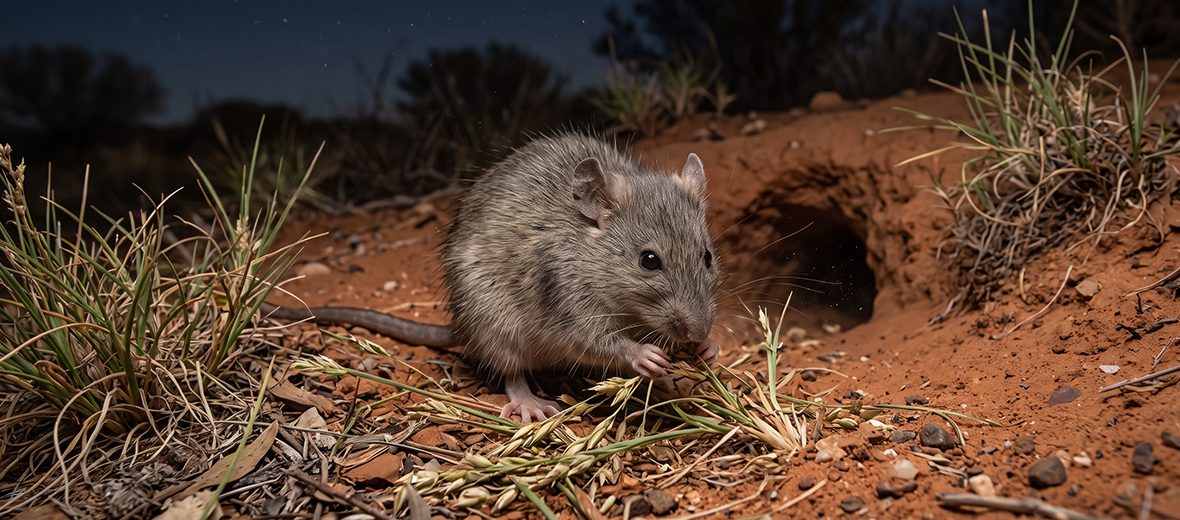
The long-haired rat, aka plague rat, is well known for their population eruptions over mass areas of Australia. Intensive grazing by cattle and invasive species like European rabbits destroy the thick vegetation and soil structures that these rats rely on for food and camouflage. Overgrazing depletes the plant cover needed to shield them from the extreme heat and from predators. Without this vegetation or the soft clay soil cracks to dig into, their survival rates drop drastically. Rainfall determines their population size. When arid conditions return to the Australian outback, they are restricted to tiny, isolated “moist refugia” (like areas near boreholes or wetlands). If these small habitats dry out completely, the local populations can potentially face extinction. Because their population booms can cause severe damage to cultivated pastures, property, and agricultural crops, they are classified as an agricultural pest in locales such as Western Australia. Landowners are usually granted legal licenses to manage and reduce their numbers utilizing rodenticide baiting and poisoning programs, which actively reduces their populations near human infrastructures. However, through all this, these rodents are quite abundant and thus listed as Least Concern by the IUCN. Their population trend is listed as unknown.
First the Stats…
Scientific name: Rattus villosissimus
Weight: Up to 10 ounces
Length: Up to 8.7 inches, plus up to a 7.1 inch tail
Lifespan: Up to 1 year or less
Now on to the Facts!
1.) During times of high rainfall and food abundance, these rats undergo a population boom that can stretch for up to 80,778 square miles in New South Wales, Queensland, Western Australia, the majority of the Northern Territory, and south Australia.
2.) During their eruptive periods, populations can reach into the hundreds of individuals per 2.47 acres!
3.) Like other species of rats, they are nocturnal (active at night).
4.) While not fully understood, their diet is believed to be omnivorous (eat plant and animal matter) in that they consume large amounts of stems, leaves, roots, grasses, herbs, succulents, a variety of crops like rockmelons and sunflowers, and insects.
5.) They are also opportunistic feeders and can, like other rat species, resort to cannibalism.
But wait, there’s more on the long-haired rat!
6.) Females can breed throughout the year and typically produce up to 10 pups. However, during a plague epidemic they can produce upwards of 12 pups every 3 weeks!
7.) The gestation (pregnancy) lasts up to 24 days.
Did you know…?
These rats can sprint up to 10 mph.
8.) Sexual maturity is reached in just 70 days.
9.) These rats are preyed on by barn owls, kites, kowaris, dingoes, cats, dogs, red foxes, and inland taipans.
10.) They are listed as a pest of agriculture under the Agriculture and Related Resources Protection Act 1976 by the Western Australian Department of Resources and Food.
Now a Short Long-Haired Rat Video!
This video talks about rats in general.
Be sure to share & comment below! Also, check out the Critter Science YouTube channel. Videos added regularly. Be sure to like and subscribe!

Want to suggest a critter for me to write about? Let me know here.
Some source material acquired from: Wikipedia & IUCN

Leave a Reply