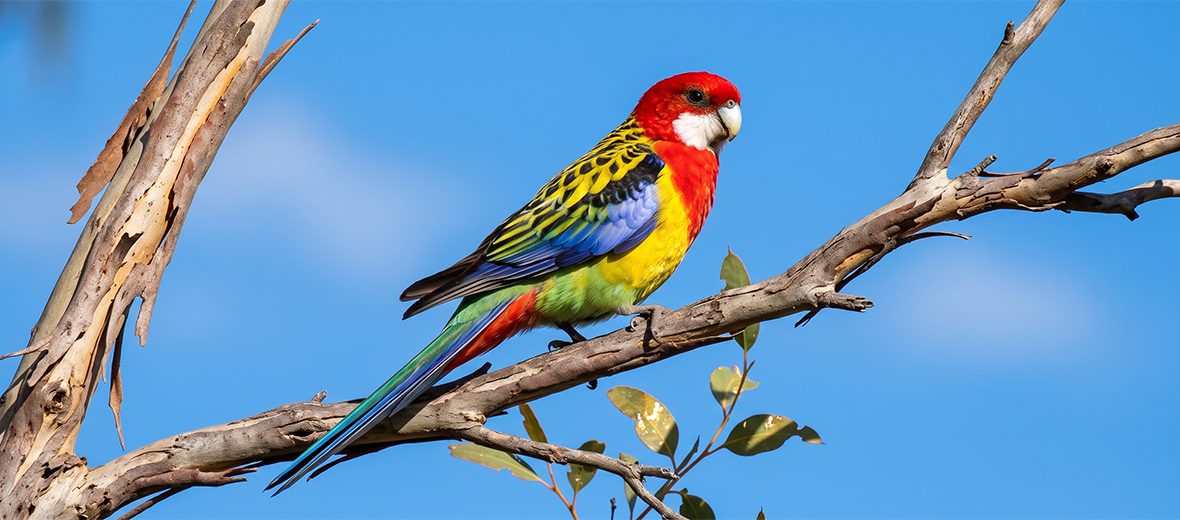
The eastern rosella is a species of parrot native to south-eastern Australia and Tasmania. They were first introduced to New Zealand in cages, and individuals were either intentionally released or accidentally escaped into the wild. Now they inhabit the entire North Island and are working on the South Island. They face the threats of habitat loss and destruction at the hands of residential and commercial developments, farming, ranching, mining, and quarrying. Feral and/or introduced birds such as the common starling and common myna fight them for available tree hollows. They are also preyed on by cats and dogs. Climate change causes extreme weather, large temperature fluctuations, and interferes with the availability of food. However, these birds are not only abundant, but their numbers are increasing. Therefore, the IUCN lists these birds as Least Concern.
First the Stats…
Scientific name: Platycercus eximius
Weight: Up to 4.2 ounces
Length: Up to 12.6 inches
Wingspan: Up to 18 inches
Lifespan: Up to 25 years
Now on to the Facts!
1.) There are 3 recognized subspecies of eastern rosellas: P. e. eximius, P. e. elecica, and P. e. diemenensis.
2.) They were first introduced to New Zealand in circa 1910, when a small shipment of eastern rosellas was denied entry into New Zealand by the Customs Department. The birds were then released off Otago Heads by the ship’s crew before returning to Sydney.
3.) In a separate situation, an estimated 12 captive rosellas escaped in Dunedin when their cages were subsequently damaged in a gale.
4.) Because they actively compete with native wildlife, damage crops, and spread disease, these birds are considered an invasive species in New Zealand.
5.) Their preferred habitats are the edges or remnant patches of open forest areas, surrounding shelter belts, gumlands, orchards, cultivated exotic crops, gardens, and golf courses.
But wait, there’s more on the eastern rosella!
6.) Buds, grass seeds, flowers, fruits, nectars, as well as insects and their larvae are all on the menu. They have been documented feeding on approximately 50 different plant species and around 15 species of insects.
7.) Breeding season lasts from August – February.
Did you know…?
They can be very territorial, and sometimes destroy the eggs of neighbors nesting too closely to their own nest.
8.) Being cavity nesters, they build their nests in tree hollows and nesting boxes.
9.) Females lay up to 6 eggs that hatch in up to 22 days.
10.) The chicks fledge in up to 30 days. In up to 40 days they are considered independent and can feed themselves.
But wait, there’s still more on the eastern rosella!
11.) In New Zealand these birds are culled by shooting them, trapping them, and hiring professional removal services to relocate them.
12.) These birds are diurnal (active during the day).
Now a Short Eastern Rosella Video!
Be sure to share & comment below! Also, check out the Critter Science YouTube channel. Videos added regularly. Be sure to like and subscribe!

Want to suggest a critter for me to write about? Let me know here.
Some source material acquired from: Wikipedia & IUCN