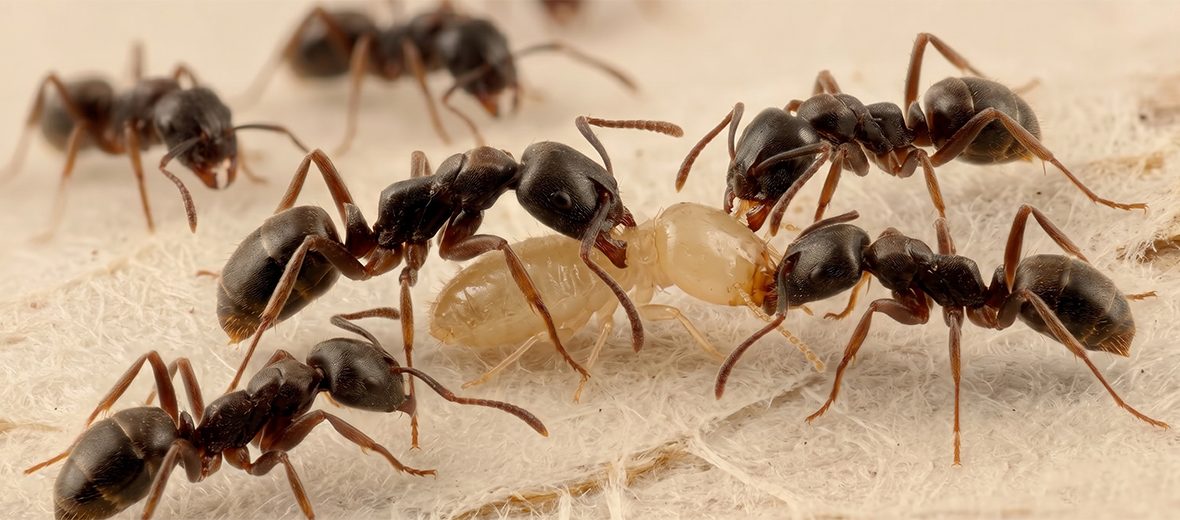
The Asian needle ant originally hails from Japan and mainland Asia. These ants are capable of medically significant stings and are considered a highly invasive species. They are a widely distributed ecological threat in the countries in which they have been introduced. They severely outcompete native species of ant in Europe and the United States and disrupt local woodland biodiversity. As a result, the IUCN lists these ants as Not Evaluated. Their population trend is listed as increasing as well.
First the Stats…
Scientific name: Brachyponera chinensis
Length: Up to .25 inch
Lifespan: Up to 1 year
Now on to the Facts!
1.) They prefer moist and shaded habitats such as natural forests, primarily beneath stones, logs, or various debris.
2.) These ants like to set up nests near termite encampments as termites are a reliable source of food.
3.) Eusociality has been documented, with overlapping generations and the division of labor within the colony.
4.) They display the highest level of organization of sociality. Defined by cooperative brood care (including care of offspring from other individuals), overlapping generations within a colony of adults, as well as a division of labor into reproductive and non-reproductive groups.
5.) A pre-adaptive trait this species has is the ability to tolerate in-breeding and eliminate the negative effects associated with genetic bottlenecks by maintaining heterozygosity (the presence of 2 different versions of a gene) levels in colonies.
But wait, there’s more on the Asian needle ant!
6.) These ants are not aggressive, like fire ants, but they will sting if they perceive a threat.
7.) Queens have a special pouch that has evolved to store male sperm which allows them to mate once and continually reproduce over their 1 year lifespan.
Did you know…?
Their sting(s) can cause anaphylaxis, and in some cases urticaria (raised, itchy welts that can range from pencil-eraser size to dinner-plate sized) due to the proteins in the ant’s venom.
8.) While there is no documentation on the amount of eggs laid by a queen in her lifetime, she will lay a steady stream of eggs daily throughout her life.
9.) The European Union has included these critters in their list of invasive alien species of Union concern. Hence, they can’t be bred, commercialized, imported, transported, or intentionally released into the environment in any EU member states.
10.) Argentine ants, ground beetles, centipedes, spiders, jumping spiders, and velvet ants all prey on these critters.
Now a Short Asian Needle Ant Video!
Be sure to share & comment below! Also, check out the Critter Science YouTube channel. Videos added regularly. Be sure to like and subscribe!

Want to suggest a critter for me to write about? Let me know here.
Some source material acquired from: Wikipedia & IUCN