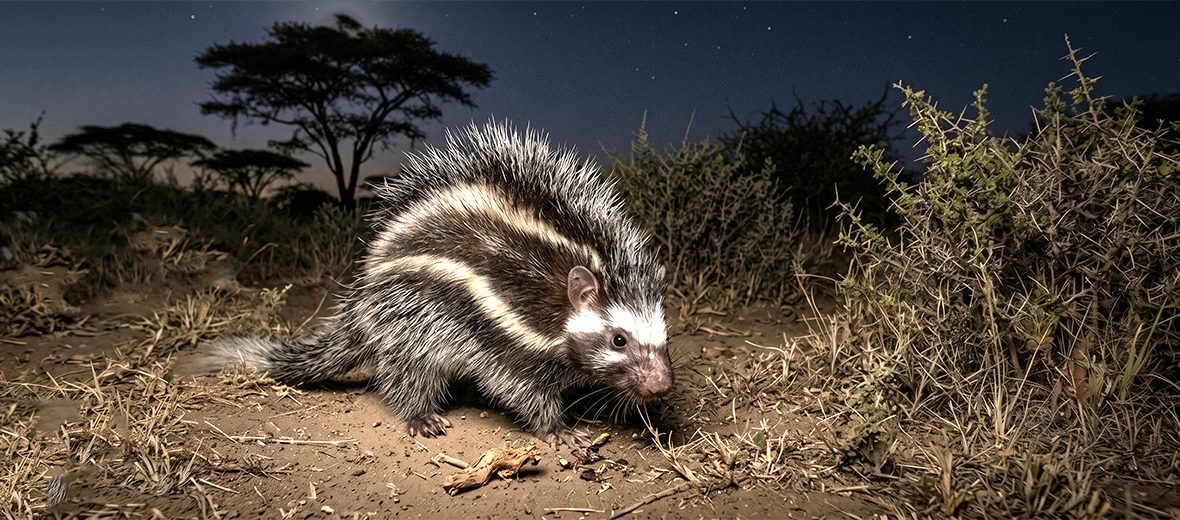
The maned rat, aka African crested rat, is the world’s only known poisonous rodent. They are a long-haired, bushy-tailed east African rodent that kind of resembles a porcupine at first glance. These large critters face the threats of habitat loss and destruction at the hands of logging and infrastructure development. They also face the threat of predation from raptors. However, they are abundant enough to be listed as Least Concern by the IUCN. Their population trend is listed as stable at this time.
First the Stats…
Scientific name: Lophiomys imhausi
Weight: Up to 6 lbs.
Length: Up to 14.2 inches, plus up to a 8.3 inch tail
Lifespan: Up to 8 years
Now on to the Facts!
1.) When threatened, they will erect their mane to appear larger and more threatening.
2.) These rats will smear their hairs with poison from the bark of the Acokanthera schimperi (the poison arrow tree), on which they chew, thus creating a defense that can sicken or even potentially kill predators that try to bite and/or eat them.
3.) They are the only known rodent to use and store toxins from a plant species to protect themselves, with no known adverse effects to the rat themself.
4.) Leaves, fruit, and other plant material are readily consumed. However, they have been known to eat meat, cereals, root vegetables, and insects while kept in captivity.
5.) Their stomach contains 5 anatomically separate sections that kind of resemble the sacculated configuration characteristic of ruminant artiodactyls (bear weight equally on 2 of their 5 toes). Sacculated configuration refers to an organ, vessel, or tube that is formed with a series of pouch-like, bag-like, or sac-like expansions.
But wait, there’s more on the maned rat!
6.) Due to their large size and weight, they might be 1 of the few muroid (all true mice, rats, gerbils, hamsters, voles, & lemmings) rodents to possess symbiotic microflora in the foregut which can metabolize cellulose by gastric fermentation, like a giraffe.
7.) These rats prefer the drier, highland forests and woodlands of Ethiopia, Kenya, Sudan, Somalia, Tanzania, Uganda.
Did you know…?
Their poison can cause vomiting and convulsions, as well as potential heart failure, if the poison is ingested. Coming into contact with and ingesting their poison can also be fatal to humans as well.
8.) Females birth up to 3 pups up to 2 times per year.
9.) Pups are weaned in up to 40 days.
10.) These rodents are nocturnal (active at night).
Now a Short Maned Rat Video!
Be sure to share & comment below! Also, check out the Critter Science YouTube channel. Videos added regularly. Be sure to like and subscribe!

Want to suggest a critter for me to write about? Let me know here.
Some source material acquired from: Wikipedia & IUCN