
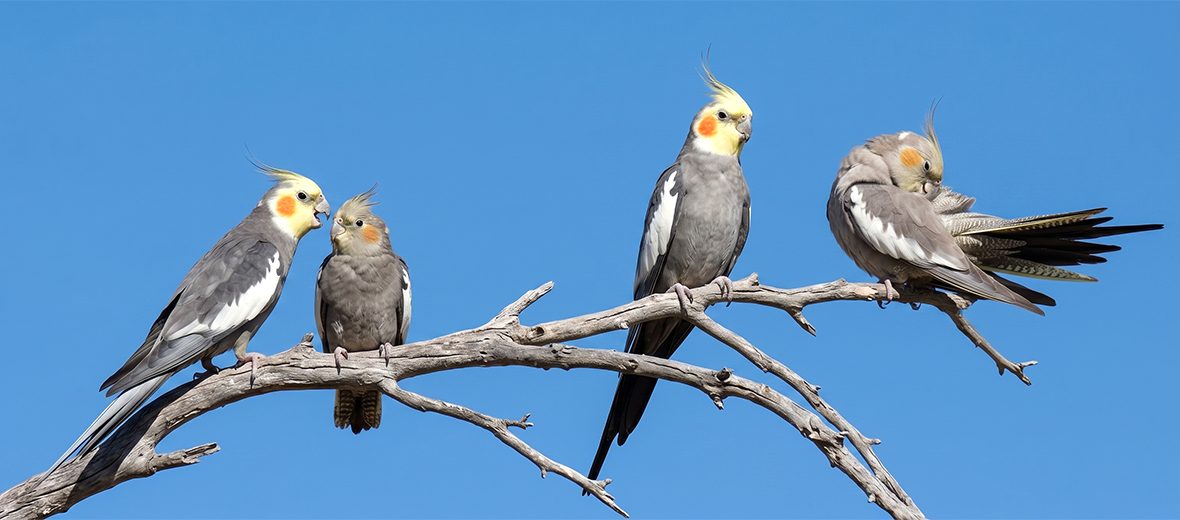
The cockatiel, aka quarrion, weero, or weiro, is actually a parrot that is also a member of its own branch of the cockatoo family, and hails from Australia. These energetic and intelligent birds face the threats of habitat loss and destruction in the form of large-scale clearing of forests and bushlands, mainly in agricultural regions, which reduces available food sources and nesting hollows. Extreme weather events, like droughts and wildfires, brought about by climate change, also reduces habitable locales. Invasive European honeybees, corellas, and galahs all compete for the already limited nesting spaces. Even though they are protected, they are still poached for the pet trade. They are also illegally shot as they are seen as an agricultural pest in larger flocks. Finally, vehicle strike (being hit by vehicles) is a common threat to their survival. However, despite all these threats, these birds are still quite abundant and thus listed as Least Concern by the IUCN. Their population trend is listed as stable.
First the Stats…
Scientific name: Nymphicus hollandicus
Weight: Up to 4.2 ounces
Length: Up to 14 inches
Wingspan: Up to 15 inches
Lifespan: Up to 30+ years
Now on to the Facts!
1.) They are highly valued as exotic household pets and companion parrots throughout the world, and are relatively easy to breed compared to other species of parrot. As a caged bird, cockatiels are 2nd in popularity only to the budgerigar (parakeet).
2.) These birds are the only member of the genus Nymphicus (a monotypic genus). It was formally uncertain whether these critters were a crested parakeet or small cockatoo; however, recent molecular studies have assigned them to their own subfamily, Nymphicinae.
3.) This species was first described by German naturalist, botanist, entomologist, and chemist J. F. Gmelin in an edition of Systema naturae in 1788.
4.) Their preferred habitats are arid or semi-arid countrysides, but they are always close to a water source.
5.) Being highly nomadic, they will travel to wherever there is food and water.
But wait, there’s more on the cockatiel!
6.) These critters feast on seeds, particularly Acacia, wheat, sunflower, and Sorghum. However, much to the woe of farmers, they will also feast on crops, causing quite a bit of damage in larger flocks.
7.) Both sexes display a round orange area on both ears, often coined as “cheddar cheeks”. This orange coloration is generally quite bright in adult males, and often duller in females.
Did you know…?
These birds are rather intelligent and capable of numerous sounds and speech. They are capable of uttering up to 100+ sounds, simple words, and even short phrases!
8.) Like other cockatoos, they often shed a white, fine powder that is often referred to as bird dander. This dust is mostly composed of broken down feather sheaths, skin cells, & various secretions from the preen gland.
9.) When frequently inhaled, this dander can cause various health problems, notably, hay fever, bird fancier’s lung, and allergic reactions.
10.) Females lay up to 7 eggs that hatch in up to 23 days, every other year.
But wait, there’s still more on the cockatiel!
11.) Males are typically quicker studies than females when it comes to speech.
12.) Cockatiels can also be taught to sing certain melodies, to the extent that some have even demonstrated the ability to synchronize their melodies with human songs.
13.) In the wild, their natural predators are various hawks, eagles, and falcons. While nesting or venturing to the ground they face predation by carpet pythons and monitor lizards.
Now a Short Cockatiel Video!
Be sure to share & comment below! Also, check out the Critter Science YouTube channel. Videos added regularly!

Want to suggest a critter for me to write about? Let me know here.
Some source material acquired from: Wikipedia & IUCN

Leave a Reply