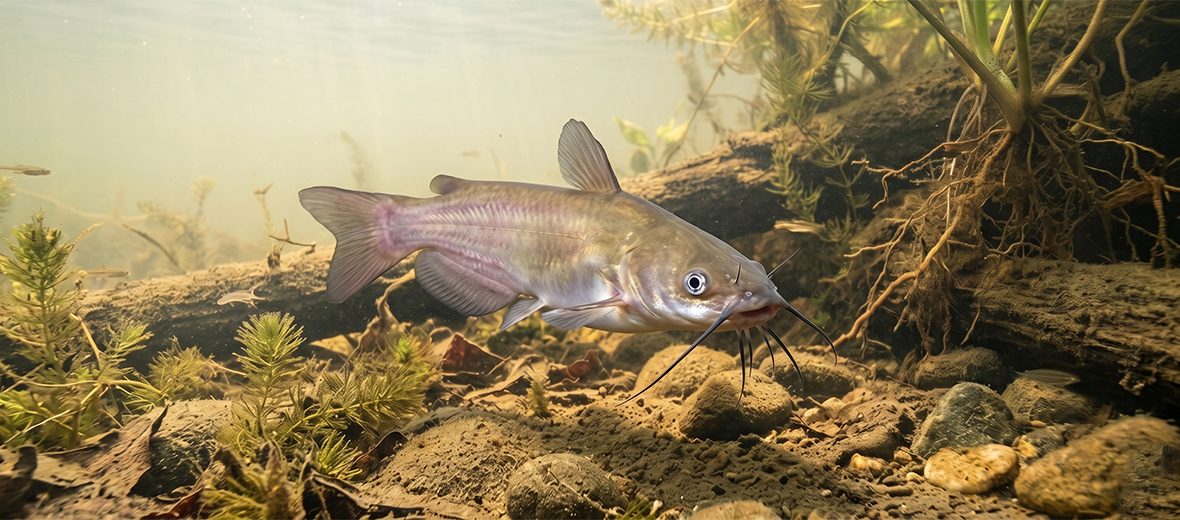
The brown bullhead, aka mud pout, horned pout, hornpout, or mud cat, can be found throughout most of North America. These catfish are regularly stocked in lakes meant for fishing all over Canada and the United States. They face the threats of habitat destruction, water pollution, overfishing, and habitat alteration, via wetlands draining. However, they are abundant enough to be listed as Least Concern by the IUCN. Their population trend is listed as stable. This article is dedicated to my youngest son, Seth.
First the Stats…
Scientific name: Ameiurus nebulosus
Weight: Up to 7.6 lbs.
Length: Up to 21 inches
Lifespan: Up to 8 years
Now on to the Facts!
1.) These catfish were first described by French Naturalist Charles Alexandre Lesueur in 1819.
2.) They are recognized as a clan symbol of the Ojibwe people. In their tradition, bullheads or “wawaazisii” are 1 of 6 beings that arose from the sea to form the original clans.
3.) Like other catfish, they are ectothermic (use external sources for thermoregulation), heterothermic (able to generate their own body heat), and bilaterally symmetrical (can be divided into identical left and right mirror-image halves along a single central plane).
4.) These catfish can be found in a variety of habitats such as lakes, swamps, murky ponds, and drainage ditches.
5.) Insects, leeches, snails, fish, clams, a variety of plants, and corn are all on the menu.
But wait, there’s more on the brown bullhead!
6.) They can survive in waters with heavy pollution and low dissolved oxygen values down to 0.2 ppm.
7.) When being fished, they are attracted to nightcrawler worms, chicken liver, corn, and a variety of commercial baits.
Did you know…?
The current International Game Fish Association world record for these fish is 7 lbs. 6 ounces.
8.) When caught, they are a feisty fish, but not really a fighter, per se. They tend to try and wedge themselves under rocks or submerged logs to avoid being reeled in.
9.) Females lay up to 10,000 externally fertilized eggs that hatch in up to 13 days.
10.) Both parents care for the fry for up to 5 days after they hatch.
But wait, there’s still more on the brown bullhead!
11.) Bullheads have been documented eating their own eggs, on various occasions.
12.) These fish have also been introduced to Chile, Puerto Rico, various European countries, New Zealand, Iran, and Turkey where they are considered an invasive species.
Did you know…?
Like some other species of catfish, they have sharp spines on their dorsal and pectoral fins that are connected to venom glands which produce a mild poison. While not fatal to humans, a puncture from these spines causes significant pain, burning, and swelling.
13.) They are nocturnal (active at night).
14.) Northern pike, muskellunge, walleye, water snakes, common snapping turtles, alligator snapping turtles, green herons, yellow perch, and sunfish all prey on these fish.
15.) These critters are the most abundant species in most lakes and streams across North America.
Now a Short Brown Bullhead Video!
Be sure to share & comment below! Also, check out the Critter Science YouTube channel. Videos added regularly. Be sure to like and subscribe!

Want to suggest a critter for me to write about? Let me know here.
Some source material acquired from: Wikipedia & IUCN