
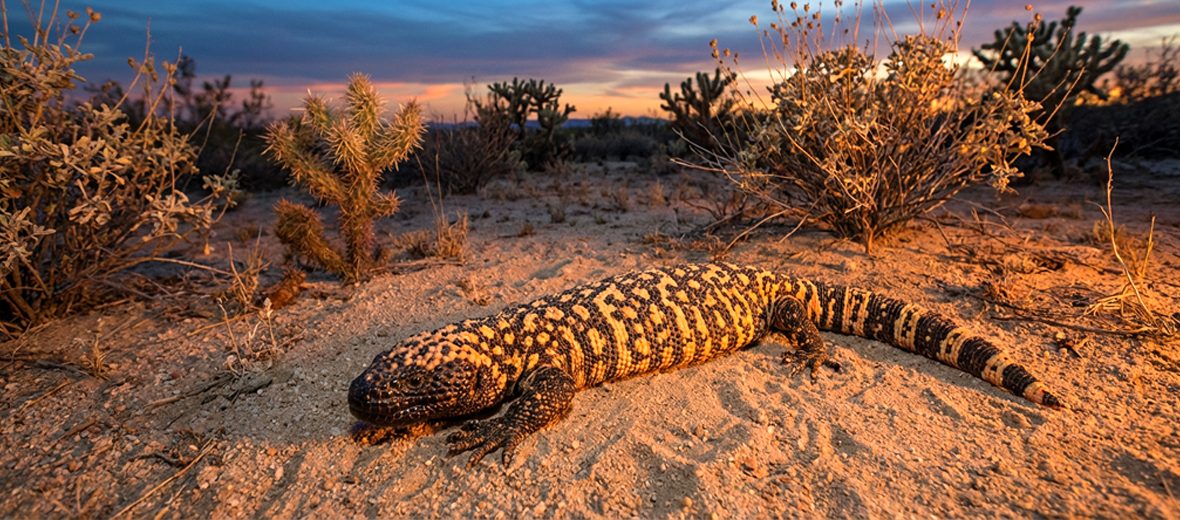
The Mexican beaded lizard, aka beaded lizard, is but 1 of 2 species of venomous lizards. The other being the Gila monster. The beaded lizard is larger and duller in coloration than the Gila monster. These lizards face the threats of habitat loss and destruction at the hands of farming, ranching, residential, and commercial developments, fires, and fire management; aversive hunting (using negative physical or psychological stimuli to make specific animals fear and avoid humans), trapping, for fear of envenomation; and climate change, that is causing droughts and flooding that are affecting their natural dry forest habitats. Despite these pressures these lizards are still abundant enough to be listed as Least Concern by the IUCN. However, their population trend is listed as decreasing.
First the Stats…
Scientific name: Heloderma horridum
Weight: Up to 8.8 lbs.
Length: Up to 36 inches, including their tail
Lifespan: Up to 40 years
Now on to the Facts!
1.) The subspecies Guatemalan beaded lizard is 1 of the rarest lizards in the world, with an estimated wild population of less than 200.
2.) These lizards, along with the Gila monster, have been around since the Miocene Epoch, 23 million years ago.
3.) Seeing as they have remained largely unchanged since the Miocene Epoch, these reptiles are often referred to as living fossils.
4.) They were first described in 1829 by zoologist and herpetologist Arend Wiegmann as Trachyderma horridum, but he then renamed them Heloderma horridum just 6 months later.
5.) These lizards are surrounded by myth and superstition in much of their native range. Myths such as being more venomous than a rattlesnake, that they can cause lightning strikes with their tail, or even making a pregnant woman miscarry by merely making eye contact with them.
But wait, there’s more on the Mexican beaded lizard!
6.) Their generic name Heloderma means “studded skin”, from the Ancient Greek words hêlos (ἧλος) (the head of a nail or stud) and dérma (δέρμα), meaning skin. Their specific name, horrĭdum, is Latin and means rough or rude.
7.) Contrary to many other lizards, their tail does not regenerate if broken or damaged.
Did you know…?
Their venom has been found to have several enzymes that are useful for manufacturing drugs in the treatment of diabetes, Alzheimer’s disease, and even HIV. Research on the pharmacological uses of their venom is ongoing.
8.) With their forked, pink tongues they smell their surroundings, with the help of a Jacobson’s organ; they stick their tongues out to gather scents and touch them to the opening of the organ when the tongue is retracted.
9.) They can be found from the Pacific drainages in southern Sonora to southwestern Guatemala and 2 Atlantic drainages, from central Chiapas to southeastern Guatemala.
10.) Their preferred habitats are deserts, tropical deciduous forests, and thorn scrub forests, but are also found in pine-oak forests, at elevations from sea level to 4,921 feet.
But wait, there’s still more on the Mexican beaded lizard!
11.) Beaded lizards are heavily fossorial (spend most of their life underground), venturing above ground for only an hour or more. Their active periods are between April – mid-November.
12.) Being a specialized vertebrate nest predator, they feed mostly on bird and reptile eggs; often climbing trees to reach them. They also prey on small birds, mice, rats, gophers, ground squirrels, frogs, lizards, and insects.
Did you know…?
Their venom is a weak hemotoxin (destroys red blood cells, disrupts blood clotting, and damages tissues or organs), and although human deaths are very rare, the venom can cause respiratory failure.
13.) The venom glands of these lizards are modified salivary glands found in their lower jaw. Each gland has a separate duct that leads to the base of their grooved teeth.
14.) When biting, they hang onto their victim and chew to get their venom into the wound.
15.) Nearly every recorded human bite (just 8 in the past century) have resulted from pestering and prodding captive lizards with a finger, hand, or bare foot. If left alone, they aren’t inclined to bite.
But wait, there’s still a bit more on the Mexican beaded lizard!
16.) Bites have been described as excruciating pain that extends well beyond the area bitten and persists for up to 24 hours. Other typical effects of bites on humans include local edema (swelling), weakness, sweating, and a rapid drop in blood pressure.
17.) Males engage in fierce, ritual battles that can last for several hours; the winner gets to mate with the female.
18.) Females lay up to 30 eggs in summer that hatch in up to 215 days. The hatchlings remain hidden for several months till they are larger.
19.) They are protected by Mexican law under the category A (Threatened), and they reside within the range of several protected areas.
Now a Short Mexican Beaded Lizard Video!
Be sure to share & comment below! Also, check out the Critter Science YouTube channel. Videos added regularly. Be sure to like and subscribe!

Want to suggest a critter for me to write about? Let me know here.
Some source material acquired from: Wikipedia & IUCN