
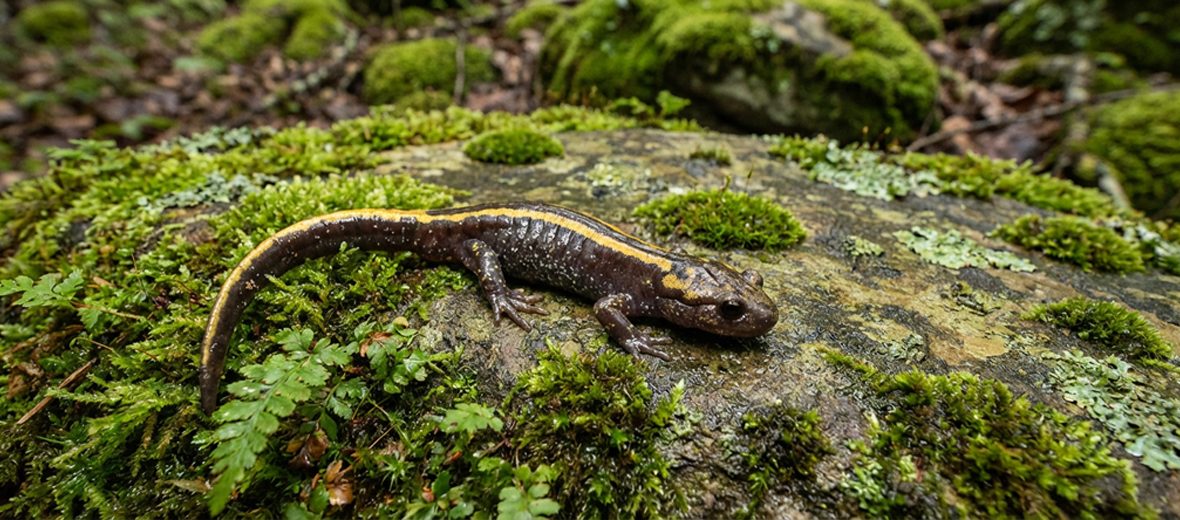
The long-toed salamander gets their name due to their long outer 4th toe on the hind limbs. These critters are found at up to 9,200 feet elevations. They face the threats of invasive species in the form of trout that consume the larval stage of these salamanders; and likely habitat loss and destruction, as well as fragmentation. However, they are abundant enough to be listed as Least Concern by the IUCN. Their population trend is listed as stable, for now.
First the Stats…
Scientific name: Ambystoma macrodactylum
Weight: Up to .26 ounce
Length: Up to 5.5 inches, including their tail
Lifespan: Up to 10 years
Now on to the Facts!
1.) Their preferred habitats are alpine meadows along the rocky shores of mountain lakes, cheatgrass plains, coniferous forests, montane riparian zones, red fir forests, sagebrush plains, semiarid sagebrush, and temperate rainforests.
2.) They dwell in slow-moving streams, ponds, and lakes during their aquatic breeding phase.
3.) These salamanders brumate (hibernation for amphibians) during the cold winter months, and survive on energy reserves stored within their skin and tail.
4.) They were first described by American naturalist Spencer Fullerton Baird in 1849 (circa 1850s).
5.) There are 5 recognized subspecies: A. m. croceum, A. m. columbianum, A. m. krausei, A. m. sigillatum, and A. m. macrodactylum.
But wait, there’s more on the long-toed salamander!
6.) Females lay upwards of 264 eggs per cluster.
7.) The larvae hatch in up to 6 weeks.
Did you know…?
This species is 1 of the most widely distributed salamanders in North America, 2nd only to the tiger salamander.
8.) To improve their chances for survival, some individuals grow larger heads and become cannibals, then they feed upon their own brood mates.
9.) The larvae metamorphose into adults in up to 4 months.
10.) Adults prey on beetles, various invertebrates, tadpoles, worms, and small fish.
But wait, there’s still more on the long-toed salamander!
11.) Garter snakes, moles, shrews, mice, rats, birds, and fish all prey on these salamanders.
12.) When threatened, these salamanders will wave their tail and secrete an adhesive white milky substance that is noxious and very likely poisonous.
Did you know…?
Places like Waterton Lakes National Park have installed a road tunnel underpass to allow safe passage and to sustain the migration ecology of these salamanders.
13.) They also have the ability of caudal autotomy (dropping the end of their tail). This shed tail will wriggle and squirm, attracting the attention of the assailant, and hopefully giving the salamander a chance to escape.
14.) Just like all amphibians, the long-toed salamander has both an aquatic and terrestrial life transition and semipermeable skin.
15.) These salamanders are primarily nocturnal (active at night).
16.) These, like all salamanders, are coined as indicator species because they are effected by changes in the surrounding environment.
Now a Short Long-Toed Salamander Video!
Be sure to share & comment below! Also, check out the Critter Science YouTube channel. Videos added regularly. Be sure to like and subscribe!

Want to suggest a critter for me to write about? Let me know here.
Some source material acquired from: Wikipedia & IUCN


Leave a Reply