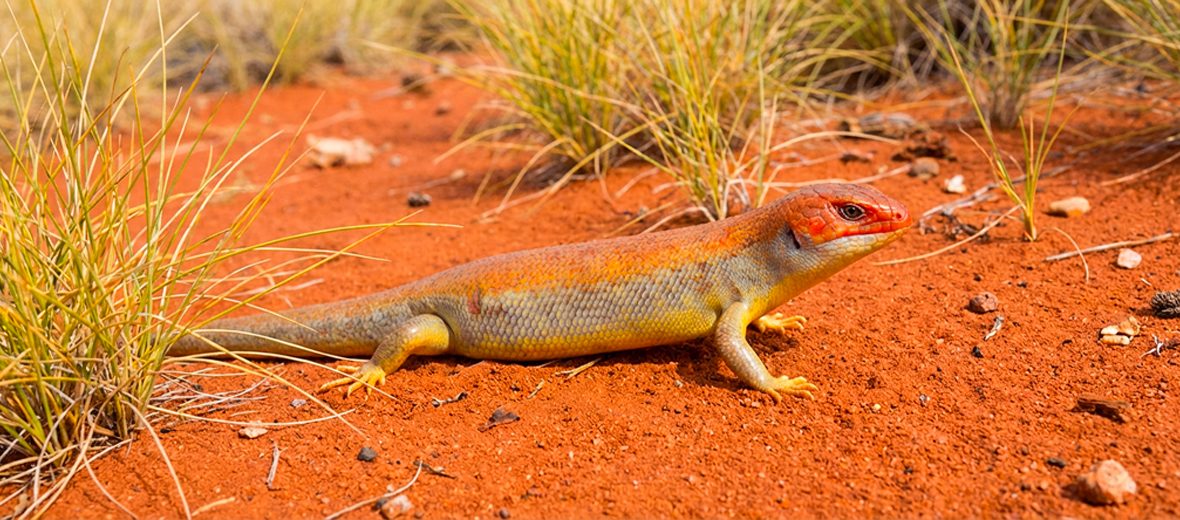
The great desert skink, aka Kintore’s egernia or tjakura, hails from the western half of Australia. They create burrows and are social as well. These lizards face the threats of predation by invasive feral cats and red foxes; habitat loss and destruction at the hands of fires and fire suppression; and human disturbance in the form of recreational activities and tourism, which effects their breeding and can destroy their burrows. The IUCN lists these skinks as Vulnerable. Their population trend is listed as decreasing.
First the Stats…
Scientific name: Liopholis kintorei
Weight: Up to 12 ounces
Length: Up to 7.9 inches, including the tail
Lifespan: Up to 20 years
Now on to the Facts!
1.) These skinks were scientifically described and named by Stirling & Zietz in 1893, following their recording by European explorers during the 1892 – 1893 Elder expedition in Australia’s Great Victorian Desert.
2.) Other Aboriginal Australian names for these skinks are mulyamiji, nampu, tjakura, tjalapa, and warrana (aka warrarna).
3.) Their burrows are extensive and can extend up to 39 feet complete with up to 20 different entrances.
4.) These lizards are rather unique in that they communally build and take care of their burrows, even excavating out specific rooms for use as a defecatorium (toilet).
5.) Although up to 40% of males choose alternate mates, up to 60% of males are monogamous (at least seasonally).
But wait, there’s more on the great desert skink!
6.) Researchers have confirmed that these lizards are family-based and allow the juveniles to stay in the tunnel system until they mature.
7.) They brumate (hibernation for reptiles) from May – June into September – October.
Did you know…?
It is estimated that there are fewer than 10,000 individuals remaining, as of 2017. Nearly 10 years later, that number is nearly halved at 6,250!
8.) Being opportunistic omnivores, they will feast on mosquitoes, termites, other invertebrates, and plant matter.
9.) Females are viviparous (give live birth) and birth up to 4 young each breeding season.
10.) These lizards are cathemeral (active both day and night).
Now a Short Great Desert Skink Video!
Be sure to share & comment below! Also, check out the Critter Science YouTube channel. Videos added regularly. Be sure to like and subscribe!

Want to suggest a critter for me to write about? Let me know here.
Some source material acquired from: Wikipedia & IUCN