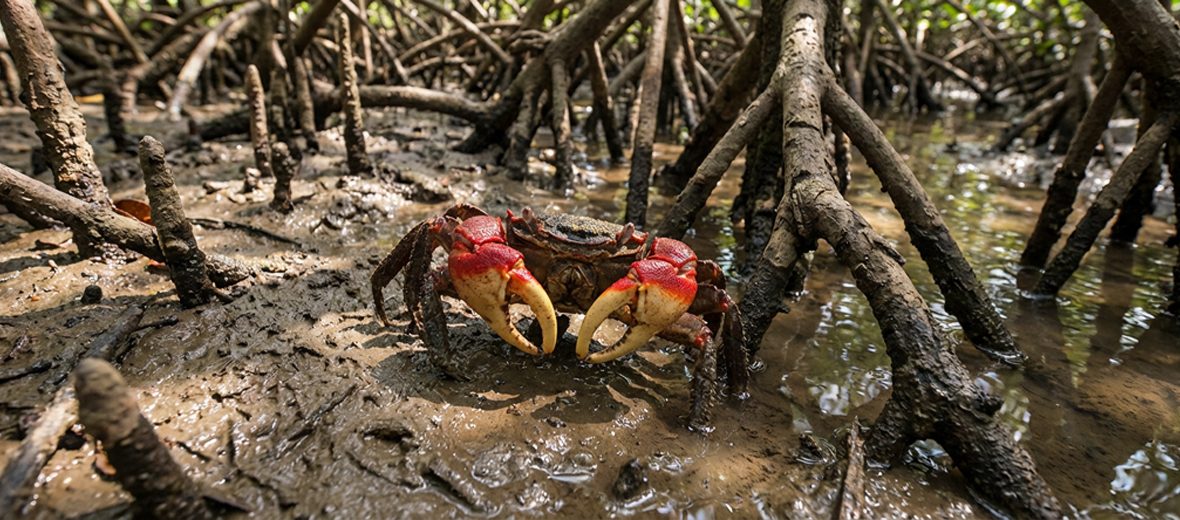
The red mangrove crab, as you would imagine, dwells in and among mangroves. They are ecologically important as they bury and consume leaf litter. These crustaceans are not currently evaluated by the IUCN, but still face the threats of habitat loss and destruction at the hands of residential and commercial developments; microplastics pollution; water pollution; land pollution; climate change, that affects water temperature and can cause storms and habitat alterations; and general predation from native and introduced species. Their population trend is listed as stable and possibly increasing, despite the threats they face.
First the Stats…
Scientific name: Neosarmatium meinerti
Weight: Up to 1.51 ounces
Length: Up to 1.8 inches
Lifespan: Up to 5 years
Now on to the Facts!
1.) Mangrove crabs, in general, are a diverse species. There are approximately 481 different species placed in 6 different families. New species are discovered all the time.
2.) They are most commonly found in the Indo-West Pacific region in mudflats along tropical coasts. The largest habitats for these crabs are in Southeast Asia, South America, and Northern Australia.
3.) Young crabs derive a majority of their nutrients from polychaete worms and a multitude of microorganisms found dwelling in the sediments and leaves of their environment.
4.) Adults are primarily omnivorous detritivores that consume already dead organic material and even the dead bodies of their own kind.
5.) Wading birds, fish, smaller sharks, monkeys, snakes, hawks, and raccoons all prey on these crabs.
But wait, there’s more on the red mangrove crab!
6.) To protect themselves from predation, they can climb trees. The only other crab known to do this is the hermit crab.
7.) Burrows are often constructed from the sediment at the base of the mangrove roots. Some burrows can reach a depth of up to 39+ inches.
Did you know…?
The practice of consuming these critters may be threatened by human activities, as microplastics have been found to be very common in the gills of red mangrove crabs.
8.) Like many other crustaceans, mangrove crabs have historically been caught, cooked, and eaten by people all over the world. Crab meat can be prepared simply by boiling the crab either dead or alive until the shell turns from black to red.
9.) Approximately 3,728 miles of mangroves were deforested between 1996 – 2016, typically to be redeveloped for fish and shrimp aquaculture, palm oil plantations, rice cultivation, and sometimes urbanization.
10.) Logging has had a significant negative effect on these critter’s diversities.
Now a Short Red Mangrove Crab Video!
This video talks about mangrove crabs in general.
Be sure to share & comment below! Also, check out the Critter Science YouTube channel. Videos added regularly!

Want to suggest a critter for me to write about? Let me know here.
Some source material acquired from: Wikipedia & IUCN