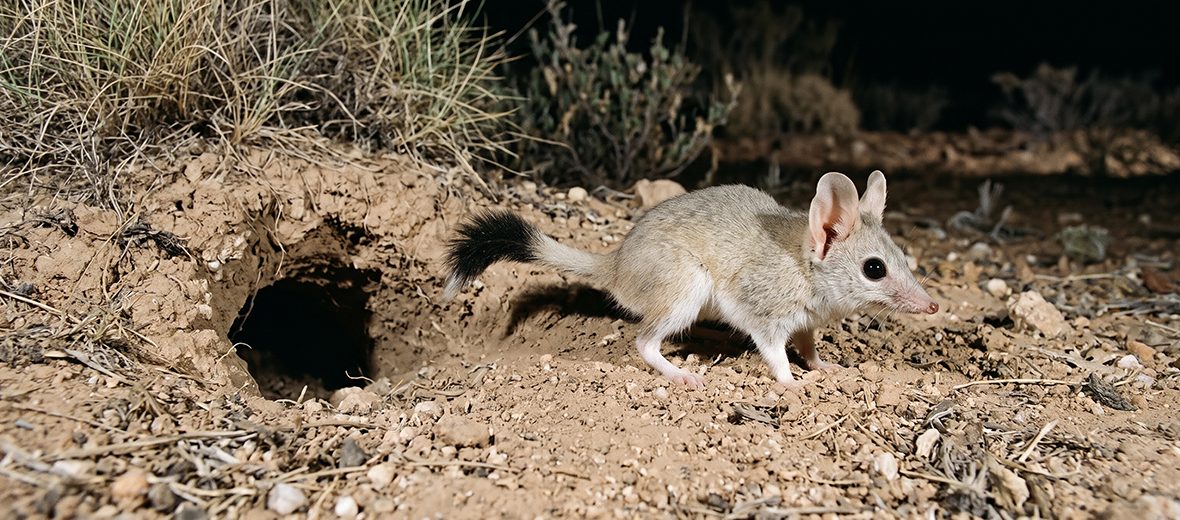
The kowari, aka kariri, is a diminutive, carnivorous marsupial that hails from the gibber deserts of central Australia. Invasive red foxes and feral cats hunt kowaris specifically, causing collapses in local populations. Heavy desert rains result in a boom in prey populations, which triggers an explosion in feral cat numbers; when conditions later dry out, these cats switch to hunting kowaris as well as other small native mammals. Cattle and sheep that roam across pastoral leases trample underground kowari burrows and compact sandy mounds, making it challenging for them to dig shelters. Livestock and introduced herbivores (like rabbits and goats) strip away native ground vegetation, reducing shelter and wiping out the invertebrates and small vertebrates that these marsupials eat. Bores and troughs draw stock and feral predators deeper into remote gibber plains, shrinking the remaining safe areas away from grazing zones. The construction of additional roads through stone-paved gibber plains increases the frequency of vehicle strikes (being hit by vehicles). Due to these threats, these marsupials are listed as Vulnerable by the IUCN. There population trend is listed as decreasing as well.
First the Stats…
Scientific name: Dasyuroides byrnei
Weight: Up to 6.2 ounces
Length: Up to 7.1 inches, plus up to a 6.3 inch tail
Lifespan: Up to 6 years
Now on to the Facts!
1.) Alternate names for these critters include: brush-tailed marsupial rat, bushy-tailed marsupial rat, Byrne’s crest-tailed marsupial rat, and Kayer rat.
2.) They were first described by evolutionary biologist, anthropologist, and ethnologist Sir Walter Baldwin Spencer in 1896.
3.) These marsupials are a member of the family Dasyuridae, and the lone member of genus Dasyuroides.
4.) Kowaris prefer habitats such as arid, sparsely vegetated stony deserts and gibber plains within the Lake Eyre basin of central Australia.
5.) They are nocturnal (active at night), spending their days in the safety of their burrows.
But wait, there’s more on the kowari!
6.) Long-haired rats, house mice, geckoes, insects, centipedes, spiders, and birds are all voraciously feasted upon.
7.) Females undergo up to a 35 day gestation (pregnancy) that can yield up to 6 joeys. Once born, the joeys migrate to mom’s marsupium (pouch) to continue developing for up to an additional 56 days.
Did you know…?
There are only an estimated 5,000 individuals remaining, to date.
8.) In Queensland, these marsupials are protected in both the Astrebla Downs and Diamantina National Parks, although they have not been seen in Diamantina National Park since circa 2012.
9.) Captive kowaris have been known to be associated with oral squamous cell carcinomas (SCCs). The SCCs cause tumors that invade the oral cavity of the individual and begin to cause swelling in the gums.
10.) In South Australia, none of their current range winds up under conservation tenement, though a predator free reserve of 29,652 acres has been established near Andamooka Station where 12 individuals were transferred to from around the Birdsville Track in 2022.
Now a Short Kowari Video!
Be sure to share & comment below! Also, check out the Critter Science YouTube channel. Videos added regularly. Be sure to like and subscribe!
Buy My Book
Select the image below to see everywhere my book is sold.


Want to suggest a critter for me to write about? Let me know here.
Some source material acquired from: Wikipedia & IUCN