
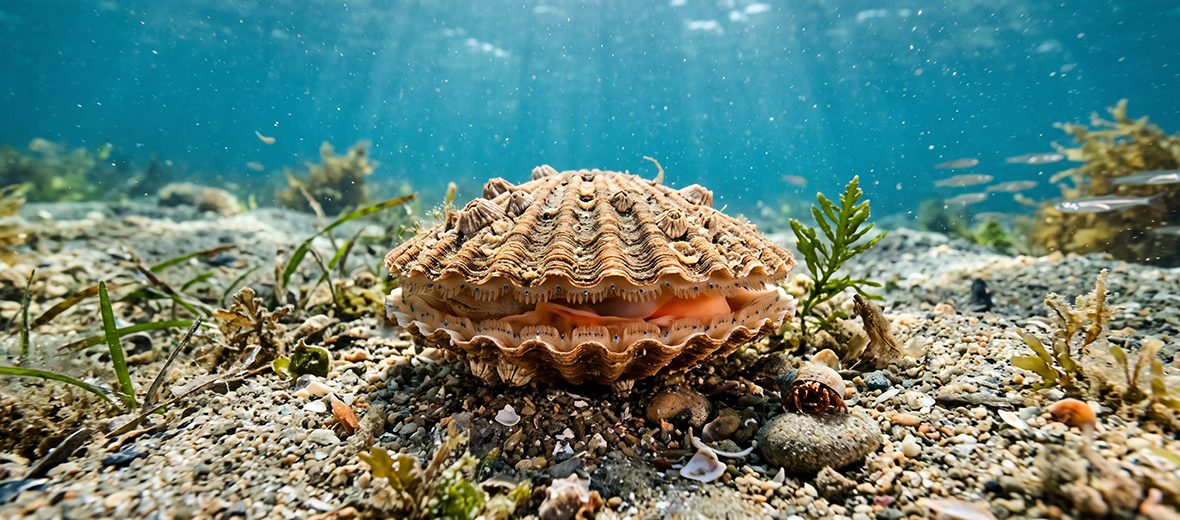
Sea scallops are a cosmopolitan family of bivalves found in all of the world’s oceans. However, they are not found in any body of freshwater. These bivalves suffer from lowered pH levels that make it difficult for their larvae to calcify and build healthy shells. Nutrient runoff causes algae blooms that drop oxygen levels and increases water acidity. Climate change causes higher temperatures which stress populations and disrupt metabolic balances. Pathogens like coccidian parasites have been known to cause catastrophic, large-scale local die-offs. Intense dredging and overfishing can reduce adult breeding stocks. Despite these threats, most species of bivalves are abundant enough to be listed as Data Deficient or Not Evaluated by the IUCN. Generally speaking, their populations are listed as stable.
First the Stats…
Scientific name: Pectinidae
Weight: Up to 1.6 ounces
Length: Up to 9 inches
Lifespan: Up to 20 years
Now on to the Facts!
1.) These creatures have a well-developed nervous system, and contrary to most other bivalves all scallops have a ring of up to 200 simple eyes situated around the edge of their mantles.
2.) Scallops are prized as a source of food, and some species are farmed as aquaculture.
3.) There are certain species that have brightly colored, symmetrical, fan-shaped, fluted ornamentation shells, which are prized by shell collectors and have been utilized since ancient times in architecture, motifs in art, and various designs.
4.) Their shell consists of 2 sides, aka valves, a left valve and a right valve, divided by a symmetrical plane.
5.) Some species are known to move in large groups from 1 area to another, as a form of migration.
But wait, there’s more on the sea scallop!
6.) Being filter feeders these critters feast on plankton.
7.) Like all types of bivalves, they lack formal brains. Rather, their nervous system is controlled by 3 paired ganglia located at various points throughout their anatomy, the cerebral or cerebropleural ganglia, the pedal ganglia, and the visceral or parietovisceral ganglia.
Did you know…?
They are 1 of very few groups of bivalves to be primarily “free-living”, with numerous species being capable of quickly swimming short distances and even migrating a fair distance across the ocean floor.
8.) Most scallops can swim at speeds of up to 2.3 mph.
9.) Females can produce up to 270,000,000 eggs each spawn.
10.) That being said, many scallops are hermaphrodites (having both female and male organs), altering their sex throughout their lives, while others exist as dioecious species, having a definite sex of male or female.
But wait, there’s still more on the sea scallop!
11.) They have been around for over 270 million years, since the Triassic period.
12.) The largest wild scallop fishery is devoted to the Atlantic sea scallop, which is found off the northeastern United States and eastern Canada. These scallops are harvested using scallop dredges and/or bottom trawls.
Did you know…?
The Shell corporation, 1 of the world’s biggest oil and gas companies, is represented by a scallop.
13.) Due to the reduction of sharks, an apex predator, some areas have shown a massive reduction in scallops. This is due to the fact that sharks prey on rays, a primary predator of scallops. When the shark populations were reduced, the ray populations increased, and the bivalves diminished.
14.) Occasionally pearls are created, though scallop pearls do not have the buildup of translucent layers or “nacre” which give desirability to the pearls of the feather oysters, and usually lack both luster and iridescence.
15.) Throughout time, scallops and other hinged shells have been symbolic of the feminine principle. From the surface, these shells can symbolize the protective and nurturing principle, and inwardly, the “life-force slumbering within the Earth”.
Now a Short Sea Scallop Video!
Be sure to share & comment below! Also, check out the Critter Science YouTube channel. Videos added regularly. Be sure to like and subscribe!

Want to suggest a critter for me to write about? Let me know here.
Some source material acquired from: Wikipedia & IUCN

Leave a Reply