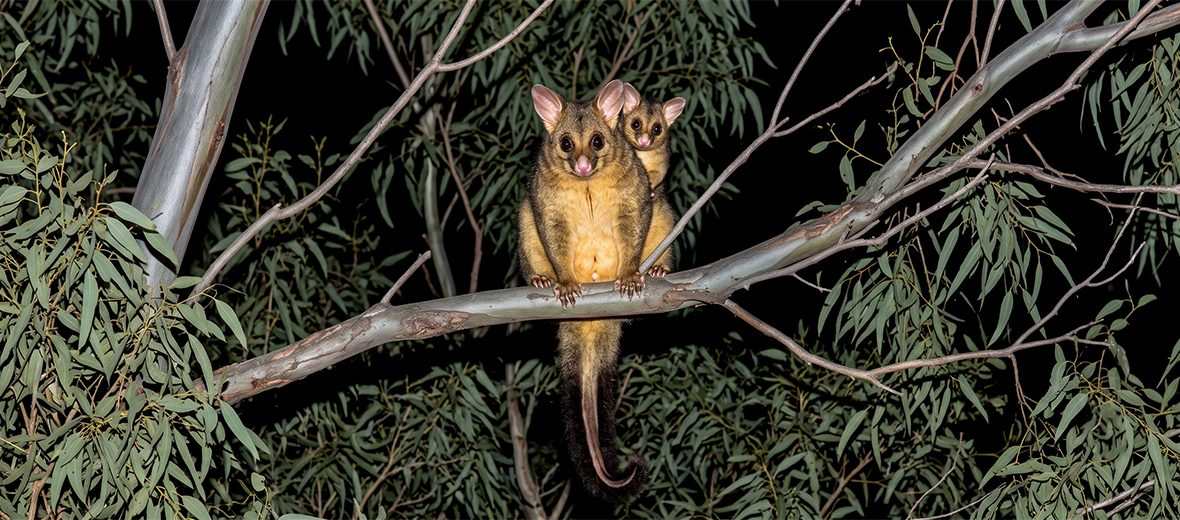
The common brushtail possum is the 2nd largest of the Australasian possums. They are native to Australia and invasive in New Zealand because they are known for rapidly destroying native forests via heavy browsing, they prey on native bird eggs and chicks, and they also spread bovine tuberculosis to farm animals. In their native range, these possums face the threats of habitat loss and destruction at the hands of deforestation for agriculture, urban expansion, mining, and quarrying. Tree hollows they rely on for housing are also often destroyed when trees are felled. Climate change also causes reduced food sources in arid zones and causes local population contractions, which could lead to inbreeding. Frequent and intense, late-season wildfires degrade their habitat quality and destroy their food networks. Occasional outbreaks of flesh-eating bacterial skin diseases have an unfortunate affect on specific regional subspecies. Lastly, vehicle strike (being hit by vehicles) on roads is another common occurrence. However, these possums are abundant enough to be listed as Least Concern by the IUCN. Their population trend is listed as decreasing.
First the Stats…
Scientific name: Trichosurus vulpecula
Weight: Up to 9.9 lbs.
Length: Up to 23 inches, plus a 15.5 inch tail
Lifespan: Up to 13 years
Now on to the Facts!
1.) As is the case for possums, these critters are nocturnal (active at night).
2.) Like other marsupials in this group they possess a prehensile tail.
3.) While primarily a folivore (eats leaves), but also coined as an omnivore (eats plant and animal matter), they have been documented eating smaller mammals, like mice and rats.
4.) Eucalyptus leaves make up the bulk of their diet, but they also like flowers, shoots, fruits, and seeds.
5.) They are preyed on by powerful owls, tiger quolls, red foxes, cats, dogs, dingoes, carpet pythons, goannas, and humans.
But wait, there’s more on the common brushtail possum!
6.) The chest of both males and females has a scent gland that produces a reddish secretion that stains the fur around it. This secretion is used to mark their territory.
7.) Their preferred habitats are eucalypt forests, open woodlands, and rainforest edges that provide mature trees with natural hollows. They’ve also adapted to urban and suburban environments.
Did you know…?
Introduced in circa 1850s to set up a fur industry, the mild subtropical climate of New Zealand, and little to no natural predators, caused these critters to thrive to the point that they have become a major agricultural and conservational pest.
8.) When among human habitations, these possums are inventive and rather determined foragers with a taste for fruit trees, vegetable gardens, and are known for raiding accessible kitchens.
9.) They are heavily arboreal (spend most of their lives in trees).
10.) These critters are not usually aggressive towards one another, and when confronted by another member of their species they will often just click, grunt, hiss, produce alarm chatters, guttural coughs, screech, and bring their ears to an erect stance till 1 or the other backs down.
But wait, there’s still more on the common brushtail possum!
11.) While they can breed year round, they typically have 2 breeding seasons. That being September – November and March – May.
12.) Females undergo up to an 18 day gestation (pregnancy) that produces a single joey. That joey weighs in as just .07 ounce and measures only .6 inch long. After being born, the joey will then crawl into its mother’s marsupium (pouch) to continue developing for an additional 5 months.
Did you know…?
Possums, as mentioned, are considered a pest in New Zealand and Tasmania, where they are killed for their meat and fur. However, due to the potential of tuberculosis being prevalent in numerous possums across most of New Zealand, possums are generally only eaten in Northland, where the disease doesn’t exist in these possums.
13.) When older, the joey is either left in the den or will ride on its mother’s back until it is up to 9 months old and independent.
14.) Although they were once hunted extensively for their fur, these possums are now largely protected throughout Australia. That being said, Tasmania does give crop-protection permits to landowners whose property has been damaged in order to allow the crop owner the right to kill on site.
15.) In Queensland, they can only be trapped by a licensed commercial relocator who must then release the possum within 82 feet of the point of capture to ensure that an animal is not released into another possum’s home range.
Now a Short Common Brushtail Possum Video!
Be sure to share & comment below! Also, check out the Critter Science YouTube channel. Videos added regularly. Be sure to like and subscribe!

Want to suggest a critter for me to write about? Let me know here.
Some source material acquired from: Wikipedia & IUCN

Leave a Reply