
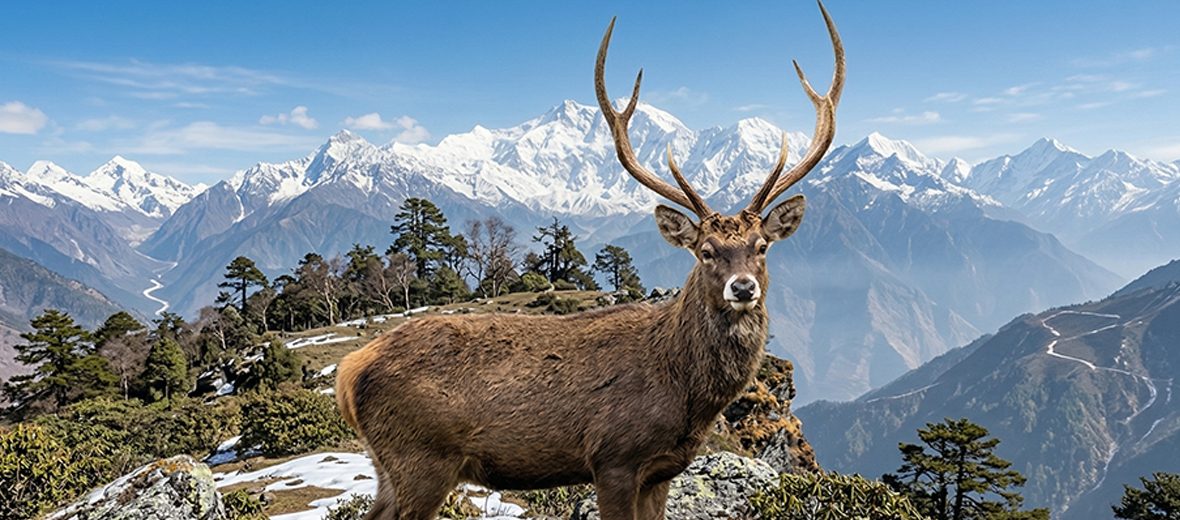
The Thorold’s deer, aka white-lipped deer or baichunlu, dwells in the grasslands, shrublands, and forest habitats at the higher altitudes of the eastern Tibetan Plateau, as well as sparce areas further north in central Western China. They face the threats of competition for food with livestock; habitat loss and destruction at the hands of farming and ranching; hunting, for their meat, hides, and antlers; trapping for antler farms; and invasive species, that can cause disease and can compete for food. They are listed as Vulnerable by the IUCN. Their population trend is listed as unknown at this time.
First the Stats…
Scientific name: Cervus albirostris
Weight: Up to 510 lbs.
Length: Up to 6.6 feet, pllus up to a 5.12 inch tail
Height: Up to 55 inches, at the shoulders
Lifespan: Up to 21 years
Now on to the Facts!
1.) These deer were first scientifically described by Polish-Russian explorer Nikolai Przhevalsky in 1883.
2.) They have been around for 13.8 million years; since the Oligocene epoch.
3.) Their hooves are wide and heavy, with rather long dewclaws.
4.) The presence of short legs and wide hooves make them adept at climbing steep terrain to avoid predators.
5.) Another adaptation of their high-altitude habitat is that they have large nostrils to take in more air. They also have smaller and more abundant red blood cells to distribute more oxygen.
But wait, there’s more on the Thorold’s deer!
6.) They can be found at elevations of up to 16,700 feet.
7.) Their natural predators are the Himalayan wolf and the snow leopard.
Did you know…?
Adult male antlers can measure up to 43 inches.
8.) They are crepuscular (active at dawn and dusk).
9.) While rarely running, they can gallop at up to 35 mph.
10.) Females undergo up to a 250 day gestation (pregnancy) that yields a single fawn.
Now a Short Thorold’s Deer Video!
Be sure to share & comment below! Also, check out the Critter Science YouTube channel. Videos added regularly. Be sure to like and subscribe!

Want to suggest a critter for me to write about? Let me know here.
Some source material acquired from: Wikipedia & IUCN

Leave a Reply