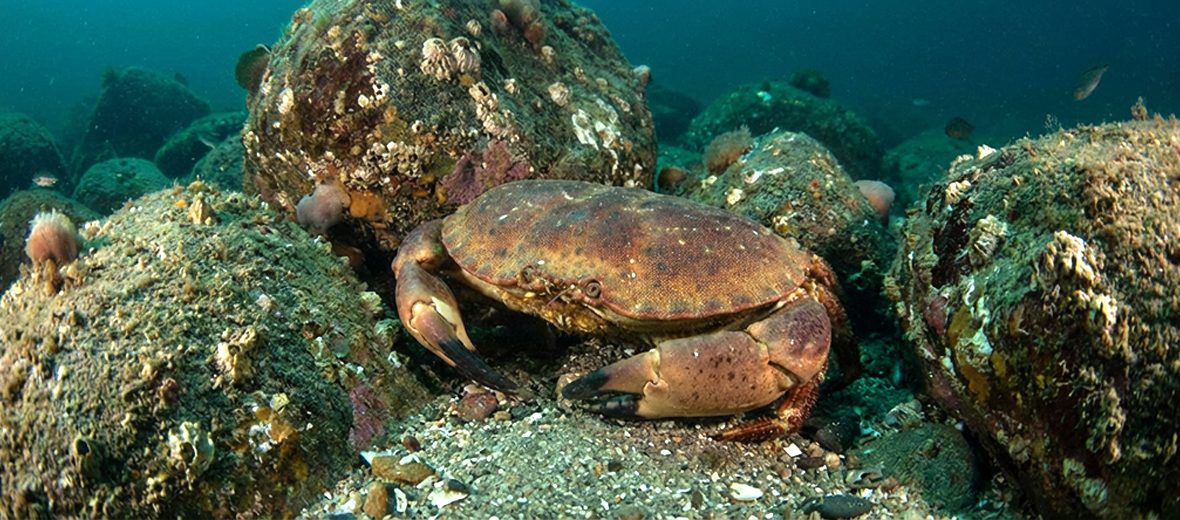
The brown crab, aka edible crab, is found in the North Sea, North Atlantic Ocean, and possibly the Mediterranean Sea. These crabs face the threats of overfishing; diseases, including: pink crab disease, shell disease syndrome, and various viruses; cadmium poisoning, which renders them unsellable due to the poisonous meat; predation, from octopuses; climate change, which causes higher water temperatures; habitat loss and destruction, at the hands of residential and commercial developments; water pollution; microplastics pollution; and general damage, in the case of limb loss – which causes a great toll to energy reserves in molting to regenerate lost limbs. However, after all those adversities, they are still abundant enough to be listed as Least Concern by the IUCN. There population trend is listed as decreasing, though.
First the Stats…
Scientific name: Cancer pagurus
Weight: Up to 6.5 lbs.
Length: Up to 10 inches
Lifespan: Up to 100 years
Now on to the Facts!
1.) These crabs are nocturnal (active at night).
2.) They are part of the largest crab fishery in Western Europe, centered on the coasts of Ireland and Britain, with more than 66,139 tons caught annually.
3.) Brown crabs dwell at depths of about 300 feet.
4.) Other crabs, lobsters, shrimps, clams, oysters, blue mussels, and snails are all on the menu.
5.) A majority of the edible crabs caught by the British fishery fleet are exported live for sale in France and Spain.
But wait, there’s more on the brown crab!
6.) Approximately 1/3rd of the weight of an adult edible crab is meat, of which 1/3rd is white meat from their claws, and 2/3rds is white and brown meat from their body.
7.) Mating takes place in the winter. The male will stand over the female and form a sort of cage with his legs protecting her while she molts.
Did you know…?
Male crabs are referred to as cocks and females as hens.
8.) Females lay up to 3,000,000 eggs each season. The eggs are carried by the female for up to 8 months till they hatch.
9.) When the eggs hatch, the larvae take on a planktonic phase and free float in the ocean till they molt and advance to the juvenile stage, where they take to the ocean floor.
10.) These crabs were first described by Carl Linnaeus in 1758, in the tenth edition of his Systema Naturae.
Now a Short Brown Crab Video!
Be sure to share & comment below! Also, check out the Critter Science YouTube channel. Videos added regularly. Be sure to like and subscribe!

Want to suggest a critter for me to write about? Let me know here.
Some source material acquired from: Wikipedia & IUCN