
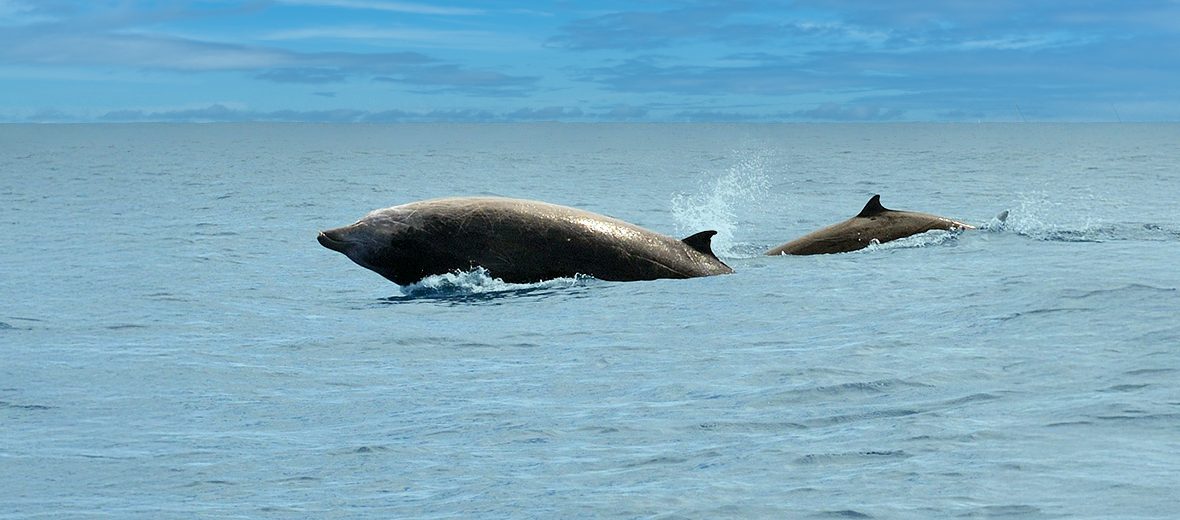
The Cuvier’s beaked whale, aka goose-beaked whale or ziphius, the most widely distributed of the beaked whales, is smaller than most baleen whales, and the larger toothed cetaceans; like sperm whales or orcas. Even though they have an incredible dive depth, they are the most frequently-spotted beaked whales when they surface. These whales face the threats of noise pollution, which is caused by military sonars and possibly high-energy sounds from other anthropogenic sources which have repeatedly resulted in the strandings and deaths of these creatures; microplastics pollution; water pollution, in the form of ingested plastic bags; and climate change, that may effect their food source via warming waters. Despite these threats, they are abundant enough to be listed as Least Concern by the IUCN. Their population trend is listed as unknown at this time. This article is dedicated to my son, Jon. Thank you for all you do.
First the Stats…
Scientific name: Ziphius cavirostris
Weight: Up to 6,800 lbs.
Length: Up to 23 feet
Lifespan: Up to 62 years
Now on to the Facts!
1.) These whales were first described in 1823 by the French naturalist and zoologist Georges Cuvier in Recherches sur les ossements fossiles “Research on Fossil Bones”.
2.) They are 1 of 24 extant (living) species in the family Ziphiidae, and the only extant member of the genus Ziphius, with the other member being the now extinct Ziphius compressus.
3.) While typically silent in shallower depths, when diving beyond 656 feet, they will resort to echolocation to locate prey.
4.) These whales utilize suction feeding to draw prey into their open mouths.
5.) Fish, octopuses, and squids are the preferred prey; with crustaceans and shrimp being thrown in, for good measure.
But wait, there’s more on the Cuvier’s beaked whale!
6.) Their echolocation organ is located in their “melon” (the bump on the top of their head).
7.) Females undergo up to a 12 month gestation (pregnancy) that yields a single calf.
Did you know…?
These whales are on record as having the deepest dive depth of up to 9,816 feet, and submerging for up to 138 minutes.
8.) The calf is born weighing 660 lbs. and measuring up to 9.10 feet.
9.) They can be spotted among the tropical and temperate waters off of all the continents, sans Antarctica.
10.) These whales have a terrible reaction to sonar. Strandings and beachings often occur near naval bases where sonar may have been in use.
Now a Short Cuvier’s Beaked Whale Video!
Be sure to share & comment below! Also, check out the Critter Science YouTube channel. Videos added regularly. Be sure to like and subscribe!

Want to suggest a critter for me to write about? Let me know here.
Some source material acquired from: Wikipedia & IUCN
Photo credit: Laurent Bouveret



Leave a Reply