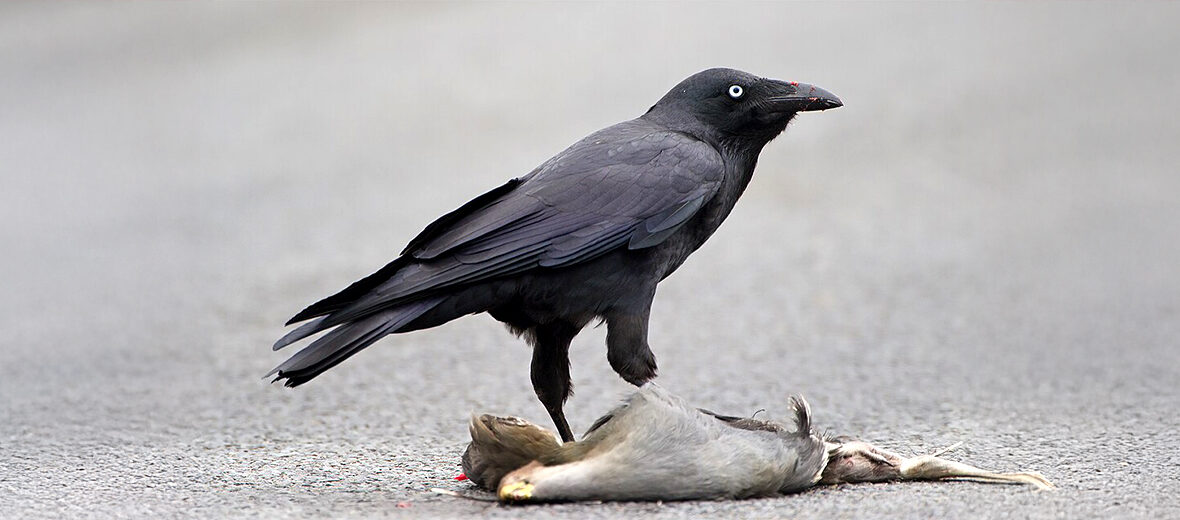
The forest raven, aka Tasmanian raven, is a passerine bird in the Corvidae family and native to Tasmania & parts of southern Victoria. These birds face the threats of habitat loss and destruction at the hands of residential and commercial development, farming, and ranching; human conflict, in the form of shooting and poisoning (for fear that they will attack their poultry – which is totally unverified); vehicle strike (being hit by vehicles); and accidental poisoning, due to consuming lead from buckshot in animal carcasses. However, these birds are listed as Least Concern by the IUCN due to their abundant numbers. Their population trend is listed as decreasing.
First the Stats…
Scientific name: Corvus tasmanicus
Weight: Up to 1.43 lbs.
Length: Up to 21 inches
Wingspan: Up to 44 inches
Lifespan: Up to 20+ years
Now on to the Facts!
1.) In Tasmania they tolerate a wide variety of habitats, such as woods, open interrupted forests, mountains, coastal areas, farmlands, and town & city fringes. However, on mainland Australia they prefer a closed forest environment.
2.) They were first described by English ornithologist and scientific illustrator John Latham as the “South-Seas raven” in 1781.
3.) Their call is a deep and husky “korr-korr-korr-korr” with a similarly drawn out last note. They also produce a barking alarm call. Juveniles have a higher pitch than those of adults.
4.) The forest raven is the most widely distributed species of bird in the state of Tasmania.
5.) These ravens are not only sedentary but territorial.
But wait, there’s more on the forest raven!
6.) They have been known to mob large birds of prey, such as wedge-tailed eagles and white-bellied sea eagles.
7.) Forest ravens typically walk when moving around on the ground, although they do hop when hurrying, like when trying to avoid an oncoming vehicle on the road.
Did you know…?
The mite Knemidocoptes intermedius has been seen on these ravens. Infestation results in crusty grey lesions around their tibiotarsal joints (ankles), caused by the mites living in tunnels under their skin.
8.) Females lay up to 6 eggs every 1 – 2 days that hatch in up to 25 days.
9.) Chicks are born altricial (esssentially helpless) but nidicolous (leave the nest not long after birth).
10.) While they primarily eat insects, earthworms, fruits, grains, and carrion (dead animals), they have also been documented preying on fairy penguins. Most of their food comes from carrion though.
But wait, there’s still more on the forest raven!
11.) Generally perceived to be a threat to both poultry and orchard crops, they are often shot or poisoned. Seeing as they aren’t protected under Tasmania’s Nature Conservation Act 2002 and no permit is required if landowners seek to kill them, the killings sadly continue.
12.) Seeing as there have been recorded instances of these corvids attacking, albeit sick, lambs they gained an unfair reputation of attacking livestock as well.
13.) These birds do way more good than harm by preying on insects and removing carrion which, if left unattended, could spread disease.
14.) Despite their taste for roadkill, they seldom ever get struck by vehicles.
Now a Short Forest Raven Video!
This video talks about the intelligence of ravens, in general.
Be sure to share & comment below! Also, check out the Critter Science YouTube channel. Videos added regularly. Be sure to like and subscribe!

Want to suggest a critter for me to write about? Let me know here.
Some source material acquired from: Wikipedia & IUCN
Photo credit: JJ Harrison