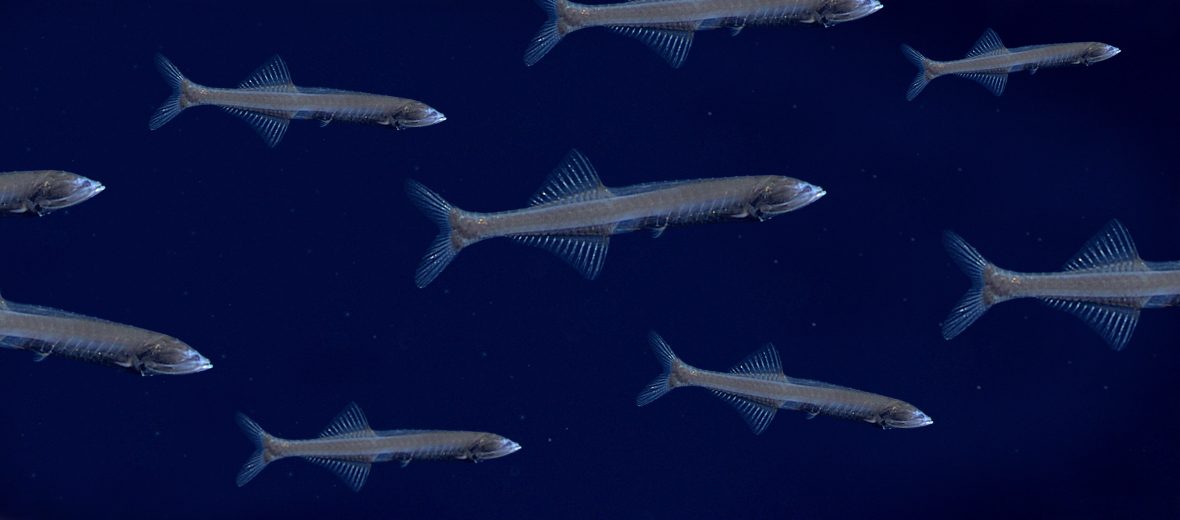
The bristlemouth, aka bristlefish or anglemouth, get their name from their sharp, bristle-like teeth. These are the most abundant fish in the ocean. However, they are rarely seen due to dwelling at depths of around 1,000 feet. They face the threats of climate change, that can cause deoxygenation (increased oxygen depletion); chemical pollution, from products like DDT; and other environmental changes. However, as mentioned, they are the most abundant fishes in the oceans, and thus are listed as Least Concern by the IUCN. Their population trend is stable. This article is dedicated to my friend Shawn D.
First the Stats…
Scientific name: Cyclothone
Weight: Up to .018 ounce
Length: Up to 3+ inches
Lifespan: Up to 2 years
Now on to the Facts!
1.) These fish are found throughout all the world’s oceans, sans the Antarctic Ocean.
2.) They dwell among the mesopelagic zone, aka the Ocean Twilight Zone.
3.) It is believed that they migrate towards the surface, although they don’t appear to do so in a diel vertical migration pattern. Other species are believed to remain at depth for their entire lives.
4.) A diel vertical migration (DVM) is a synchronized, 24-hour cycle where marine and freshwater organisms (such as zooplankton and fish) migrate between deep, dark waters during the day and the surface at night.
5.) Dwelling at depths of up to 4,920 feet is not uncommon.
But wait, there’s more on the bristlemouth!
6.) Due to their adaptation to deep water and the pressures therein, these fishes cannot survive when brought to the surface, and therefore can’t be observed alive in a laboratory setting (ex situ).
7.) It is believed that they feast on copepods, chaetognaths, Euphausiids, mysid shrimp, ostracods, detritus, and fecal (poop) pellets.
Did you know…?
Their quantities are estimated at a quadrillion individuals! They’re so abundant that they’re believed to be the most abundant genus of vertebrate on the planet.
8.) They are believed to be protandrous, meaning that all individuals start life as males and some become females upon reaching a reproductive age.
9.) Not much else is known about their reproductive habits.
10.) Their predators are typically dragonfish and fangtooths.
Now a Short Bristlemouth Video!
Be sure to share & comment below! Also, check out the Critter Science YouTube channel. Videos added regularly!

Want to suggest a critter for me to write about? Let me know here.
Some source material acquired from: Wikipedia & IUCN