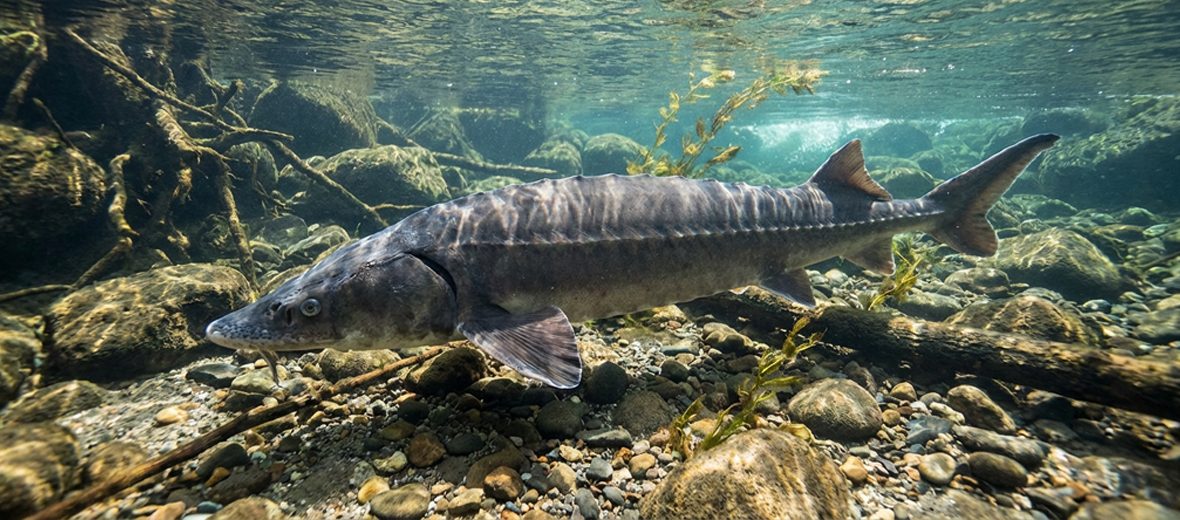
The European sea sturgeon, aka Atlantic sturgeon or common sturgeon, were once abundant and found in coastal habitats all over Europe. Now they can only be seen in the Black Sea and Baltic Sea. They face the threats of habitat loss and destruction at the hands of mining and quarrying of gravel in the Garonne; getting caught in shipping lanes, which can result in vehicle strike; overfishing, that can result in bycatch (being caught in fishing nets and long lines); over harvesting, for their roe (eggs); and habitat division, due to dams and water management. Due to all these adversities these fish are listed as Critically Endangered by the IUCN. Their population trend is listed as decreasing, as well.
First the Stats…
Scientific name: Acipenser sturio
Weight: Up to 800 lbs.
Length: Up to 20 feet
Lifespan: Up to 150+ years
Now on to the Facts!
1.) Like other sturgeons, they will spawn in freshwater rivers inland from the coast.
2.) Caught extensively for their caviar from the latter half of the 19th century, their disappearance from a majority of European waters became an alarm to many and necessitated their protection in 1982.
3.) These sturgeons have become so rare that they only breed in the Garonne river basin in France.
4.) Various conservation projects involving this species of sturgeon have included reintroductions based on specimens from aquaculture with the first releases back in 1995.
5.) 87 sturgeons were experimentally released in the Rhine river near Nijmegen in 2012 and again in 2015.
But wait, there’s more on the European sea sturgeon!
6.) Crabs, shrimp, and polychaete worms make up their diet.
7.) The last time these sturgeons hatched was in the Garonne River in France in 1994.
Did you know…?
There are only an estimated 750 wild individuals remaining, to date.
8.) Even though upwards of 3,750,000 eggs are laid, they are only produced every few years, at best. Plus, most, if not all, of the eggs never reach adulthood.
9.) Females are only receptive to mating every 3 – 4 years and aren’t even able to reproduce till their mid to late teens.
10.) These sturgeons are considered both crepuscular (active at both dawn and dusk) and nocturnal (active at night).
Now a Short European Sea Sturgeon Video!
Be sure to share & comment below! Also, check out the Critter Science YouTube channel. Videos added regularly!

Want to suggest a critter for me to write about? Let me know here.
Some source material acquired from: Wikipedia & IUCN