Critter Science
  • Zoology
    • Ecology
      • Animal Conservation
        • CITES: Protecting Wildlife
        • Dame Jane Goodall
        • Endangered Animals
        • Ex Situ Explained
        • In Situ Explained
        • Zoological Branches
      • Chromatophores and Survival
      • Ecosystems
        • Animal Habitats
        • The Biomes
        • Coastal Erosion
        • Rainforest Types
      • Evolution. The Facts.
        • Animal Devolution
        • Animal Mimicry
        • Convergent Evolution
        • Carl Linnaeus
        • Charles Darwin
        • Evolution of Amphibians
        • Evolution of Birds
        • Genetic Drift in the Animal Kingdom
        • Naturalism
        • Natural Selection
      • Invertebrate Families Explored
        • What are Arachnids?
          • Spider Webs
      • Predator vs Prey
      • Producers and Consumers
      • Vertebrate Animal Families
        • Snakes vs Legless Lizards
        • What is a Marsupial?
    • Sustainability
      • Climate Change
      • Global Warming
      • Pollution
        • Air Pollution
        • Land Pollution
        • Light Pollution
        • Microplastics Pollution
        • Noise Pollution
        • Water Pollution
      • Recycling
        • Recycling Plastics
      • Renewable Energy
    • Animal Behavioral Patterns
      • Avian Communication
      • Cetacean Communication
      • Elephant Communication
      • Herpetofauna Communication
      • Primate Language: The Debate
      • Types of Animal Dormancy
    • What are Species?
      • Amphibians vs Reptiles
      • Animal Reproduction
      • Claws, Nails, and Talons
      • Fur and Hair
      • Gecko Feet
      • Invasive Species
      • IUCN Statuses
      • Speciation
      • Species Complex
      • The Enigmatic Purr
      • Venom vs Poison
    • About the Critterman
  • Daily Critter Facts
    • Amphibian Facts
      • Frog Facts
      • Newt Facts
      • Salamander Facts
      • Toad Facts
    • Arthropod Facts
      • Arachnid Facts
      • Insect Facts
    • Bird Facts
      • Flightless Bird Facts
      • Predatory Bird Facts
      • Scavenger Bird Facts
      • Wading Bird Facts
    • Cryptozoology
    • Fish Facts
      • Cephalopod Facts
      • Crustacean Facts
      • Jellyfish Facts
      • Reefs
      • Shark and Ray Facts
      • Shellfish Facts
    • Flying Mammal Facts
    • Gastropod Facts
    • Land Mammal Facts
      • Canine Facts
      • Feline Facts
      • Lagomorph Facts
      • Marsupial Facts
      • Mustelid Facts
      • Primate Facts
      • Rodent Facts
      • Ungulate Facts
    • Parasite Facts
    • Reptile Facts
      • Crocodilian Facts
      • Lizard Facts
      • Snake Facts
      • Turtle Facts
    • Sea Mammal Facts
      • Dolphin Facts
      • Porpoise Facts
      • Sea Lion Facts
      • Seal Facts
      • Whale Facts
    • Worm Facts
  • For Teachers
    • Animal Quizzes
      • Amphibian Quiz
      • Bird Quiz
      • Cat Quiz
      • Dog Quiz
      • Dolphin Quiz
      • Insect Quiz
      • Reptile Quiz
    • Animal Word Search
    • Butterfly Life Cycle
      • Butterfly Metamorphosis
      • World’s Largest Butterfly
      • World’s Largest Moth
    • The Cellular Structure of an Animal
    • Coloring Pages
    • Fish and Sharks
    • Frogs vs Toads
    • Insect vs Bug
    • Metamorphosis – A Frog’s Life Cycle
  • Study Guides
    • African Animals
    • Antarctica Animals
    • Asian Animals
    • Australian Animals
    • Central American Animals
    • European Animals
    • North American Animals
    • South American Animals
  • Diseases & Parasites
    • Bsal
    • Canine Distemper Virus (CDV)
    • Chronic Wasting Disease (CWD)
    • The Deadly Chytrid Fungus
    • All About Parasites
    • The Rabies Virus
    • Toxoplasmosis
    • White-Nose Syndrome
  • Contact
    • General Contact
    • Guest Article Submission
      • Guest Articles
        • Guest Articles – 2024
    • What Critter is This?
    • Animal Welfare Organizations
    • Privacy Policy
Subscribe
cone snail

The Deadly Cone Snail

  • 15 January, 2021
  • Critterman
  • No Comments
  • 2506 Views
  • 5 Likes
Daily Critter Facts, Fish Facts, Gastropod Facts

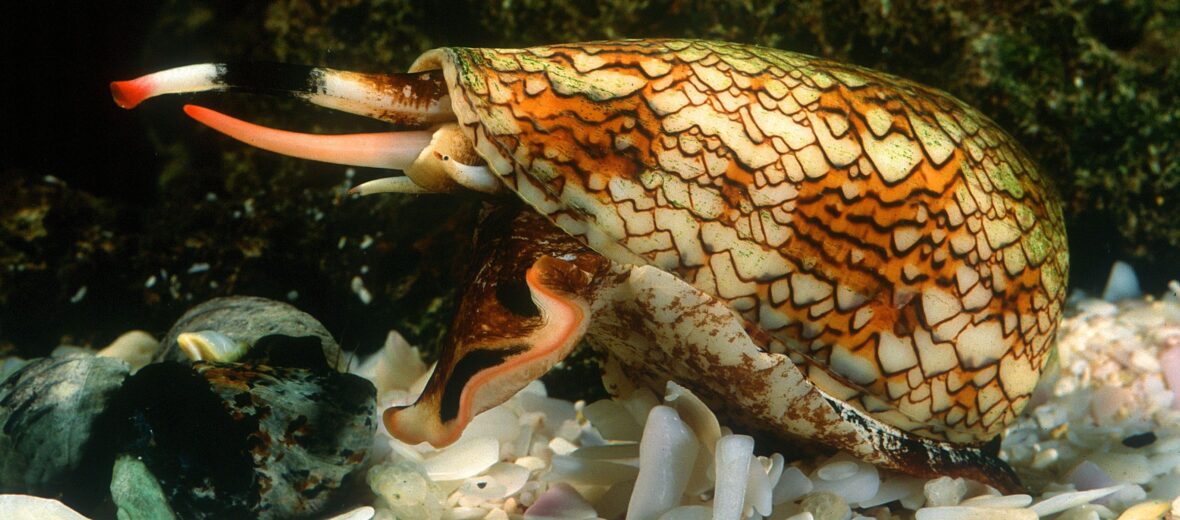
Seemingly harmless looking, the cone snail is actually a predatory animal that uses a specialized harpoon-like tooth to inject lethal venom into prey. They can be found in the Indian Ocean, Pacific Oceans, Great Barrier Reef, southern Australia, Baja California, California, and Hawaii. Cone snails live in predominantly shallow water near coral reefs. They hide under coral shelves, in the sand, or under piles of debris. Some can even be found living among mangroves. This article is dedicated to Katie.

First the Stats…

Scientific name: Conidae
Weight: Up to 5+ ounces
Length: Up to 8.5 inches
Lifespan: Up to 20 years

Now on to the Facts!

1.) They snag their prey by the use of harpoon-like hollow teeth (radula) that are rapidly stabbed into their prey to inject their toxic venom.

2.) Smaller cone snails’ stings hurt with no more punch than a bee sting. But larger ones, like Conus geographus, Conus tulipa and Conus striatus, have a sting that can sometimes be fatal.

3.) These snails are divided into 3 groups: piscivores – fish eaters, molluscivores – mollusk/snail eaters, and vermivores – worm eaters. The fish eaters are the most dangerous.

4.) Most cone snails are nocturnal (active at night) but some are crepuscular (active during dawn and dusk).

5.) The 3 main types of perception used are tactile (using its foot), visual (eyes to detect light), and chemoreception (detecting dissolved chemicals in the water).

But wait, there’s more on the cone snail!

6.) Their conotoxins have chemicals that are up to 10,000 times more potent than morphine. And there is no antivenom!

7.) The most toxic critters are the textile, geographic, and tulip snails with a higher risk of death with the geographic and textile snails.

Did you know…?
Cone snails are among the most toxic creatures known on earth. Over 30 cases of envenomation have been reported worldwide with a few fatalities. The venom, which has 100s of active components, inhibits transmission of neuromuscular signals in the body. This initially causing numbing and/or tingling at the sting site, which then spreads to the affected limb, finally progressing throughout the whole body.

8.) After the mating ritual, clusters of egg sacs (totaling around 40 eggs per sac) are produced and attached on an appropriate hard surface. In up to 15 days the eggs hatch to produce a planktonic version of the snail. In time, the larval snails develop into adults and move to the substrate to begin looking for prey.

Now a Short Cone Snail Video!

Also, check out the Critter Science YouTube channel. Videos added frequently!

Want to suggest a critter for me to write about? Let me know here.

Learn more about all kinds of cool critters, right here!
conecone snailfishlethalmolluskoceanparalizepredatorreefseasnailtoxictoxinvenom
Critterman

With over 50 years of critter experience to my credit and hundreds of zoology teaching hours to people around the world, I have amassed not only a continuing thirst for critter knowledge but a desire to teach others all I can about the majesty and wonder of our natural world. Critter Science is a culmination of such knowledge. I have hands on as well as book acquired intel on all kinds of critters. Whether they're on land, sea, or in the air. I will never say that I know everything about all animals. That's impossible, even for a savant. But, that being said, ask me any animal question and I'll answer it. If I don't know the answer, I'll get an answer for you!

The Unique Saola
The Secretary Bird
Related Posts
  • little raven
    The Little Raven 20 January, 2026
  • African wolf
    The African Wolf 19 January, 2026
  • Atlantic sturgeon
    The Atlantic Sturgeon 16 January, 2026
  • Daily Critter Facts
  • Guest Articles
  • BYET
  • Teachers
  • Study Guides
  • Contact

Copyright © 2025, Critter Science. All Rights Reserved.