
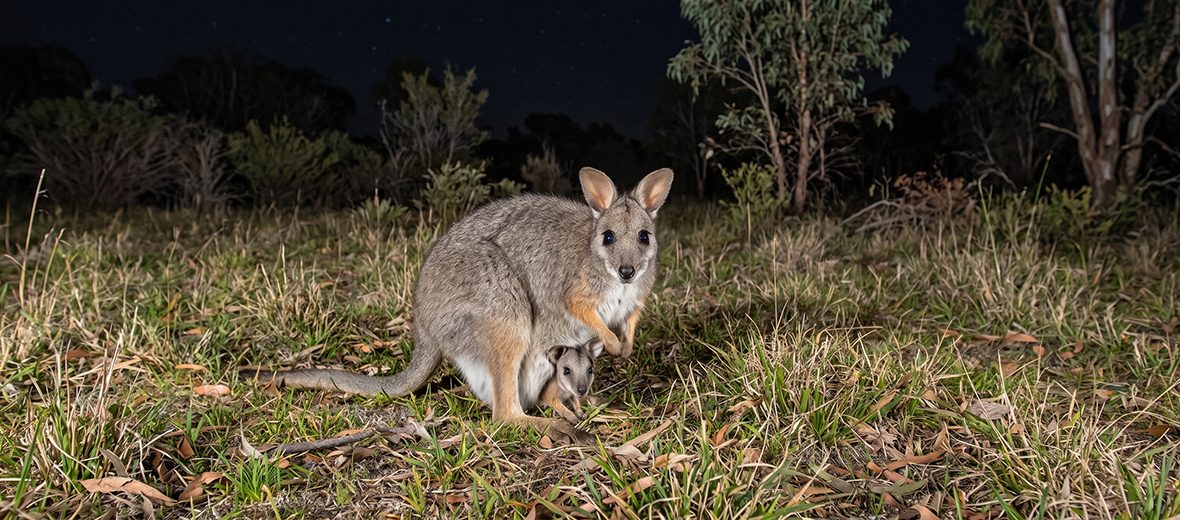
The tammar wallaby, aka dama wallaby or darma wallaby, is 1 of the smallest of the species of wallabies in the genus Notamacropus. They hail from western Australia. These wallabies face the threat of predation by invasive species such as feral cats and red foxes. They also face the threat of inappropriate fire regimes. Lastly, they are subject to vehicle strike (being hit by vehicles). Their populations are vastly spread apart, however they are abundant enough to be listed as Least Concern by the IUCN. Their population trend is listed as stable at this time.
First the Stats…
Scientific name: Notamacropus eugenii
Weight: Up to 22 lbs.
Length: Up to 27 inches, plus up to a 17.72 inch tail
Lifespan: Up to 15 years
Now on to the Facts!
1.) These wallabies were first described in 1817 by the French naturalist Anselme Gaëtan Desmarest.
2.) Their common name hails from the thickets of the shrub locally known as tamma (Allocasuarina campestris) which shelters them in Western Australia.
3.) Like other species of wallaby, they are classified within the same family as kangaroos and wallaroos.
4.) They have been around since the Late Pleistocene Era (129,000 years ago).
5.) As is the case with most macropods, these wallabies move around by hopping.
But wait, there’s more on the tammar wallaby!
6.) These wallabies have a hopping speed of up to 30 mph.
7.) As they leap back off the ground, they can recover much of their energy for reuse through elastic recoil. When on the move, their respiration is tied to their hopping cycle, inhaling when leaping and exhaling when landing. As they move faster, their heart rate increases to nearly twice as much as their hopping rate.
Did you know…?
There are approximately up to 50,000 wild individuals remaining, to date.
8.) They can hop at distances of up to 7.9 feet per stride.
9.) These wallabies can see with a 324° peripheral vision and 50° binocular vision, which gives them a wide field of view while still being able to see their hands in front of them.
10.) Like other wallabies, they are nocturnal (active at night).
But wait, there’s still more on the tammar wallaby!
11.) To stay cool when the temperatures rise, they lick their forearms and pant.
12.) In order to help avoid dehydration, tammars urinate less frequently and suck up water from the distal colon, which gives them relatively dry feces. Being capable of concentrating more urine in their kidneys affords them the ability to survive on seawater.
Did you know…?
Varying populations have different degrees of resistance to sodium fluoroacetate. This is a highly toxic organofluorine chemical compound used in vertebrate control measures.
13.) Their diet consists of various grasses and plants.
14.) Dingoes and wedge-tailed eagles are their primary natural predators.
15.) Females undergo up to a 28 day gestation (pregnancy) that yields a single joey. After being born, the joey makes its way to the mother’s marsupium (pouch) and continues to develop for an additional 9 months.
Now a Short Tammar Wallaby Video!
Be sure to share & comment below! Also, check out the Critter Science YouTube channel. Videos added regularly. Be sure to like and subscribe!

Want to suggest a critter for me to write about? Let me know here.
Some source material acquired from: Wikipedia & IUCN

Leave a Reply