
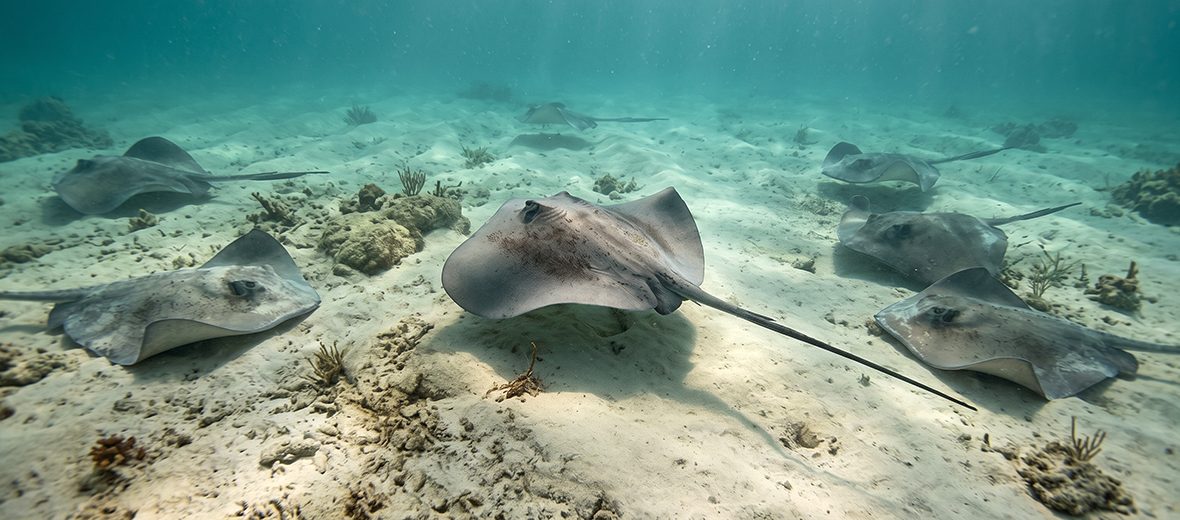
The pink whipray is a gregarious species of stingray that can be found in south and eastern Africa, south Asia, Australia, and Australasia. They are caught across their range as intentional targets and incidental bycatch by a wide range of coastal fisheries that include demersal trawl, Danish seine, gillnet, dropline, longline, and handline gears. These rays are retained in certain parts of their range for their meat and highly valued skin. Due to their preference for inshore coastal waters, they are also threatened by extensive habitat degradation. This includes pollution, clearing, and destructive fishing practices. Large coastal areas, particularly mangroves, have been lost in Indonesia and Malaysia through land conversion for urban development, shrimp farms, and agriculture. As a result of these threats they are listed as Vulnerable by the IUCN. Their population trend is listed as decreasing as well.
First the Stats…
Scientific name: Pateobatis fai
Weight: Up to 42 lbs.
Length: Up to 16 feet, including the tail
Lifespan: Up to 14 years
Now on to the Facts!
1.) They are a shallow water species that rarely exceeds 230 foot depths.
2.) These rays prefer habitats with warm, shallow tropical waters that contain soft, sandy substrates or coral rubble.
3.) Prawns, crabs, shrimp, bottom dwelling fish, squid, octopuses, clams, and snails are all preyed on.
4.) Hammerhead sharks and orcas are 2 primary predators of these rays.
5.) They were first described in the last century by American ichthyologists (someone who studies aquatic life) David Starr Jordan and Alvin Seale in 1906.
But wait, there’s more on the pink whipray!
6.) These rays posses a single serrated stinging venomous spine that is used for defense.
7.) When resting, up to 10 individuals may pile atop one another, sometimes even mixing with other species of rays.
Did you know…?
The venom is not typically considered lethal or highly dangerous to humans, although it can cause intense localized pain. Because the spine is sharp and serrated, it acts like a barbed blade—meaning it can inflict a deep, ragged laceration upon entry and tear tissue if pulled out or if the ray lashes its tail. Wounds from marine barbs carry a high risk of bacterial infection.
8.) The venomous spine measures up to 7.2 inches in length.
9.) They are aplacental viviparous (ovoviviparous). This means that the mother retains the eggs inside her body until they hatch, and then she gives birth to live young.
10.) Females undergo up to a 12 month gestation (pregnancy) that yields pups that measure up to 24 inches across.
But wait, there’s still more on the pink whipray!
11.) Known parasites of the pink whipray include the monogeneans Heterocotyle capricornensis, Trimusculotrema heronensis, Monocotyle helicophallus, M. spiremae, Neoentobdella parvitesticulata, M. youngi, Merizocotyle australensis, the tapeworms Prochristianella spinulifera, and the isopod Gnathia grandilaris.
12.) They are valuable to various ecotourism sites in the Maldives, French Polynesia, and other locales; they are attracted to visitors in large numbers by the promise of food handouts.
Now a Short Pink Whipray Video!
Be sure to share & comment below! Also, check out the Critter Science YouTube channel. Videos added regularly. Be sure to like and subscribe!

Want to suggest a critter for me to write about? Let me know here.
Some source material acquired from: Wikipedia & IUCN


Leave a Reply