
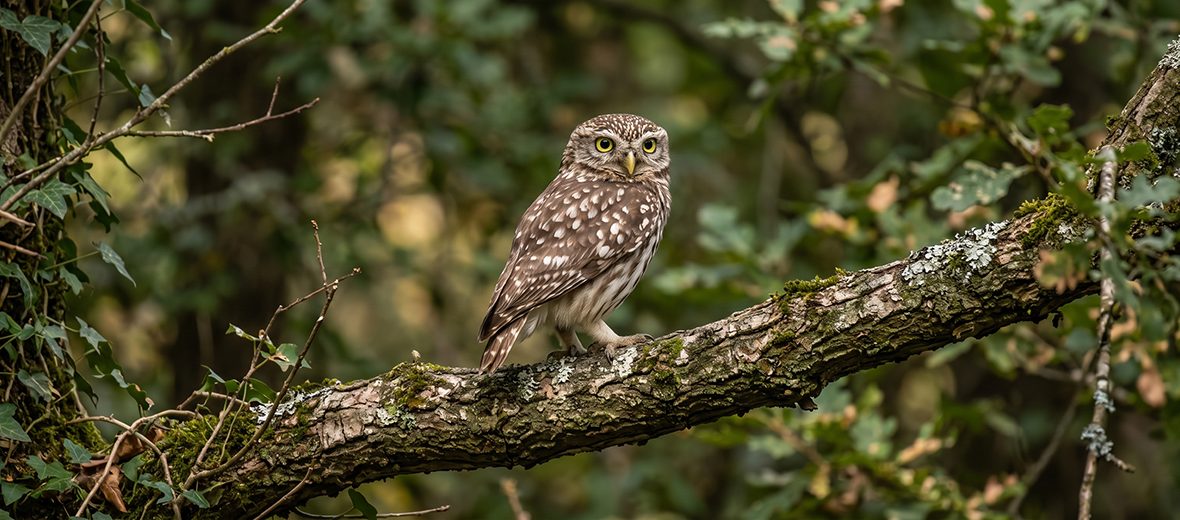
The little owl, aka owl of Athena or owl of Minerva, hails from Europe, Asia, and Africa. They’ve also been introduced to New Zealand’s South Island. Population levels can suffer dramatic decreases after severe winters. Their range has shrunken locally in numerous locales in Europe, which is thought to be mainly due to habitat loss and destruction, including the loss of suitable nest-sites and, potentially, the use of pesticides. Industrialized farming practices have yielded a reduction of prey items like voles and earthworms. Agricultural intensification, ground clearance, excessive use of toxic chemicals and vehicle strikes (being hit by vehicles) all lend to declines as well. The loss of nest holes from the felling of old hollow trees and the restoration of old buildings is also likely to affect this species. However, they are abundant throughout their ranges and thus listed as Least Concern by the IUCN. Their population trend is listed as stable.
First the Stats…
Scientific name: Athene noctua
Weight: Up to 9.88 ounces
Length: Up to 9 inches
Wingspan: Up to 23 inches
Lifespan: Up to 16 years
Now on to the Facts!
1.) Like most other owl species, they are primarily nocturnal (active at night). However, they can also display diurnal (active during the day) behaviors.
2.) Their preferred habitats are open, dry to semi-arid landscapes that provide a mix of sparse vegetation for foraging and natural or man-made cavities for sheltering and nesting.
3.) These owls were formally described in 1769 by the Italian naturalist Giovanni Antonio Scopoli.
4.) There are 13 subspecies currently recognized.
5.) Amphibians, reptiles, insects, birds, mice, rats, voles, squirrels, shrews, moles, and rabbits are all preyed on.
But wait, there’s more on the little owl!
6.) Their calls are a mix of short, repetitive whistles, barks, and sharp screeches.
7.) Females lay up to 8 eggs that hatch in up to 29 days.
Did you know…?
There are approximately 15,000,000 wild individuals, to date.
8.) In the beginning, the female incubates the eggs while the male tends to bringing food. Once the eggs hatch, both parents tend to acquiring food.
9.) Pairs are monogamous (mate for life) and stay together till 1 dies.
10.) Evidence suggests that around the 19th century, little owls were occasionally kept as ornamental birds. In Italy, tamed and docked little owls were often kept to hunt rodents and insects in homes and gardens.
Now a Short Little Owl Video!
Be sure to share & comment below! Also, check out the Critter Science YouTube channel. Videos added regularly. Be sure to like and subscribe!

Want to suggest a critter for me to write about? Let me know here.
Some source material acquired from: Wikipedia & IUCN



Leave a Reply