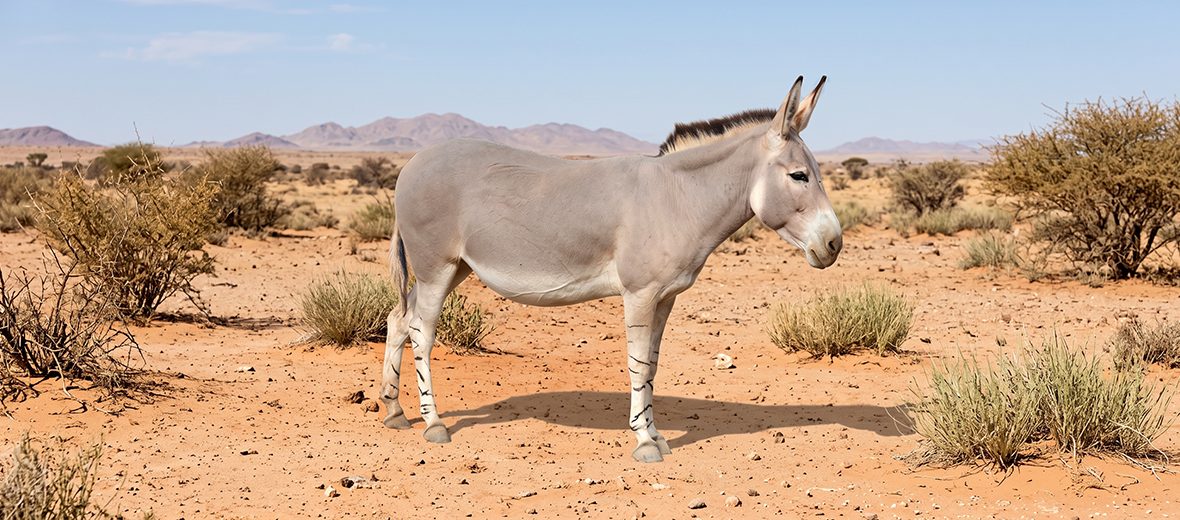
The African wild ass, aka African wild donkey, is presumed to be the ancestor of the domestic donkey. They are a wild member of the horse family, Equidae. These ungulates face the threat of hunting for food and medicinal purposes. For instance, their body parts and soup made from bones are used in traditional medicine for treating tuberculosis, constipation, rheumatism, backache, and bone ache. They do not treat any of these ailments, however. Limited access to drinking water and forage, primarily due to competition with livestock, is also a major threat, with reproductive females and foals less than 3 months old being most at risk. Another possible concern is potential interbreeding with the domestic donkey. Climate change brings about severe droughts and extreme weather conditions, worsening food and water shortages in their native Horn of Africa habitats. As a result of these threats these wild equines are listed as Critically Endangered by the IUCN. Their population trend is also listed as decreasing.
First the Stats…
Scientific name: Equus africanus
Weight: Up to 605 lbs.
Length: Up to 6.6 feet, plus up to a 18 inch tail
Height: Up to 57 inches
Lifespan: Up to 40 years
Now on to the Facts!
1.) Having at 1 time a wider range north and west into Sudan, Egypt, and Libya, they now exist only in the deserts and arid areas of the Horn of Africa, in Eritrea, Ethiopia, and Somalia.
2.) The oldest fossil record to date is approximately 3.5 million years old from Idaho in the United States. That’s right, they once dwelled in North America. However, they spread quickly to the Old World.
3.) They were first described by zoologist and ornithologist Theodor von Heuglin and zoologist and herpetologist Leopold Fitzinger in 1866.
4.) There are 3 currently existing subspecies recognized: Nubian wild ass, Somali wild ass, and the Domestic donkey.
5.) These equines prefer desert or semidesert environments.
But wait, there’s more on the African wild ass!
6.) Their powerful digestive systems are able to break down desert vegetation and extrude moisture from food efficiently, limiting their need for standing water.
7.) These asses are capable of surviving on surprisingly small amounts of water and have evolved to handle drinking saltwater and brackish water (partially salty water).
Did you know…?
There are only an estimated 570 wild individuals remaining, to date.
8.) They are crepuscular (active at dawn and dusk).
9.) Being agile and quick-footed, these critters can reach speeds of up to 43 mph.
10.) Their soles are exceptionally rigid and their hooves grow very rapidly.
But wait, there’s still more on the African wild ass!
11.) They dwell in loose herds consisting of up to 50 individuals.
12.) Females undergo up to a 12 month gestation (pregnancy) that yields a single foal.
13.) The calls from these critters can be heard for approximately 1.9 miles.
14.) Bark, grasses, and leaves are all grazed upon.
Now a Short African Wild Ass Video!
Be sure to share & comment below! Also, check out the Critter Science YouTube channel. Videos added regularly. Be sure to like and subscribe!

Want to suggest a critter for me to write about? Let me know here.
Some source material acquired from: Wikipedia & IUCN

Leave a Reply