
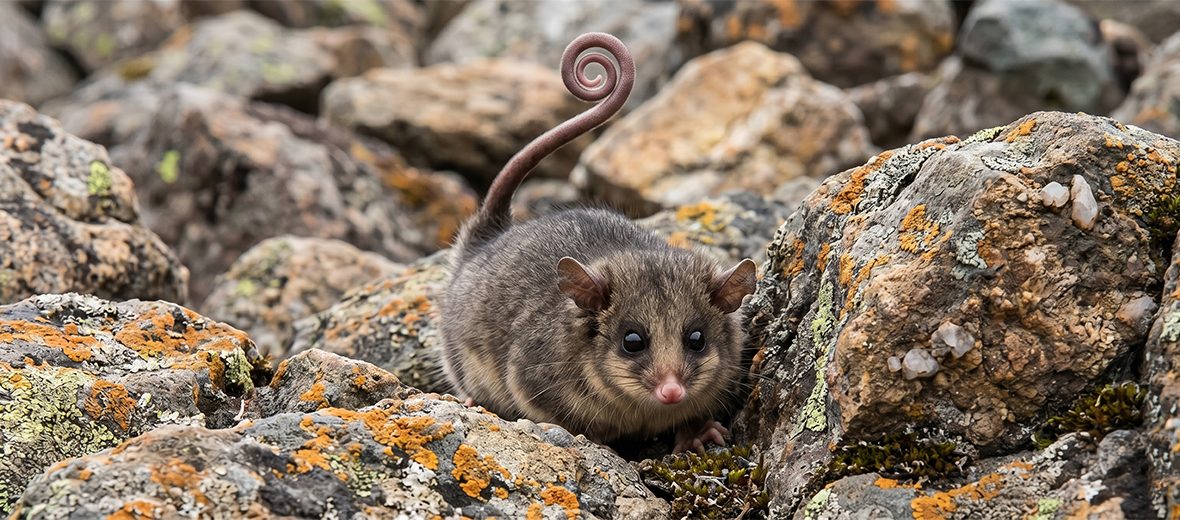
The mountain pygmy possum, aka burramys, is the only extant species in the genus Burramys. They hail from southern Australia. These diminutive critters face the threats of habitat loss and destruction at the hands of the skiing industry, and fires. Habitat division due to roads and railroads, as well as dams are other issues faced. Invasive species, such as cats and red foxes that prey on these possums. Finally, climate change causes harsher winters that these possums are unable to survive. Due to all these threats, they are listed as Critically Endangered by the IUCN, and their population trend is sadly listed as decreasing.
First the Stats…
Scientific name: Burramys parvus
Weight: Up to 1.6 ounces
Length: Up to 4.3 inches, plus up to a 5.5 inch tail
Lifespan: Up to 13 years
Now on to the Facts!
1.) Their tails are prehensile (serve as an additional appendage).
2.) They are the only known Australian mammal that is restricted to an alpine habitat.
3.) These little marsupials were first described by South African palaeontologist Robert Broom in 1896.
4.) It wasn’t until 1966 that a living specimen was discovered at a ski resort at Mount Hotham in Victoria.
5.) Currently they are found in 3 isolated, genetically distinct populations in the alpine regions of southern Australia.
But wait, there’s more on the mountain pygmy possum!
6.) Their hind feet are equipped with an opposable halux (a big toe capable of moving toward and touching the other toes on the same foot, functioning like a thumb for gripping).
7.) These possums can be found at elevations of up to 7,310 feet.
Did you know…?
Females typically dwell among familiar groups consisting of up to 10 individuals, while males tend to by solitary.
8.) Bogong moths make up about 1/3rd of their diet. The remaining 2/3rds comprise various fruits and seeds.
9.) When they find a moth, they will first smell it before picking it up with their incisors. They will then transfer the prey item to their forelimbs so that they can manipulate it and tear off pieces of flesh.
10.) Females undergo up to a 16 day gestation (pregnancy) that yields up to 4 joeys. The joeys then undergo up to an additional 5 week developmental period in the marsupium (pouch).
But wait, there’s still more on the mountain pygmy possum!
11.) Joeys are weaned in up to 10 weeks.
12.) These possums are, like other possums and opossums, nocturnal (active at night).
Did you know…?
During hibernation, they are capable of reducing their body temperature to a chilly 36°F!
13.) Contrary to their opposable hind toes and prehensile tail, these critters are actually more terrestrial (spend their lives on the ground) than arboreal (spend their lives in trees).
14.) These critters spend upwards of 7 months out of the year in hibernation.
15.) Females have been documented acting very aggressively towards both males and females when defending nesting sites, especially when offspring are present. Plus, females are aggressive to adult males after the breeding season, and also to juvenile males post-weaning.
But wait, there’s still a tad more on the mountain pygmy possum!
16.) There are only an estimated 2,500 wild individuals remaining, to date.
17.) The first national recovery plan (under the Commonwealth Environment Protection and Biodiversity Conservation Act 1999) for these critters was prepared, to counter the threats caused by habitat loss and fragmentation in 2016.
18.) In 2018 – 2019, scientists documented a massive drop in bogong moth numbers in the summer, due to climate-change-induced droughts in the moth’s breeding areas. This inevitably caused a significant drop in Mountain pygmy possum numbers, due to starvation.
Now a Short Mountain Pygmy Possum Video!
Be sure to share & comment below! Also, check out the Critter Science YouTube channel. Videos added regularly. Be sure to like and subscribe!

Want to suggest a critter for me to write about? Let me know here.
Some source material acquired from: Wikipedia & IUCN

Leave a Reply