
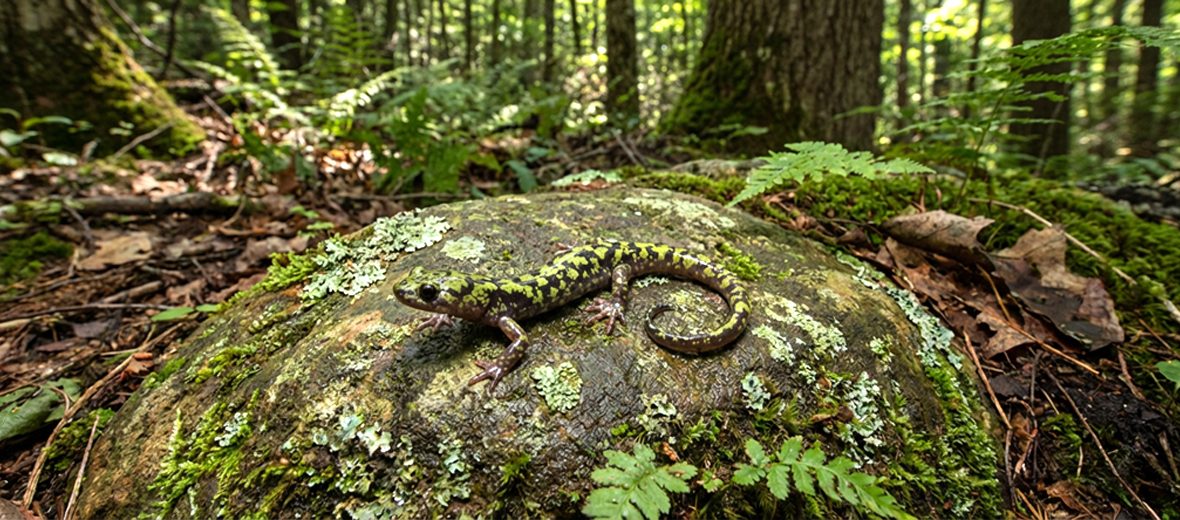
The green salamander is a species of lungless salamander in the family Plethodontidae, and are the only currently-described members of the genus Aneides. They hail from the eastern half of the United States. These salamanders face the threats of habitat loss and destruction at the hands of residential and commercial developments, deforestation, fires, and fire suppression; hunting and trapping, for the pet trade; disease, in the form of Batrachochytrium salamandrivorans, “Bsal”, that is often introduced from other invasive species such as amphibians, like the American bullfrog; and finally climate change, which can cause severe droughts. The IUCN lists these salamanders as Near Threatened. Their population trend is shown as decreasing.
First the Stats…
Scientific name: Aneides aeneus
Weight: Up to .11 ounce
Length: Up to 5.5 inches
Lifespan: Up to 20 years
Now on to the Facts!
1.) Their name, Aneides, hails from the Greek term for “lacking form or shape”, and is in reference to their flattened, elongated bodies. The species epithet, aeneus, is Latin, meaning bronze or copper, and is in reference to their dorsal coloration.
2.) A 2019 study discovered several populations that represent distinct taxonomic groups, supporting the presence of a possible species complex.
3.) These salamanders diverged from the Aneides hardii lineage upwards of 27.2 – 32.3 million years ago during the Oligocene epoch.
4.) They prefer moist, shaded crevices in sandstone or limestone rock outcrops and cliffs, often within the mature, hardwood forests of the Appalachian Mountains.
5.) Another threat to their existence is the fact that they are an extreme habitat specialist. They depend extensively on their specific habitat to survive.
But wait, there’s more on the green salamander!
6.) These salamanders are extremely aggressive towards other salamanders or any predator closing in on their eggs or entering their territory, and the intruder is met with butting, snapping, biting, and/or snout-pressing.
7.) After their almost ritualistic mating dance, the male deposits a spermatophore on the ground and the female scoops it up with her cloaca.
Did you know…?
During the 3 months of egg gestation the female will not eat.
8.) An average of up to 25 eggs are laid up to 30 hours after fertilization.
9.) The female will coil around her egg mass and guard it till the eggs hatch.
10.) When the eggs hatch there is no larval stage, the hatchling salamanders enter the world fully developed.
But wait, there’s still more on the green salamander!
11.) As soon as the eggs hatch, the female loses all defensiveness and guarding behaviors and leaves her young to their own devices.
12.) Another threat to these salamanders is the fact that they grow rather slowly for plethodontids, and population bounceback is made more challenging due not only to their slow growth, but their preferred habitat and small clutch size.
13.) Green Salamanders are listed as “imperiled” in Georgia and North Carolina, as well as “critically imperiled” in South Carolina.
Now a Short Green Salamander Video!
Be sure to share & comment below! Also, check out the Critter Science YouTube channel. Videos added regularly. Be sure to like and subscribe!

Want to suggest a critter for me to write about? Let me know here.
Some source material acquired from: Wikipedia & IUCN



Leave a Reply