
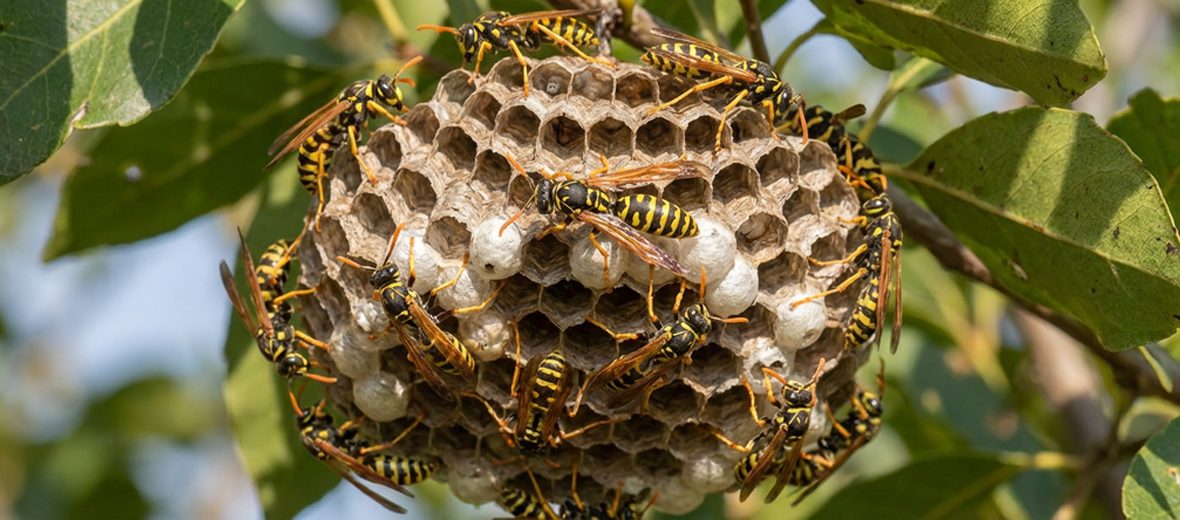
The European paper wasp is among the most common and well-known species of social wasps. While initially hailing from Europe, they are considered an invasive species in North America. These critters are not evaluated by the IUCN, as they are not only invasive but also highly abundant on 2 continents. They are also thought of as an ecological threat to native wasps, as they tend to outcompete other species for territory and food. Their population trend is listed as increasing.
First the Stats…
Scientific name: Polistes dominula
Weight: Up to 0.002 ounce
Length: Up to .71 inch
Lifespan: Up to 1 year
Now on to the Facts!
1.) Dominant females are the primary egg layers, while the subordinate females (“auxiliaries”) or workers primarily forage and don’t lay eggs. This hierarchy is not permanent, however; when the queen is removed from the nest, the second-most dominant female takes over the role of laying eggs.
2.) These wasps are common and cosmopolitan due to their incredible survival features like a productive colony cycle, short development time, and higher ability to survive predator attacks.
3.) They were first discovered by German naturalist Johann Ludwig Christ in 1791.
4.) Even though they don’t display obvious variations that enables a person to tell them apart with the naked eye, certain features are unique to each individual. For instance, the abdominal spots on males vary in size, location, and pattern.
5.) Males with smaller, more regular patterns of spots tend to be more aggressive and dominant over those with larger, irregular patterns.
But wait, there’s more on the European paper wasp!
6.) The opposite goes for the females. The larger and the more scattered the clypeus (broad plate at the front of an insect’s head) marks on the foundress (the founding female), the higher the probability that she will be dominant over the other females.
7.) They originally hail from Europe and northern Africa. However, they have been introduced (much to other insect’s dismay) to Canada and the United States.
Did you know…?
The first North American occurrence of these wasps was reported in Massachusetts in the late 1970s, and by 1995, they had been documented throughout the northeastern USA. They are also found in numerous other states as well, but haven’t been widely documented.
8.) While their natural habitats are chaparrals, forests, and grassland biomes, they tend to conglomerate near human settlements as houses make for great protection and they are always close to food, such as refuse left in trash cans.
9.) The populations in the United States feed mostly on caterpillars, but also feed on a variety of other insects as well. In Canada, they have been documented feeding on cherry and grape skins, damaging the fruits. They’re also a nuisance to field workers, too.
10.) Another method used by these wasps to propagate is to utilize last year’s nest. This eliminates the need for building an entirely new nest from scratch.
But wait, there’s still more on the European paper wasp!
11.) Females are produced first, then later in the year males are produced. Some males and females will pair up, close to the arrival of winter, then they will mate and the female will aestivate over winter and emerge to start her own colony in the spring.
12.) Males have not only curved antennae, but lack a stinger.
Did you know…?
They are the first invertebrate to show the ability to perform the mental operation of transitive inference. This is the ability to calculate that if Jon is taller than Hope and Hope is taller than Seth, Jon must be taller than Seth. This mental ability is common in vertebrates.
13.) A majority of their success includes productive colony cycles, short developmental times, aposematic colorations (colorations that warn of toxicity or foul taste), a generalist diet, and the ability to easily colonize new environments.
14.) The queen lays hundreds of eggs in a short period of time, from spring to early fall.
15.) Salivary proteins collected from the nest of these wasps have been cloned for use as a waterproof coating that is utilized in the manufacture of biodegradable drones.
Now a Short European Paper Wasp Video!
Be sure to share & comment below! Also, check out the Critter Science YouTube channel. Videos added regularly. Be sure to like and subscribe!

Want to suggest a critter for me to write about? Let me know here.
Some source material acquired from: Wikipedia & IUCN


Leave a Reply