
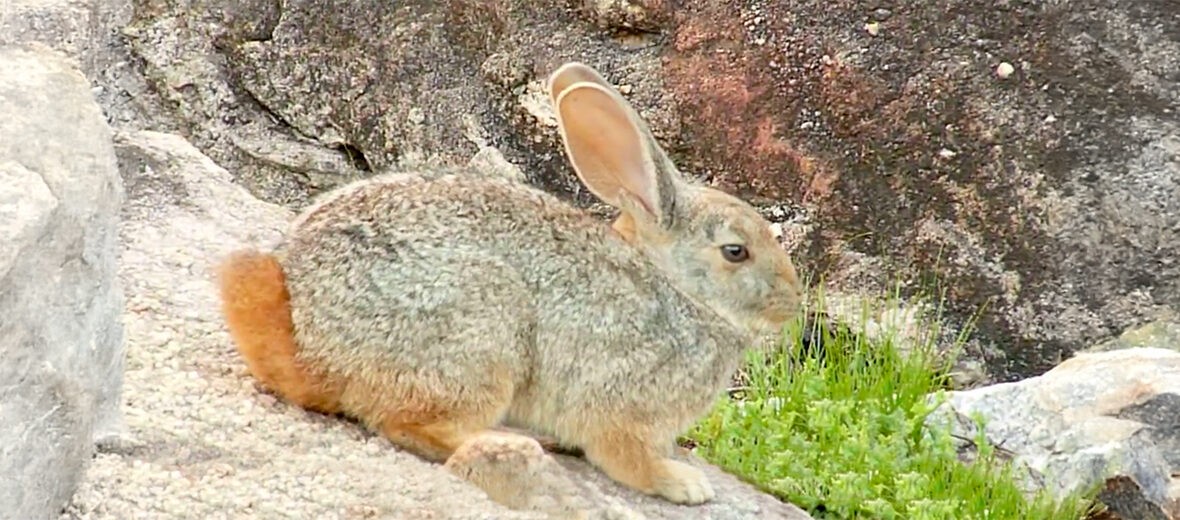
The Smith’s red rock hare, aka Smith’s red rockhare or Smith’s red rock rabbit, might carry the name “hare“, but they are actually rabbits. These lagomorphs hail from central and southern Africa. They face the threats of habitat loss and destruction at the hands of residential and commercial developments, farming, and ranching; hunting, for their meat and fur; trapping; and predation by feral dogs. The IUCN lists these rabbits as Least Concern, due to their estimated population size of around 10,000 individuals. Their population trend is listed as unknown at this time.
First the Stats…
Scientific name: Pronolagus rupestris
Weight: Up to 4.4 lbs.
Length: Up to 26 inches, plus up to a 4.3 inch tail
Lifespan: Up to 5 years
Now on to the Facts!
1.) These rabbits were first discovered by Scottish zoologist Andrew Smith in 1834.
2.) They are also called rock rabbits. Or in Swahili, they’re name is sungura mwekundu or kitengule.
3.) There are currently 7 recognized subspecies, as of circa 1980s: P. r. melanurus, P. r. curryi, P. r. saundersiae, P. r. australis, P. r. fitzsimonsi, P. r. barbetti, and P. r. rupestris.
4.) However, in the 3rd edition of Mammal Species of the World published in 2005, R. S. Hoffman and A. T. Smith listed the Smith’s red rock hare as a separate species and included only 5 subspecies.
5.) These rabbits tolerate a range of habitats such as rocky slopes, the tops of rocky outcrops, stony countries where grass, rocks, and bushes are intertwined, ravines with boulders, hillsides, slabs of stones, and rock creaks.
But wait, there’s more on the Smith’s red rock hare!
6.) They are typically nocturnal (active at night) in places where they’re heavily hunted and crepuscular (active at dawn and dusk) in others.
7.) While being pursued they ave been documented producing a series of loud, startling screams when running away at night.
Did you know…?
They can run at speeds of up to 50 mph, if the need arises.
8.) These rabbits also emit shrill voices and barking sounds at varying times. Juveniles produce churring sounds when captured.
9.) They graze on various grasses, herbs, and shrubs.
10.) Females undergo up to a 1 month gestation (pregnancy) that yields between 1 – 2 kittens.
11.) Eagles, owls, feral dogs, and leopards all prey on these rabbits.
Now a Short Smith’s Red Rock Hare Video!
Be sure to share & comment below! Also, check out the Critter Science YouTube channel. Videos added regularly. Be sure to like and subscribe!

Want to suggest a critter for me to write about? Let me know here.
Some source material acquired from: Wikipedia & IUCN

Leave a Reply