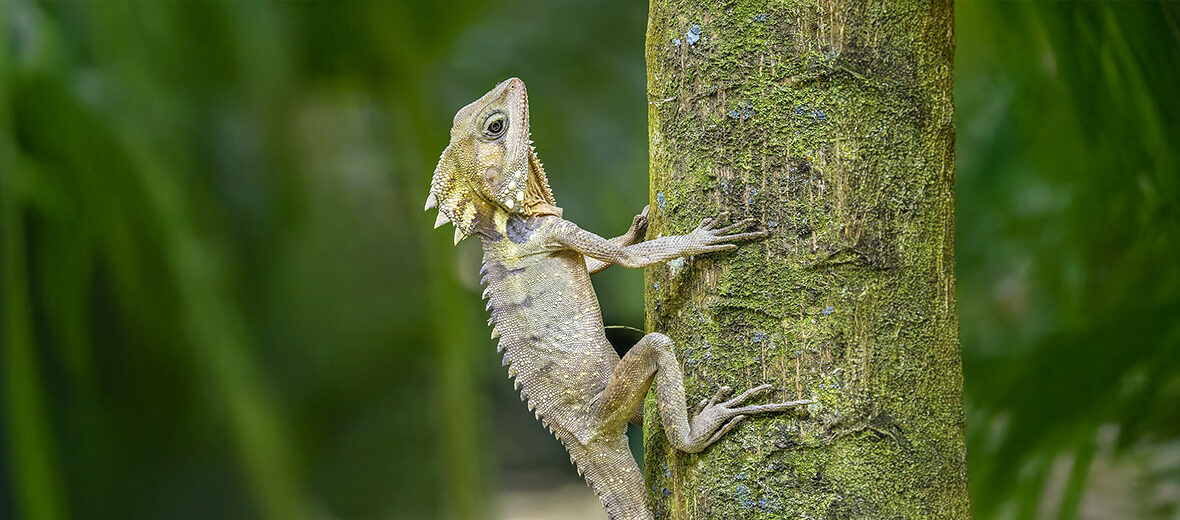
The Boyd’s forest dragon is a species of arboreal (tree dwelling) lizard from the family Agamidae (iguanas). Contrary to the popular belief of some tour guides they are not endangered reptiles, although they do however face the threats of habitat loss due to deforestation; climate change, that can cause droughts and temperature extremes; predation; and over-collecting for the illegal pet trade. However, despite all these obstacles, these iguanas are listed as Least Concern by the IUCN. Their population trend is listed as Stable. This article is dedicated to Ben.
First the Stats…
Scientific name: Lophosaurus boydii
Weight: Up to 5.3 ounces
Length: Up to 6.3 inches, plus up to a 12.8 inch tail
Lifespan: Up to 30+/- years
Now on to the Facts!
1.) The generic name Lophosaurus translates to “crested lizard”, from the Greek lophos for “crest”, and saurus for “lizard”.
2.) The specific name, boydii, is a reference to John Archibald Boyd (1846 – 1926), who lived in Fiji from 1865 – 1882 and then on a sugar plantation at Ingham, Queensland. He collected specimens for the Australian Museum.
3.) These lizards hail from northeastern Australia.
4.) They were first discovered and described by naturalist and zoologist William John Macleay in 1884.
5.) Their preferred habitats are upper and lower rainforests and their margins.
But wait, there’s more on the Boyd’s forest dragon!
6.) Even though they can sometimes scale to heights of up to 330 feet, they tend to stay at heights of around 6 feet on the trunks of trees.
7.) Often preferring to thermoconform, rather than thermoragulate, these lizards regulate their body’s temperature via the surrounding air, rather than basking in the sun. However, gravid (pregnant) females do indeed bask in sunny locations to incubate her eggs before laying them.
Did you know…?
The Kuku Yalanji people of North Queensland call this lizard “Jalbil”, after the mythological creature who split Snapper Island away from the mainland.
8.) These iguanids are diurnal (active during the day). They are active from just after dawn to just before dusk.
9.) Females lay up to 6 eggs that hatch in up to 100 days.
10.) A variety of insects, and primarily earthworms, make up the bulk of their diet; with mice, newly born rat pups, and fruit being occasionally consumed.
11.) Goshawks, feral pigs, and snakes are their primary predators.
Now a Short Boyd’s Forest Dragon Video!
Be sure to share & comment below! Also, check out the Critter Science YouTube channel. Videos added regularly. Be sure to like and subscribe!

Want to suggest a critter for me to write about? Let me know here.
Some source material acquired from: Wikipedia & IUCN
Photo credit: Charles J. Sharp