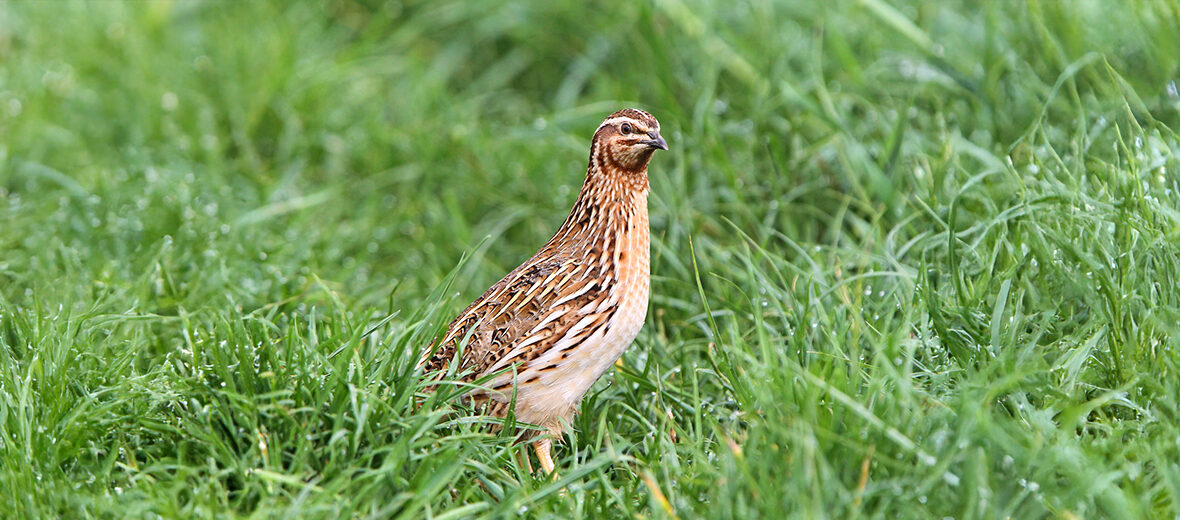
The common quail, aka European quail, is a small ground-nesting game bird that hails from the pheasant family. They are migratory, breeding in the western Palearctic and wintering in Africa and southern India. These birds face the threats of habitat loss and destruction at the hands of farming, ranching, residential, and commercial developments. This leads to the loss of rough grass and uncultivated land. Other threats are the overuse of herbicides and pesticides that reduce the availability of the foods they eat; and hybridization with the Japanese quail, which can reduce their lineages via genetic swamping. Genetic swamping occurs when extensive gene flow (hybridization) from a common or introduced species overwhelms and replaces the unique genetic makeup of a rare or distinct population, leading to the loss of local adaptations and potentially the “genome extinction” of the rare lineage itself. Due to the large population of these birds the IUCN lists them as Least Concern. However, their populations are decreasing.
First the Stats…
Scientific name: Coturnix coturnix
Weight: Up to 5 ounces
Length: Up to 7 inches
Wingspan: Up to 14 inches
Lifespan: Up to 5 years
Now on to the Facts!
1.) These quails can be found in Europe, Northern Africa, and Asia.
2.) With their characteristic call of 3 repeated chirps (repeated 3 times in quick succession), these quails are more often heard than seen.
3.) Common quails are often kept as poultry.
4.) They were formally described by the Swedish naturalist Carl Linnaeus in 1758 in the tenth edition of his Systema Naturae.
5.) There are 5 subspecies recognized: C. c. conturbans, C. c. inopinata, C. c. africana, C. c. erlangeri, and of course C. c. coturnix.
But wait, there’s more on the common quail!
6.) Beetles, true bugs, ants, earwigs, orthopterans, as well as weed and grass seeds are all on the menu.
7.) These birds are heavily migratory, unlike other game birds.
Did you know…?
There are approximately 35,000,000 wild individuals, to date.
8.) Females lay up to 13 eggs, 24 hours apart, that hatch in up to 20 days.
9.) Chicks fledge at about 19 days of age, but stay in the family group for up to 50 days.
10.) The young are precocial (self sufficient) and can leave the nest & feed themselves soon after birth.
But wait, there’s still more on the common quail!
11.) Huge numbers are caught in nets along the Mediterranean coast of Egypt. It is surmised that in 2012, during their autumn migration, approximately 3.4 million birds were caught in northern Sinai and possibly as many as 12.9 million in the entirety of Egypt.
12.) In 1537, Queen Jane Seymour, 3rd wife of Henry VIII, when pregnant with the future King Edward VI, acquired an unstoppable desire for quail. Courtiers and diplomats abroad were commanded to find adequate quantities for the Queen’s appetite.
13.) If these quails have eaten certain plants, although what plants is still in question, the meat from the quail can be tainted and poisonous, with 1 in 4 who eat the poisonous flesh becoming ill with coturnism, which is described as muscle soreness, and which could lead to kidney failure.
Now a Short Common Quail Video!
Be sure to share & comment below! Also, check out the Critter Science YouTube channel. Videos added regularly. Be sure to like and subscribe!

Want to suggest a critter for me to write about? Let me know here.
Some source material acquired from: Wikipedia & IUCN
Photo credit: christoph_moning