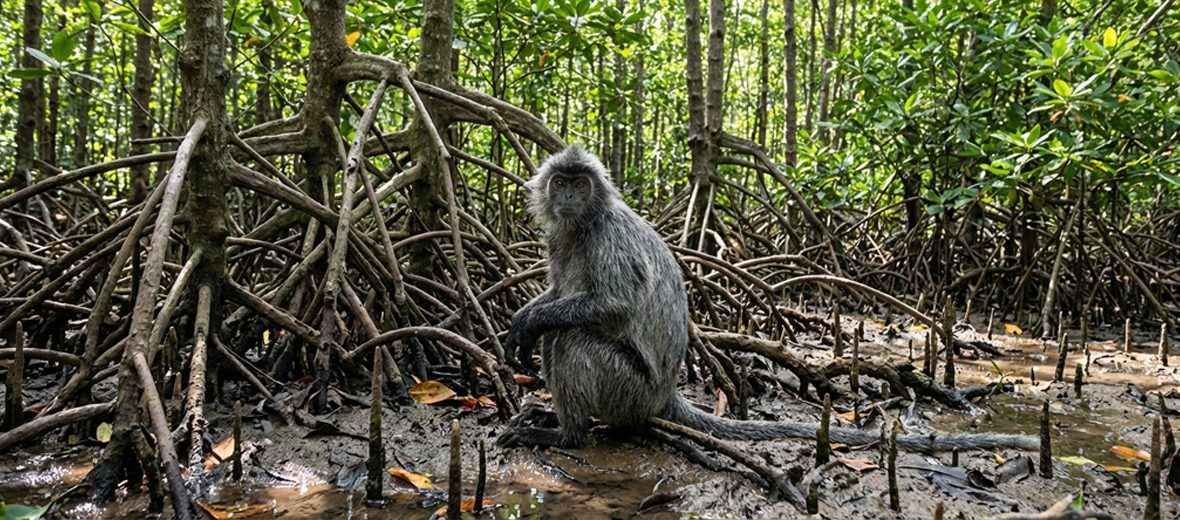
The silvery lutung, aka silvered leaf monkey or silvery langur, hails from coastal, mangrove, and riverine forests in Sumatra, Borneo, Java, as well as parts of the southwestern Malay Peninsula, the Natuna Islands, and other surrounding islands. They are threatened by habitat loss and destruction at the hands of agriculture (primarily palm oil plantations), logging, forest fires, and fire management; hunting, for their meat; and trapping, for the pet trade. The IUCN lists these primates as Vulnerable. Their population trend is listed as decreasing.
First the Stats…
Scientific name: Trachypithecus cristatus
Weight: Up to 17.6 lbs.
Length: Up to 23 inches, plus up to a 30 inch tail
Lifespan: Up to 31 years
Now on to the Facts!
1.) As is the case with other langurs, they have a large 3-chambered stomach that has evolved to digest the cellulose found in their herbivorous (eat plant matter) diet.
2.) These primates likely evolved during a rapid speciation event that occurred between 0.95 – 1.25 million years ago.
3.) They have been observed in mixed-species groups with proboscis monkeys, and interspecific mating and a possible hybrid has also been witnessed.
4.) Hybrid animals are typically infertile, mainly with regards to distantly related species, because hybridization causes malfunctions in the chromosomes that ultimately prevents fertility.
5.) Like so many other primates, these critters are diurnal (active during the day).
But wait, there’s more on the silvery lutung!
6.) Troops consist of up to 40 individuals, many of whom are females with infants.
7.) Each troop occupies a range of approximately 106 acres.
Did you know…?
Even though males dominate the females, and females with young dominate those without, there is little aggression amongst the troop though.
8.) They are heavily arboreal (spend their lives in trees). This affords them protection against terrestrial (ground dwelling) predators.
9.) Their social structure is matrilineal (tracing of kinship through the female) and harem based. Females stay in the troop for life, while infant males leave not long after reaching adulthood. They then form bachelor troops.
10.) Male led troops that overlap with other male led troops often result in vocalizations and fighting. Whereas female led troops that overlap with other female led troops result in peaceful interactions.
But wait, there’s still more on the silvery lutung!
11.) Around 13 different vocalizations are made by these primates. The primary sound is that of the males defending their harem and troop. Other vocalizations are made to denote anger, excitement, fear, and satisfaction.
12.) Up to 91% of their diet consists of the leaves of various plants. The remaining 9% consists of fruit, flowers, and seeds.
Did you know…?
Being unusually susceptible to human diseases, including AIDS, they have therefore been widely used in medical research.
13.) The females are receptive to breeding roughly every 2 years.
14.) Females undergo up to a 200 day gestation (pregnancy) that yields a single infant.
15.) Infants are communally tended to and weaned in up to 18 months. However, the mother will stop lactating after 12 months.
But wait, there’s still a little more on the silvery lutung!
16.) The females are able to breed just 36 months after birth.
17.) Dholes, leopards, tigers, and some larger species of snakes prey on the adults and infants; while binturongs prey on the infants only.
Now a Short Silvery Lutung Video!
Be sure to share & comment below! Also, check out the Critter Science YouTube channel. Videos added regularly!

Want to suggest a critter for me to write about? Let me know here.
Some source material acquired from: Wikipedia & IUCN