
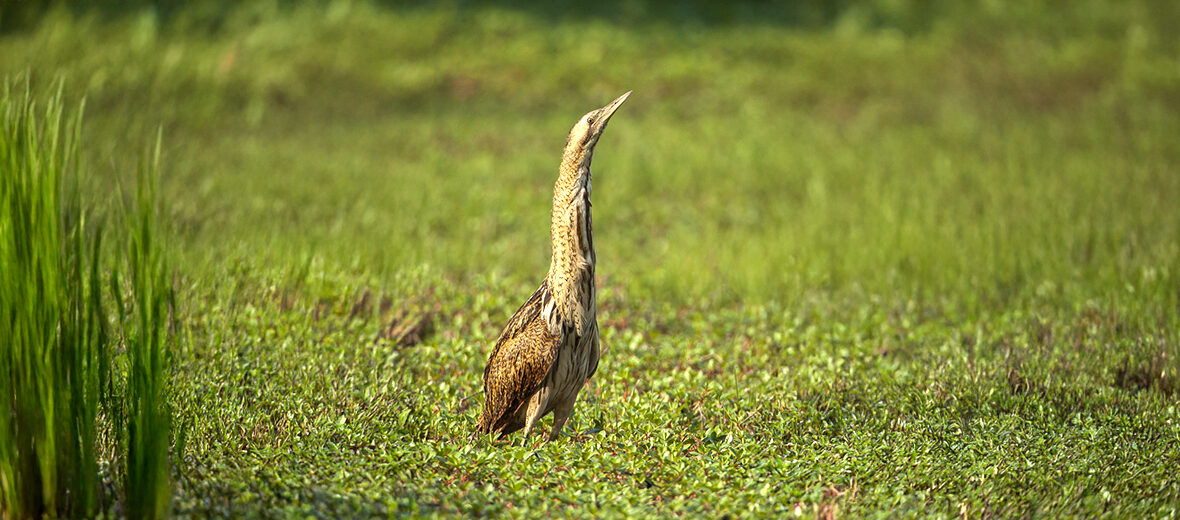
The Eurasian bittern, aka great bittern, is a wading bird from the heron family Ardeidae. They can be found in Europe, Africa, and Asia. These birds face the threats of habitat loss and destruction at the hands of wetland drainage, residential and commercial developments, reduction and loss of loss of Phragmites reed marshes, sea level rise and water intrusion; the effects of wave action from boat traffic at the edge of open water; water pollution; land pollution; pesticides; recreation and water sports; egg collection; hunting; trapping; and climate change, that can cause elongated freezing temperatures. However, despite all this, these birds are abundant enough to be listed as Least Concern by the IUCN. Their population trend is also listed as stable.
First the Stats…
Scientific name: Botaurus stellaris
Weight: Up to 4.5 lbs.
Length: Up to 32 inches
Wingspan: Up to 50 inches
Lifespan: Up to 12 years
Now on to the Facts!
1.) They were first described as Ardea asteria sive stellaris as early as 1603 by Ulisse Aldrovandi in his Ornithologiae.
2.) There are a host of colloquial names given to these birds such as “barrel-maker”, “bog-bull”, “bog hen”, “bog-trotter”, “bog-bumper”, “butter bump”, “bitter bum”, “bog blutter”, “bog drum”, “boom bird”, “bottle-bump”, “bull of the bog”, “bull of the mire”, “bumpy cors”, “heather blutter”, and “mire drum(ble)”.
3.) Their preferred habitats are large, dense reed beds (Phragmites) in freshwater or brackish marshes, usually at low elevations.
4.) These bitterns will, if disturbed, point their head straight upwards and hold perfectly still in an attempt to blend in with the surrounding reeds.
5.) Eels, fish, mice, voles, rats, small birds and fledglings, frogs, newts, salamanders, crabs, shrimps, molluscs, spiders, dragonflies, bees, grasshoppers, earwigs, along with some subsequent plant matter are all consumed.
But wait, there’s more on the Eurasian bittern!
6.) The males are polygamous (1 male mates with multiple females), mating with up to 5 females each season.
7.) Females lay up to 6 eggs that incubate in up to 26 days.
Did you know…?
There are an estimated 310,000 wild individuals remaining, to date.
8.) Their call is a deep, sighing fog-horn or bull-like boom with a quick rise and slightly longer fall. The call is usually heard in the evening; and can be heard up to 3 miles away!
9.) These birds are both crepuscular (active at dawn and dusk) and nocturnal (active at night).
10.) These birds are proposed as 1 of the rational explanations behind the drekavac, a creature of the graveyard and darkness originating in south Slavic mythology.
Now a Short Eurasian Bittern Video!
Be sure to share & comment below! Also, check out the Critter Science YouTube channel. Videos added regularly!

Want to suggest a critter for me to write about? Let me know here.
Some source material acquired from: Wikipedia & IUCN
Photo credit: Francesco Veronesi



Leave a Reply