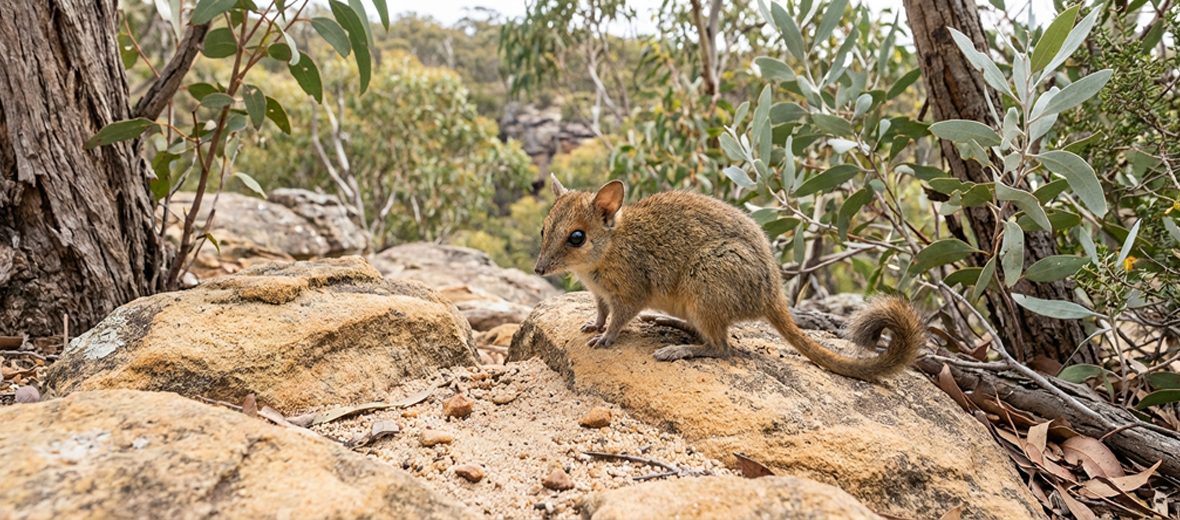
The monjon, aka Burbidge’s rock-wallaby or Burbidge’s rock-weasel, is the smallest species of rock-wallaby. They hail from northwestern Australia. These little critters face the threats of habitat loss and destruction at the hands of fires, fire management, mining, and quarrying (for bauxite); and invasive species, in the form of feral cats. The IUCN lists these marsupials as Near Threatened. Their population trend is listed as unknown at this time.
First the Stats…
Scientific name: Petrogale burbidgei
Weight: Up to 40 ounces
Length: Up to 14 inches, plus up to a 15.4 inch tail
Lifespan: Up to 15 years
Now on to the Facts!
1.) They were first officially described in 1978 by researchers D. J. Kitchener and G. Sanson.
2.) These marsupials are very shy and retreat quickly when approached.
3.) Monjons are nocturnal (active at night).
4.) Their preferred habitats contain high rainfall amounts.
5.) The vegetation in their habitats consists primarily of the open woodlands of eucalypts and emu apples.
But wait, there’s more on the monjon!
6.) Females undergo up to a 30 day gestation (pregnancy) that yields a single joey.
7.) The joey remains in the mom’s marsupium (pouch) for up to an additional 9 months.
Did you know…?
Annother common name for these critters is warabi. Which is from the Wunumbal language.
8.) Grasses and ferns make up their diet.
9.) Conservation efforts supported by the development of the Kimberley Conservation Hub include: fire management, predator control, habitat protection, monitoring, and research.
10.) Their known natural predators are dingoes, monitor lizards, pythons, and birds of prey.
Now a Short Monjon Video!
This video talks about marsupial facts in general.
Be sure to share & comment below! Also, check out the Critter Science YouTube channel. Videos added regularly!

Want to suggest a critter for me to write about? Let me know here.
Some source material acquired from: Wikipedia & IUCN