
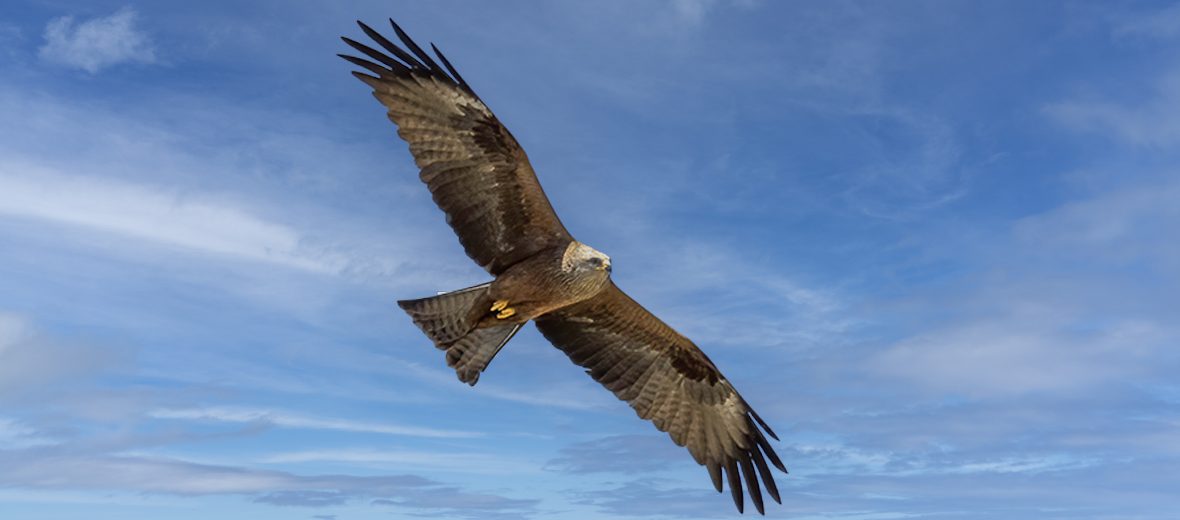
The black kite, aka fire kite, is believed to be the world’s most abundant species of Accipitridae (hawks, eagles, kites, harriers, and Old World vultures). They can be found throughout Europe, Asia, Africa, and Australia. They face the threats of habitat loss and destruction at the hands of residential and commercial development, farming, ranching, and logging; renewable energy, that can cause deaths from windmill accidents; electrocution from power lines; hunting; trapping; poisoning; and land pollution, that can effect these birds via exposure to harmful chemicals and heavy metals. However, they are abundant enough to be listed as Least Concern by the IUCN. Their population trend is listed as stable. This article is on special request from my friend Stefan.
First the Stats…
Scientific name: Milvus migrans
Weight: Up to 25.9 ounces
Length: Up to 24 inches
Wingspan: Up to 60 inches
Lifespan: Up to 28 years
Now on to the Facts!
1.) Their current global numbers are estimated at 6.7 million individuals!
2.) These kites were first described by French polymath Georges-Louis Leclerc, Comte de Buffon in his Histoire Naturelle des Oiseaux in 1770.
3.) There are 5 recognized subspecies: black-eared kite, small Indian kite, fork-tailed kite, Taiwan kite, and the European black kite.
4.) Birds, bats, mice, rats, moles, voles, gophers, fish, refuse (trash), and carrion (dead animals) are all on the menu.
5.) They are a major hazard at certain airports, where their size makes them a significant bird-strike risk.
But wait, there’s more on the black kite!
6.) The eagle-owl frequently picks off kites of any age.
7.) These birds of prey are attracted to smoke and fires, where they have been documented seeking escaping prey and picking them off.
Did you know…?
Kites are also known to spread wildfires in northern Australia via picking up and dropping burning twigs so as to flush out their prey, which leads to their being known by some as ‘firehawks’.
8.) Females lay up to 3 eggs that hatch in up to 34 days.
9.) Parent birds defend their nest and will dive ferociously at intruders. Humans who come close the nest appear to be recognized by the birds and targeted with dive attacks.
10.) Just like most species of birds, they are hosts to parasites; several species of endoparasitic trematodes are known and some Digenea species that are transmitted via fish are also present.
Now a Short Black Kite Video!
Be sure to share & comment below! Also, check out the Critter Science YouTube channel. Videos added regularly!

Want to suggest a critter for me to write about? Let me know here.
Some source material acquired from: Wikipedia & IUCN


Leave a Reply