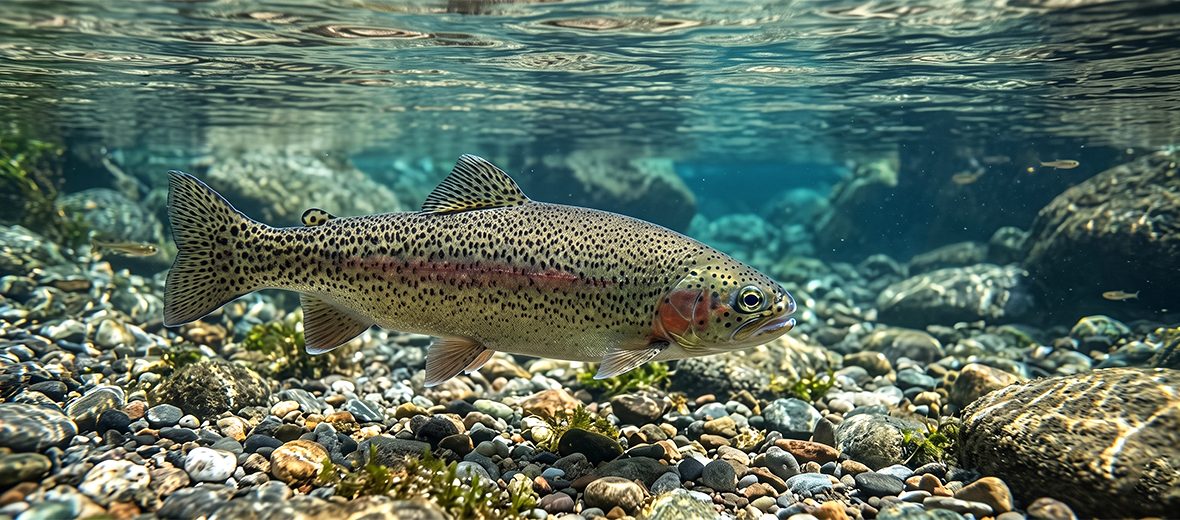
The rainbow trout, aka steelhead or steelhead trout, is an anadromous (migrates from saltwater to freshwater) species of fish that originally hails from the Pacific Ocean regions. These fish have been introduced to every continent, sans Antarctica. They migrate from saltwater to freshwater after living from between 2 – 3 years in the ocean. Generally speaking these fish are not overly threatened. However, many subspecies and populations do face serious threats of pollution, overfishing, sports fishing, hatcheries, major dams, estuary alterations, logging, and the threat of invasive species. However, due to their global distribution and abundant populations, they are listed as Least Concern by the IUCN. Their population trend is listed as stable.
First the Stats…
Scientific name: Oncorhynchus mykiss
Weight: Up to 20 lbs.
Length: Up to 45 inches
Lifespan: Up to 11 years
Now on to the Facts!
1.) Introduced populations in United States, southern Europe, Australia, New Zealand, and South America are considered invasive and have caused havoc to local fish populations.
2.) Introduced specimens can negatively affect native species by preying on them, out-competing them, transmitting contagious diseases (like whirling disease), and/or hybridizing with related species and subspecies.
3.) They were first described by German naturalist and taxonomist Johann Julius Walbaum in 1792
4.) Various insects and their larvae, crayfish, shrimp, other crustaceans, fish, fish eggs, and algae are all on the menu.
5.) Since circa 1870s, these trout have been artificially propagated in various fish hatcheries to restock streams for introduction into non-native waters.
But wait, there’s more on the rainbow trout!
6.) Global rainbow trout farming yields up to 1,102,311+ tons annually for an annual value of up to $2.6 billion USD.
7.) Females lay up to 3,000 eggs per 2.2 lbs. of body weight.
Did you know…?
Rainbow trout are included in the list of the top 100 globally invasive species.
8.) Unfortunately, hatchery-bred specimens introduced into the Kern River have diluted the genetic purity of the Kern River rainbow trout and golden trout through intraspecific breeding.
9.) Numerous locations have been working on removing rainbow trout in order to reestablish native trout populations.
10.) These trout are often cooked as soon as they are cleaned, without scaling, skinning, or filleting.
Now a Short Rainbow Trout Video!
Be sure to share & comment below! Also, check out the Critter Science YouTube channel. Videos added regularly. Be sure to like and subscribe!

Want to suggest a critter for me to write about? Let me know here.
Some source material acquired from: Wikipedia & IUCN