
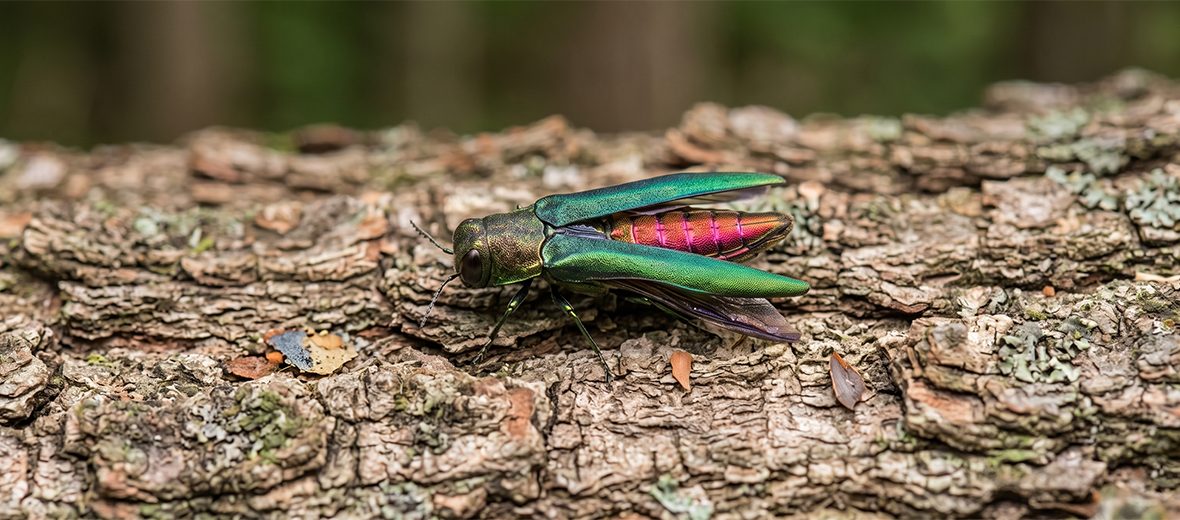
The emerald ash borer, aka EAB, feeds on various ash species and hails from north-eastern Asia. Removed from their native locale, they are considered an invasive species and are highly destructive to ash trees native to Europe and North America. Female beetles lay eggs in bark crevices. Once they hatch, the larvae burrow underneath the bark and feed on the tree’s phloem (the tissue that transports sugars and nutrients) in telltale zigzag patterns. This feeding essentially girdles the tree, cutting off its circulatory system and starving the canopy. Infested trees usually die within 2 – 3 years. Due to their invasive habits and abundance, these insects are listed as Not Evaluated by the IUCN. Unfortunately, their population trend is listed as increasing.
First the Stats…
Scientific name: Agrilus planipennis
Weight: Up to .0018 ounce
Length: Up to .5 inch
Lifespan: Up to 2 years, with adults living only 1 month
Now on to the Facts!
1.) Within infested regions, mature ash mortality can reach up to 98% within 6 years.
2.) In North America, numerous local governments have been attempting to control this species by monitoring their spread, diversifying tree species, and through the use of insecticides and also biological control.
3.) They were first described by French entomologist Léon Fairmaire in 1888.
4.) Adults feed for approximately 1 week on ash leaves in the canopy before mating, but seldom cause much defoliation.
5.) These beetles have 4 larval instars (4 stages of development), egg, larvae, pupae, and adult.
But wait, there’s more on the emerald ash borer!
6.) While all ash trees are susceptible to attack, green and black ash trees are of the highest risk of attack.
7.) Females can lay up to 200 eggs that hatch in up to 15 days.
Did you know…?
Due to special antifreeze chemicals, these beetles can survive overwintering temperatures down to −22°F and as high as 127°F.
8.) Blue ash trees have evolved a higher level of tannin than other ash species and are thus not preferred by these beetles.
9.) These insects have killed 10,000,000+ ash trees so far and threaten to kill a majority of the 8.7 billion ash trees throughout North America!
10.) Government agencies located in both Canada and the U.S. have utilized a native species of parasitoid wasp as a means of locating areas to which the emerald ash borer has spread.
But wait, there’s still more on the emerald ash borer!
11.) The wasps stun these beetles then carry them back to their burrows underground, where they’re stored till the wasps’ eggs hatch and the wasp larvae feed on the beetles.
12.) Volunteers catch the wasps as they return to their burrows carrying the beetles to assess whether an ash borer is present. This methodology is referred to as biological surveillance, as opposed to biological control, because there is only monitoring involved, not extermination.
13.) Systemic pesticides are often utilized and injected into the tree. When the larvae feasts on the tree it takes in the pesticides and dies. However, systemics are not feasible in forested areas.
14.) The USDA is also considering the use of Beauveria bassiana, an insect fungal pathogen, for controlling these beetles in conjunction with parasitoid wasps.
Now a Short Emerald Ash Borer Video!
Be sure to share & comment below! Also, check out the Critter Science YouTube channel. Videos added regularly. Be sure to like and subscribe!

Want to suggest a critter for me to write about? Let me know here.
Some source material acquired from: Wikipedia & IUCN

Leave a Reply