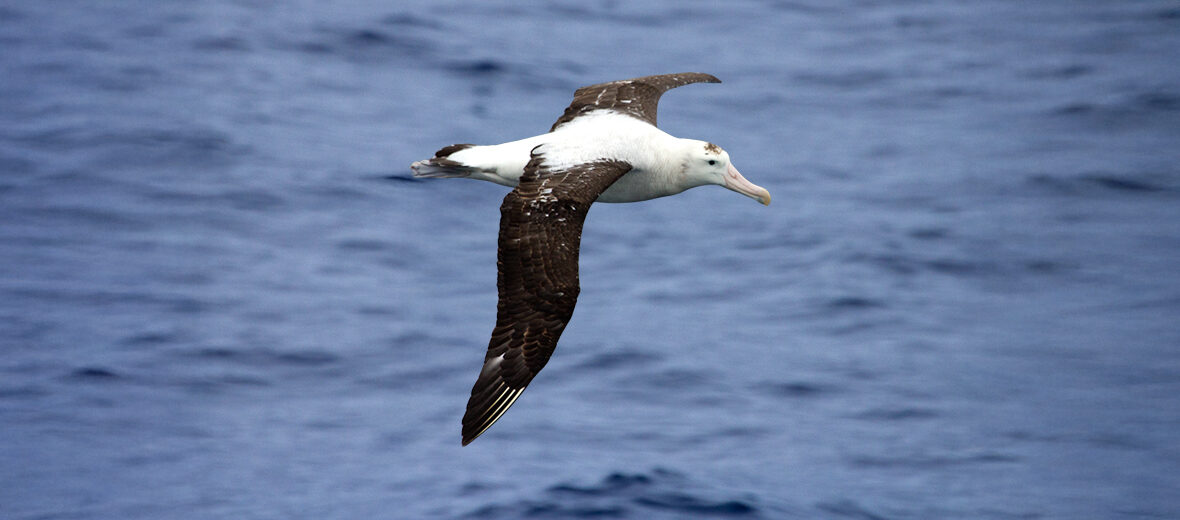
The Tristan albatross was only partially recognized as its own species in 1998. These seabirds were (and in some cases still are) considered a subspecies of the wandering albatross. They face the threats of hunting; trapping; overfishing; bycatch, often being caught in long lines; and invasive species, in the form of rats, house mice, and feral pigs. The IUCN lists these birds as Critically Endangered. Their population trend is listed as decreasing.
First the Stats…
Scientific name: Diomedea dabbenena
Weight: Up to 16.1 lbs.
Length: Up to 43 inches
Wingspan: Up to 10 feet
Lifespan: Up to 50 years
Now on to the Facts!
1.) They were first suggested as a separate species by Gregory Mathews in 1929.
2.) Albatrosses hail from the family Diomedeidae of the order Procellariiformes. They share this family with shearwaters, petrels, storm petrels, and diving petrels.
3.) These birds share some traits with these other birds, such as nasal passages that attach to the upper bill called naricorns, their bills are also unique in that they are split into between 7 – 9 horny plates, and they also produce a stomach oil that is made up of wax esters and triglycerides that is stored in the proventriculus.
4.) Their stomach oil is used against predators as well as an energy rich source of food for chicks and even for the adults during their long oceanic flights.
5.) In a 2004 study of the mitochondrial DNA of the wandering albatross species complex scientists supported the split of these albatrosses from the wandering albatross.
But wait, there’s more on the Tristan albatross!
6.) The genus name Diomedea refers to Diomedes, whose companions were believed to turn into birds. The epitheton dabbenena is in honor of Roberto Dabbene, Italian-Argentine ornithologist.
7.) Their bill measures up to 6.73 inches.
Did you know…?
There are only an estimated 4,800 wild individuals remaining, to date.
8.) They are endemic to the islands of the Tristan da Cunha group and more specifically Gough Island. The vast majority of the world’s population nest on Gough Island. This population consists of up to 1,500 pairs.
9.) Various fish, octopuses, and squids are all feasted upon.
10.) These birds are monogamous (mate for life) and don’t start breeding till they reach the age of 10 years old.
But wait, there’s still more on the Tristan albatross!
11.) Females lay a single egg that hatches in up to 80 days.
12.) They have an occurrence range of 5,400,000 square miles and a breeding range of 31 square miles.
13.) Recent estimates suggest that the population of these birds on Gough has decreased by 28% over the last 46 years.
Now a Short Tristan Albatross Video!
Be sure to share & comment below! Also, check out the Critter Science YouTube channel. Videos added regularly. Be sure to like and subscribe!

Want to suggest a critter for me to write about? Let me know here.
Some source material acquired from: Wikipedia & IUCN
Photo credit: Pierre van der Wielen