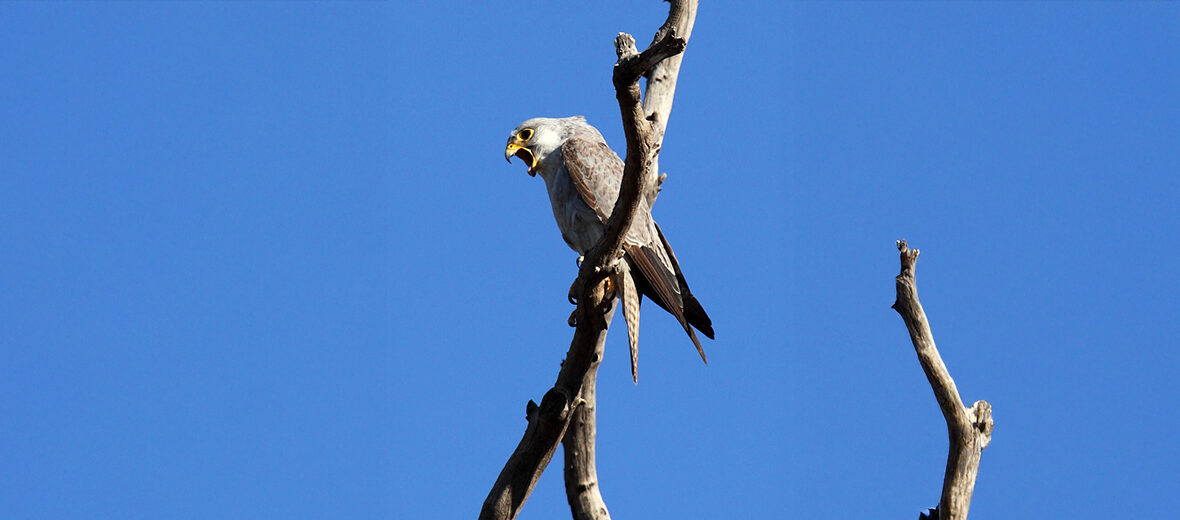
The grey falcon is most likely the rarest falcon species in Australia. These beautiful birds of prey face the threats of habitat loss and destruction at the hands of farming and ranching; hunting; trapping; invasive species; competition with native species; land pollution; water pollution; poisoning, from DDT; and climate change, that causes severe droughts and storms, and can alter their habitat. The IUCN lists these raptors as Vulnerable. Their population trend is listed as stable.
First the Stats…
Scientific name: Falco hypoleucos
Weight: Up to 21.16 ounces
Length: Up to 17.72 inches
Wingspan: Up to 37.40 inches
Lifespan: Up to 15 years
Now on to the Facts!
1.) Eagles, peregrine falcons, owls, crows, ravens, feral cats, feral dogs, and humans are all known predators of these falcons.
2.) Parrots, pigeons, smaller birds, lizards, snakes, rats, mice, locusts, and worms are all on the menu.
3.) These raptors were first discovered by John Gould in 1841.
4.) Their specific epithet hypoleucos hails from Ancient Greek, literally translating to ‘beneath’ and ‘white’ as to mean ‘whitish’.
5.) They prefer to inhabit Triodia grasslands, Acacia shrublands, as well as lightly timbered arid woodlands.
But wait, there’s more on the grey falcon!
6.) Their nest is built in an upright fork, of the top of tall trees.
7.) Females lay up to 4 eggs that hatch in up to 35 days.
Did you know…?
There are only an estimated 1,000 wild breeding pairs remaining, to date, making the grey falcon 1 of the world’s rarest falcons.
8.) The eggs tend to pip (crack) up to 48 hours before actually hatching.
9.) These falcons dwell in several protected areas, including Sturt National Park.
10.) They were previously listed as near-threatened. However, they were uplisted in 2012 to Vulnerable. These birds are listed on CITES Appendix II.
Now a Short Grey Falcon Video!
This video talks about falcons in general.
Be sure to share & comment below! Also, check out the Critter Science YouTube channel. Videos added regularly!

Want to suggest a critter for me to write about? Let me know here.
Some source material acquired from: Wikipedia & IUCN
Photo credit: Christopher Watson