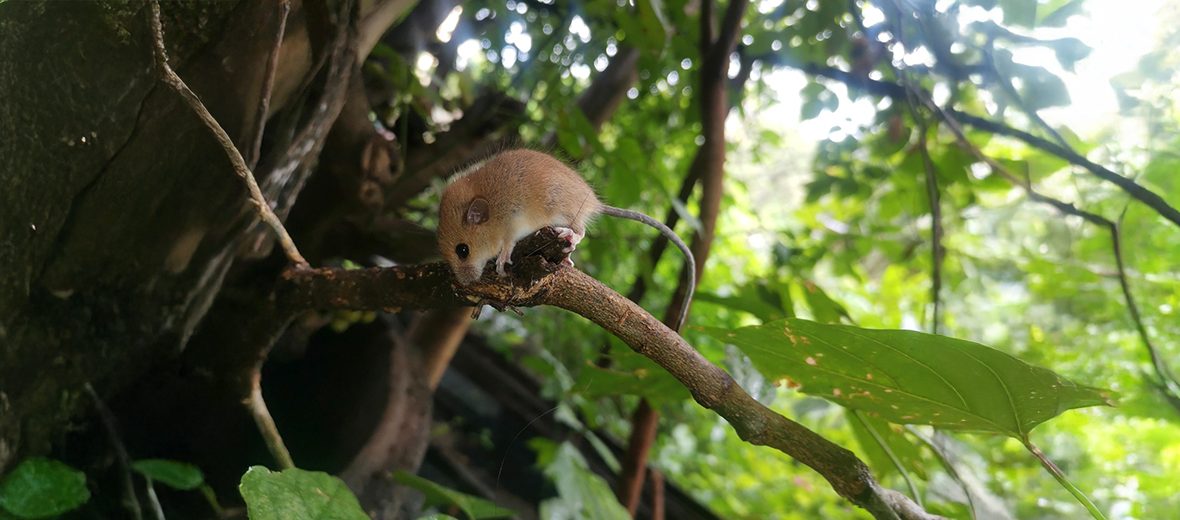
The Asiatic long-tailed climbing mouse, aka Sinhala: ගස් මීයා, hails from southern and southeastern Asia. These mice face the threats of habitat loss and destruction at the hands of farming, ranching, logging, residential developments, and commercial developments; invasive plants; overgrazing by deer; persecution as pests; and general predation. However, these mice are abundant enough to be listed as Least Concern by the IUCN. Their population trend is listed as stable.
First the Stats…
Scientific name: Vandeleuria oleracea
Weight: Up to .35 ounce
Length: Up to 3.5 inches, plus up to a 4.7 inch tail
Lifespan: Up to 2 years
Now on to the Facts!
1.) These mice prefer a arborial life among the shrubs and trees.
2.) Their large hind feet are equipped with nails rather than claws on the outer toes.
3.) Their hind feet have opposable digits.
4.) Even though these mice were first described by William Bennett in 1832, they were specifically collected by amateur zoologist A. C. Tutein-Nolthenius in 1929, leading to their scientific naming after him.
5.) Their closest relatives are the Nolthenius’s long-tailed climbing mouse and the Nilgiri long-tailed tree mouse.
But wait, there’s more on the Asiatic long-tailed climbing mouse!
6.) They prefer to dwell among forests, grasslands, and shrublands.
7.) These mice are most commonly found at elevations of up to 4,921 feet.
Did you know…?
They are able to secrete and carry 2 different viruses, Xenotropic Type C Virus (which is fatal to rodents) and Kyasanur Forest Disease (which can result in a 10% fatality rate in humans).
8.) Females breed up to twice annually and at any time of the year.
9.) The female undergoes a gestation (pregnancy) of up to 21+ days and produces up to 8 pups.
10.) In extensive studies, the xenotropic type C virus was found to cause chronic fatigue syndrome and prostate cancer in primates. The Kyasanur Forest Disease can cause low blood pressure, low blood cell counts, liver/kidney issues, red eyes, and prolonged weakness during recovery, with severe cases requiring hospitalization for complications like dehydration or blood loss.
Now a Short Asiatic Long-Tailed Climbing Mouse Video!
Be sure to share & comment below! Also, check out the Critter Science YouTube channel. Videos added regularly!

Want to suggest a critter for me to write about? Let me know here.
Some source material acquired from: Wikipedia & IUCN
Photo credit: iNaturalist