
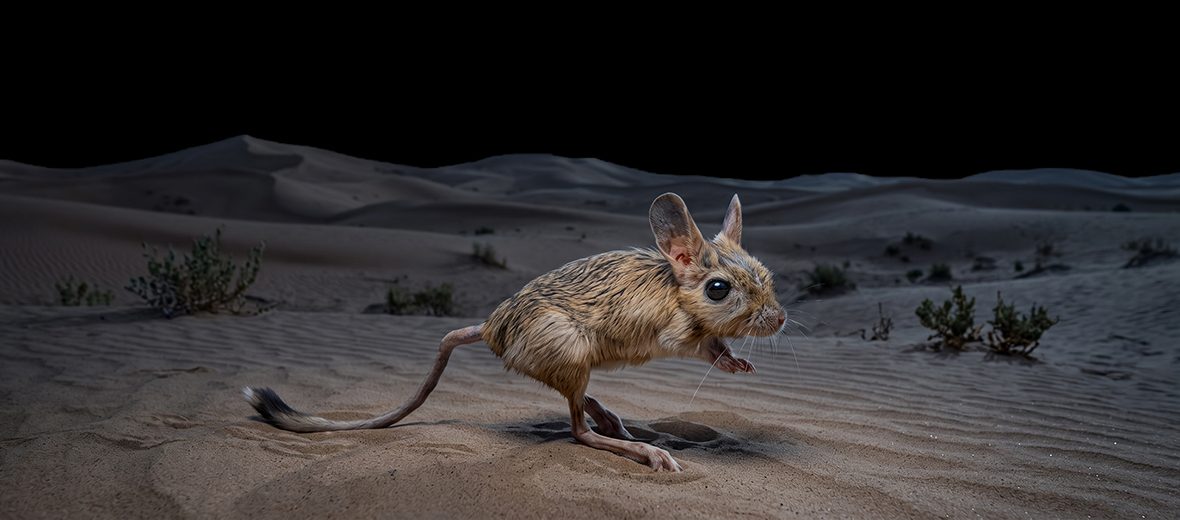
The greater Egyptian jerboa hails from northern Africa and the Middle East. These rodents prefer habitats that contain deserts and semi-deserts, sand dunes near the coastlines, marshes, pastures, and arable lands. They face the threats of hunting, trapping, and even poisoning due to being seen as food by the Bedouin farmers, as well as an agricultural pest species of barley and rain fields. However, these critters are abundant throughout their range and thus listed as Least Concern by the IUCN. Their population trend is listed as stable.
First the Stats…
Scientific name: Jaculus orientalis
Weight: Up to 6.42 ounces
Length: Up to 6.3 inches, plus up to a 8.5 inch tail
Lifespan: Up to 6 years
Now on to the Facts!
1.) Their hind legs are rather large and are about 4 times longer than their forelimbs. Their feet have hairy pads that assist with locomotion on sand.
2.) Burrows can reach depths of up to 5.74 feet and lengths of up to 8.2 feet.
3.) These jerboas are nocturnal (active at night) and crepuscular (active at dawn and dusk).
4.) Succulent roots, green shoots, seeds, grains, and desert fungi, supplemented by the occasional insect are all on the menu.
5.) Breeding season lasts from November – July.
But wait, there’s more on the greater Egyptian jerboa!
6.) Females undergo up to a 40 day gestation (pregnancy) that yields up to 5 pups.
7.) When first born, the young have hind legs the same length as their forelegs. As they begin to move around, they drag themselves with their forelimbs. The hind legs eventually lengthen and by 4 weeks, quadrupedal locomotion starts. Bipedal locomotion begins at about 7 weeks after birth.
Did you know…?
These critters can jump to heights of up to 10 feet!
8.) The ear length is up to .9 inch.
9.) They are preyed on by snakes, foxes, and owls.
10.) Jerboas tend to get most of their needed moisture from the plants they eat, rather than drinking standing water.
Now a Short Greater Egyptian Jerboa Video!
Be sure to share & comment below! Also, check out the Critter Science YouTube channel. Videos added regularly. Be sure to like and subscribe!

Want to suggest a critter for me to write about? Let me know here.
Some source material acquired from: Wikipedia & IUCN

Leave a Reply