
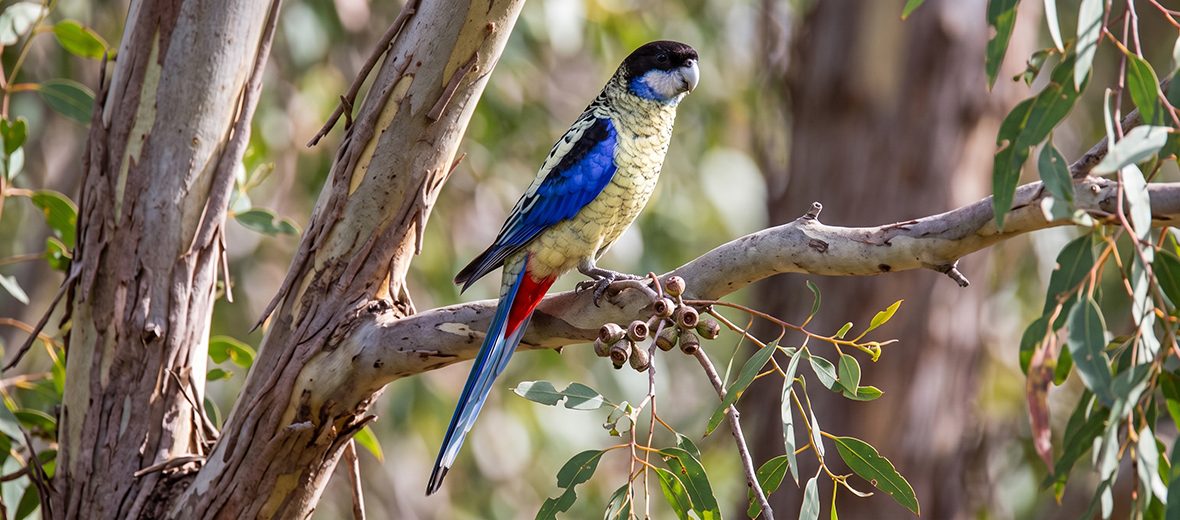
The northern rosella, aka Brown’s rosella or smutty rosella, is a species of parrot that hails from northern Australia, ranging from the Gulf of Carpentaria and Arnhem Land to the Kimberley. These birds face the threat of land clearing for development or agriculture which reduces available woodland habitats. Uncontrolled or altering fire patterns in the tropical savannas can damage the eucalyptus and melaleuca woodlands where they forage and nest. Climate change causes extreme shifts in the weather patterns. Increased human activity can also impact food sources and nesting tree hollows if left unchecked. However, these parrots are abundant enough to be listed as Least Concern by the IUCN. Their population trend is listed as stable.
First the Stats…
Scientific name: Platycercus venustus
Weight: Up to 3.9 ounces
Length: Up to 12 inches, including up to a 5.7 inch tail
Wingspan: Up to 17 inches
Lifespan: Up to 20 years
Now on to the Facts!
1.) They were first described by German naturalist and zoologist Heinrich Kuhl in 1820.
2.) These birds prefer open, grassy forests, eucalyptus savanna woodlands, and locales near small creeks or sandstone escarpments.
3.) Not being gregarious, they are typically found alone or in pairs rather than in large flocks. However, sometimes they can be seen in flocks of up to 15 individuals.
4.) They produce a sharp, short chit-chut chit-chut contact call in mid flight. 3-note whistles on an ascending scale as well as metallic piping sounds are made while perched.
5.) Seeds, nectar, flowers, and insect grubs are all feasted upon.
But wait, there’s more on the northern rosella!
6.) Their primary predator is the rufous owl.
7.) Females lay up to 5 eggs that hatch in up to 20 days.
Did you know…?
It’s illegal to import, export, and/or trade these birds. But that is the case with all Australian flora and fauna.
8.) The chicks fledge in up to 7 weeks.
9.) They are protected by the Convention on International Trade in Endangered Species of Wild Fauna and Flora (CITES) with their placement on the Appendix II list of vulnerable species.
10.) These birds are diurnal (active during the day).
Now a Short Northern Rosella Video!
Be sure to share & comment below! Also, check out the Critter Science YouTube channel. Videos added regularly. Be sure to like and subscribe!

Want to suggest a critter for me to write about? Let me know here.
Some source material acquired from: Wikipedia & IUCN

Leave a Reply