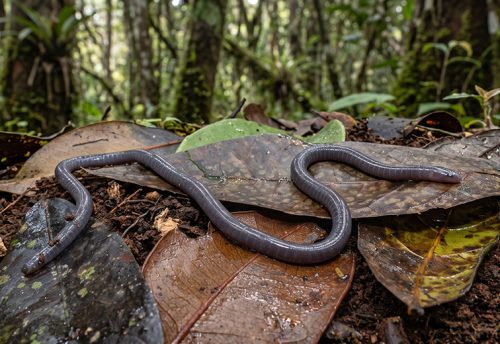
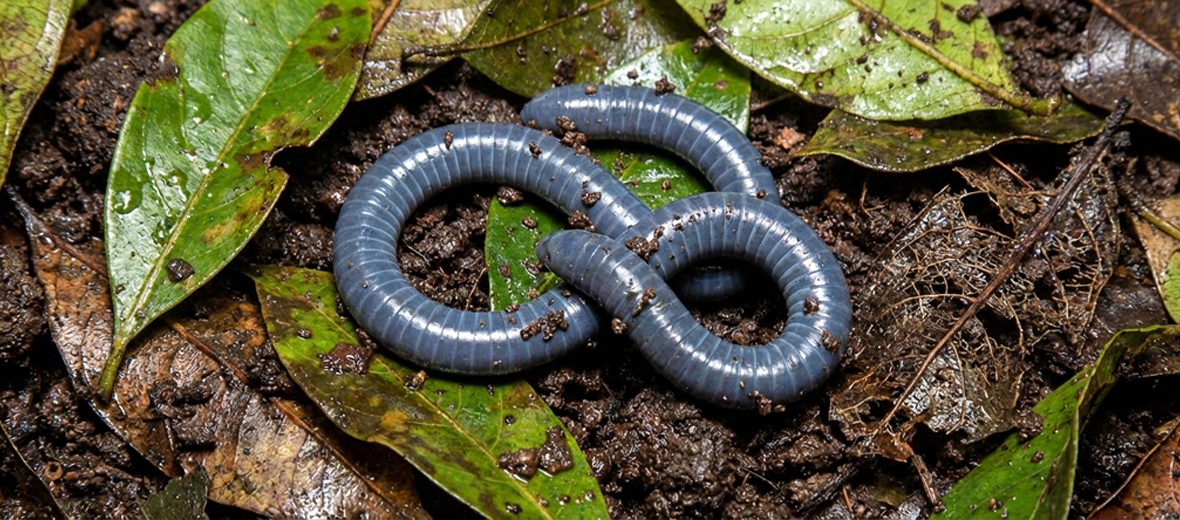
The Taita African caecilian, aka Taita Hills caecilian or Taita Mountains caecilian, hails from the Taita Hills region of southeast Kenya, in Africa. These critters face the threats of habitat loss and destruction at the hands of residential development, commercial development, farming, and ranching; land pollution; and water pollution; both pollution types infiltrate the soil and water and causes a high rate of mortality. As a result, these caecilians are listed as Endangered by the IUCN. Their population trend is listed as stable though.
First the Stats…
Scientific name: Boulengerula taitana
Weight: Up to .52 ounce
Length: Up to 12+ inches
Lifespan: Up to 10+ years
Now on to the Facts!
1.) These caecilians have 2 rows of pointed teeth in the premaxillary-maxillary parts of the jaw and vomer palatine in the dentary and splenial parts of the jaw.
2.) Their preferred habitats are moist forest biomes.
3.) They are often called “ming’ ori”, a term typically used for earthworms.
4.) Earthworms, termites, dipteran larvae, ants, slugs, thrips, and centipedes are all preyed on.
5.) These amphibians engage in internal fertilization.
But wait, there’s more on the Taita African caecilian!
6.) Females lay clutches of up to 9 eggs each, after internal fertilization.
7.) Juveniles metamorphosize into adults in up to 1 year.
Did you know…?
After their birth, the juveniles position themselves along different parts of their mother’s body and repeatedly use their lower jaws to lift and peel the outer layers of the skin, which are high in lipids.
8.) The teeth of the offspring include ‘fetal-like’ teeth that are replaced by adulthood.
9.) Observations have shown that it is not unusual for 2 fathers to sire a single litter.
10.) There is also a high chance of offspring not being cared for by their biological mothers, which invites the idea of alloparenting (where other mothers will care for offspring that aren’t their own).
Now a Short Taita African Caecilian Video!
Be sure to share & comment below! Also, check out the Critter Science YouTube channel. Videos added regularly. Be sure to like and subscribe!

Want to suggest a critter for me to write about? Let me know here.
Some source material acquired from: Wikipedia & IUCN