
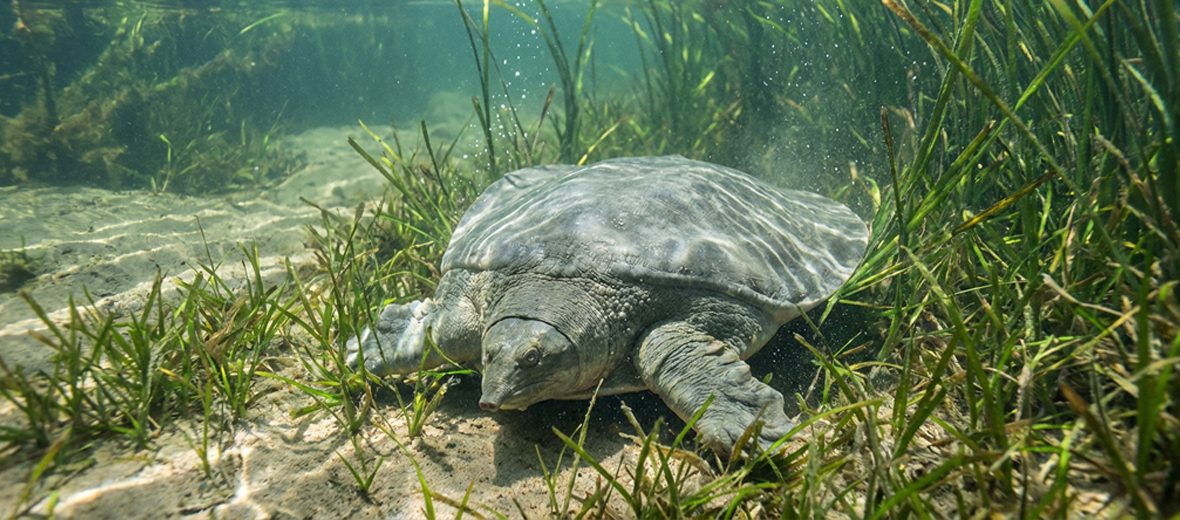
The Asian giant softshell turtle, aka Cantor’s giant softshell turtle or the frog-faced softshell turtle, vanished from most of their range in the 20th century. These turtles face the threats of habitat loss and destruction at the hands of residential and commercial developments, marine and freshwater aquaculture, mining, quarrying, dams (which divide their territory and prevent seasonal relocations); hunting, for their meat; trapping, for sale in the exotic pet trade; invasive species, that can bring about predation; land pollution; water pollution; microplastics pollution; and climate change, that can cause severe, habitat altering storms, droughts, and flooding. Due to all these threats, these critters are listed as Critically Endangered by the IUCN. Their population trend is also listed as decreasing.
First the Stats…
Scientific name: Pelochelys cantorii
Weight: Up to 220 lbs.
Length: Up to 39 inches
Lifespan: Up to 100+ years
Now on to the Facts!
1.) They are the world’s largest extant freshwater species of turtle.
2.) Crustaceans, fish, and mollusks are all on the menu.
3.) These turtles spend 95% of their life buried and totally motionless, with only their eyes and mouth sticking out from the substrate.
4.) Their specific name, cantorii, is in honor of Danish zoologist Theodore Edward Cantor.
5.) They were first described by British zoologist John Edward Gray in 1864.
But wait, there’s more on the Asian giant softshell turtle!
6.) These turtles have soft, leathery shells that are completely devoid of scales.
7.) Females lay up to 28 eggs each season, between February – March.
Did you know…?
These turtles surface only 2 times a day to grab a breath of fresh air. The rest of the time they engage in cloacal respiration, aka they breathe oxygenated water through their butt.
8.) The eggs hatch in up to 90 days.
9.) Hatchlings emerge from their shells under the cover of night and measure up to only 1.5 inches in carapace (shell) length.
10.) The Department of Environment and Natural Resources lists these turtles as a protected species and their trade is illegal. However, they look very similar to the Chinese softshell turtle, so they are sometimes confused and accidentally captured for sale.
Now a Short Asian Giant Softshell Turtle Video!
Be sure to share & comment below! Also, check out the Critter Science YouTube channel. Videos added regularly. Be sure to like and subscribe!

Want to suggest a critter for me to write about? Let me know here.
Some source material acquired from: Wikipedia & IUCN

Leave a Reply