
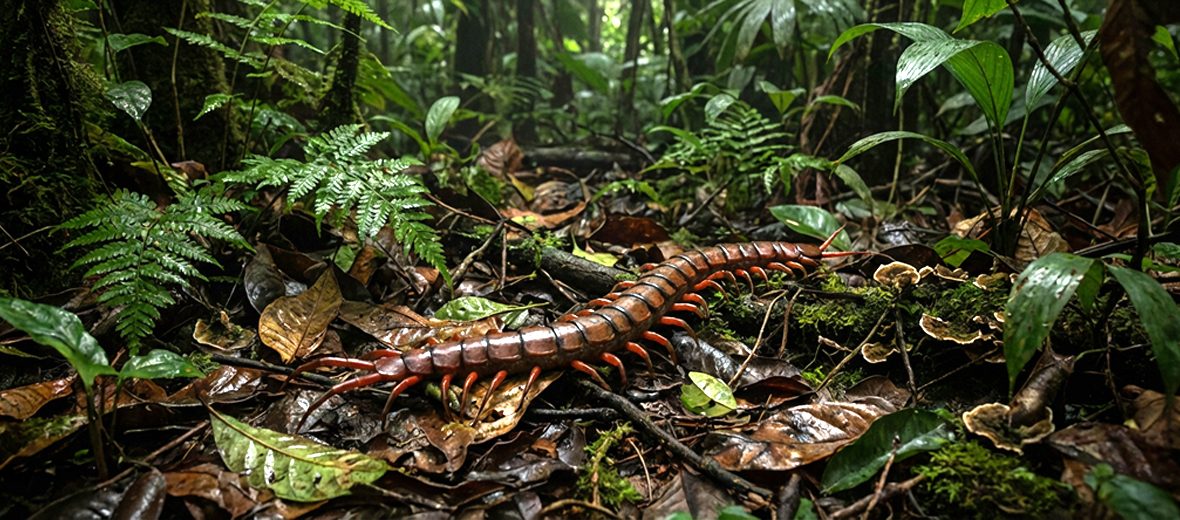
The Amazonian giant centipede, aka Peruvian giant yellow-leg centipede, hails primarily from South America, but can be found in the Caribbean as well. These large and ferocious arthropods face the threats of habitat loss and destruction, at the hands of residential and commercial developments, as well as farming and ranching; climate change, that can cause flooding and extreme droughts; and over-collection for the pet trade. However, these critters are not currently evaluated by the IUCN. Their population trend is listed as stable.
First the Stats…
Scientific name: Scolopendra gigantea
Weight: Up to .88 lbs.
Length: Up to 14 inches
Lifespan: Up to 15 years
Now on to the Facts!
1.) They prefer tropical or sub-tropical rainforests and tropical dry forests, in dark, moist places like among leaf litter or under rocks and/or logs.
2.) When human-made structures happen near to their natural habitat, these centipedes will typically forage and/or seek refuge in trash piles, rubble, plant pots, crawl spaces under buildings, beneath old floors and ceiling boards, and crevices in wooden, concrete, and brick walls.
3.) These centipedes will prey on any other animal they can overpower and kill; such as large insects, worms, snails, spiders, millipedes, scorpions, tarantulas, small lizards, frogs (up to 3.75 long), snakes (up to 10 inches long), sparrow-sized birds, mice, young rats, and even smaller bats.
4.) Large individuals have been documented employing unique strategies to catch bats with muscular strength. They will climb cave ceilings and hold or manipulate their heavier prey with only a few legs attached to the cave ceiling.
5.) Large birds, spiders, coatis, kinkajous, and opossums all prey on these centipedes.
But wait, there’s more on the Amazonian giant centipede!
6.) At least 1 human death has been attributed to the venom of these centipedes. In 2014, a 4-year-old child in Venezuela died after being bitten, that was hidden inside an open soda can.
7.) Their venom is a powerful mix of neurotoxins, cytotoxins, and enzymes, causing intense pain, paralysis, swelling, and potential cardiovascular/respiratory issues in humans, though fatalities are extremely rare.
Did you know…?
These are the largest known centipede in the world!
8.) The bite of 1 of these critters is compared to being shot by a bullet and requires medical attention for symptom management.
9.) Females lay up to 30 eggs and coil around to protect them until they hatch in up to 4 months.
10.) Newly hatched youths stay with mom for up to a few weeks, and reach adulthood in up to 1 year.
Now a Short Amazonian Giant Centipede Video!
Be sure to share & comment below! Also, check out the Critter Science YouTube channel. Videos added regularly. Be sure to like and subscribe!

Want to suggest a critter for me to write about? Let me know here.
Some source material acquired from: Wikipedia & IUCN

Leave a Reply