
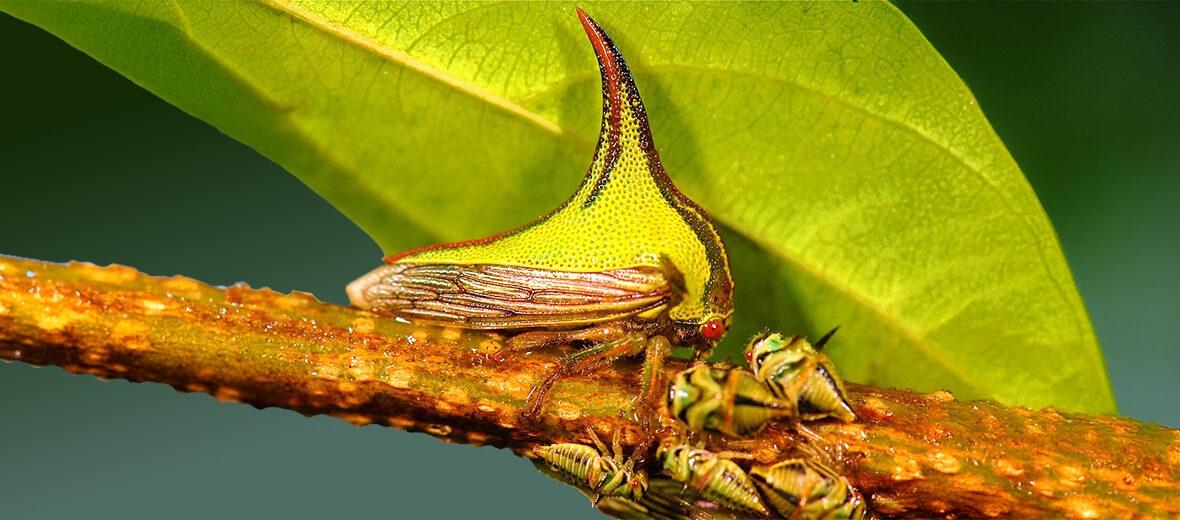
The thorn bug is a widely distributed insect that is often considered a pest to many ornamental shrubs and trees. These insects utilize their thornlike pronotum to thwart various predators, such as birds, from eating them. They can be found in Florida and other southern states, Mexico, Central America, and into South America. The IUCN has not evaluated them, as they are so widespread.
First the Stats…
Scientific name: Umbonia crassicornis
Weight: Up to .0015 ounce
Length: Up to .5 inch
Lifespan: Up to 2 years
Now on to the Facts!
1.) These critters feast on the sap from ornamental trees and shrubs, as well as fruit trees.
2.) They are restricted to warmer climates, as if the temperature drops to zero, they will die.
3.) As soon as they are mature enough to leave, the males leave first and travel up to 22.97 feet from their host plant. Whereas females travel only 9.84 feet from their host plant.
4.) When a mother is signaled by a false alarm and she can’t detect a predator she will send out her signal to the nymphs alerting them that there is none. This signal serves as a negative feedback signal basically training the nymphs to be less sensitive to disturbances and become more accurate in detecting possible threats.
5.) When performing their courtship call, males use the muscles in their abdomen to generate a continuous call that decreases in frequency as the tone gets longer. Plus, high frequency clicks at various times in the call are caused by the muscles pulling on the horn of the insect.
But wait, there’s more on the thorn bug!
6.) Males utilize what is coined as a fly-call-walk strategy to find females. This entails the male flying from 1 plant to another, then calling while walking around and strutting to attract a female.
7.) Females lay upwards of 100 eggs on tree branches or on the undersides of leaves.
Did you know…?
Inbreeding often occurs with these insects.
8.) The female will watch over the eggs until the nymphs are mature.
9.) If the females do not watch over the eggs and nymphs, there is a drop in survivability from 53% to 27%.
10.) If a predator approaches the group, it is more likely to take a nymph that is on the outer parts of the plant, this produces a rivalry for siblings to try to be in the center of the group and will fight over who will be on the outside because they have a higher risk of being preyed on.
Now a Short Thorn Bug Video!
Be sure to share & comment below! Also, check out the Critter Science YouTube channel. Videos added regularly!

Want to suggest a critter for me to write about? Let me know here.
Some source material acquired from: Wikipedia & IUCN
Photo credit: Marshal Hedin