Critter Science
  • Zoology
    • Ecology
      • Animal Conservation
        • CITES: Protecting Wildlife
        • Dame Jane Goodall
        • Endangered Animals
        • Ex Situ Explained
        • In Situ Explained
        • Zoological Branches
      • Chromatophores and Survival
      • Ecosystems
        • Animal Habitats
        • The Biomes
        • Coastal Erosion
        • Rainforest Types
      • Evolution. The Facts.
        • Animal Devolution
        • Animal Mimicry
        • Convergent Evolution
        • Carl Linnaeus
        • Charles Darwin
        • Evolution of Amphibians
        • Evolution of Birds
        • Genetic Drift in the Animal Kingdom
        • Naturalism
        • Natural Selection
      • Invertebrate Families Explored
        • What are Arachnids?
          • Spider Webs
      • Predator vs Prey
      • Producers and Consumers
      • Vertebrate Animal Families
        • Snakes vs Legless Lizards
        • What is a Marsupial?
    • Sustainability
      • Climate Change
      • Global Warming
      • Pollution
        • Air Pollution
        • Land Pollution
        • Light Pollution
        • Microplastics Pollution
        • Noise Pollution
        • Water Pollution
      • Recycling
        • Recycling Plastics
      • Renewable Energy
    • Animal Behavioral Patterns
      • Avian Communication
      • Cetacean Communication
      • Elephant Communication
      • Herpetofauna Communication
      • Primate Language: The Debate
      • Types of Animal Dormancy
    • What are Species?
      • Amphibians vs Reptiles
      • Animal Reproduction
      • Claws, Nails, and Talons
      • Fur and Hair
      • Gecko Feet
      • Invasive Species
      • IUCN Statuses
      • Speciation
      • Species Complex
      • The Enigmatic Purr
      • Venom vs Poison
    • About the Critterman
  • Daily Critter Facts
    • Amphibian Facts
      • Frog Facts
      • Newt Facts
      • Salamander Facts
      • Toad Facts
    • Arthropod Facts
      • Arachnid Facts
      • Insect Facts
    • Bird Facts
      • Flightless Bird Facts
      • Predatory Bird Facts
      • Scavenger Bird Facts
      • Wading Bird Facts
    • Cryptozoology
    • Fish Facts
      • Cephalopod Facts
      • Crustacean Facts
      • Jellyfish Facts
      • Reefs
      • Shark and Ray Facts
      • Shellfish Facts
    • Flying Mammal Facts
    • Gastropod Facts
    • Land Mammal Facts
      • Canine Facts
      • Feline Facts
      • Lagomorph Facts
      • Marsupial Facts
      • Mustelid Facts
      • Primate Facts
      • Rodent Facts
      • Ungulate Facts
    • Parasite Facts
    • Reptile Facts
      • Crocodilian Facts
      • Lizard Facts
      • Snake Facts
      • Turtle Facts
    • Sea Mammal Facts
      • Dolphin Facts
      • Porpoise Facts
      • Sea Lion Facts
      • Seal Facts
      • Whale Facts
    • Worm Facts
  • For Teachers
    • Animal Quizzes
      • Amphibian Quiz
      • Bird Quiz
      • Cat Quiz
      • Dog Quiz
      • Dolphin Quiz
      • Insect Quiz
      • Reptile Quiz
    • Animal Word Search
    • Butterfly Life Cycle
      • Butterfly Metamorphosis
      • World’s Largest Butterfly
      • World’s Largest Moth
    • The Cellular Structure of an Animal
    • Coloring Pages
    • Fish and Sharks
    • Frogs vs Toads
    • Insect vs Bug
    • Metamorphosis – A Frog’s Life Cycle
  • Study Guides
    • African Animals
    • Antarctica Animals
    • Asian Animals
    • Australian Animals
    • Central American Animals
    • European Animals
    • North American Animals
    • South American Animals
  • Diseases & Parasites
    • Bsal
    • Canine Distemper Virus (CDV)
    • Chronic Wasting Disease (CWD)
    • The Deadly Chytrid Fungus
    • All About Parasites
    • The Rabies Virus
    • Toxoplasmosis
    • White-Nose Syndrome
  • Contact
    • General Contact
    • Guest Article Submission
      • Guest Articles
        • Guest Articles – 2024
    • What Critter is This?
    • Animal Welfare Organizations
    • Privacy Policy
Subscribe
cheetah

The Fastest Land Animal on Earth… the Cheetah!

  • 12 November, 2018
  • Critterman
  • No Comments
  • 2586 Views
  • 7 Likes
Daily Critter Facts, Feline Facts, Land Mammal Facts

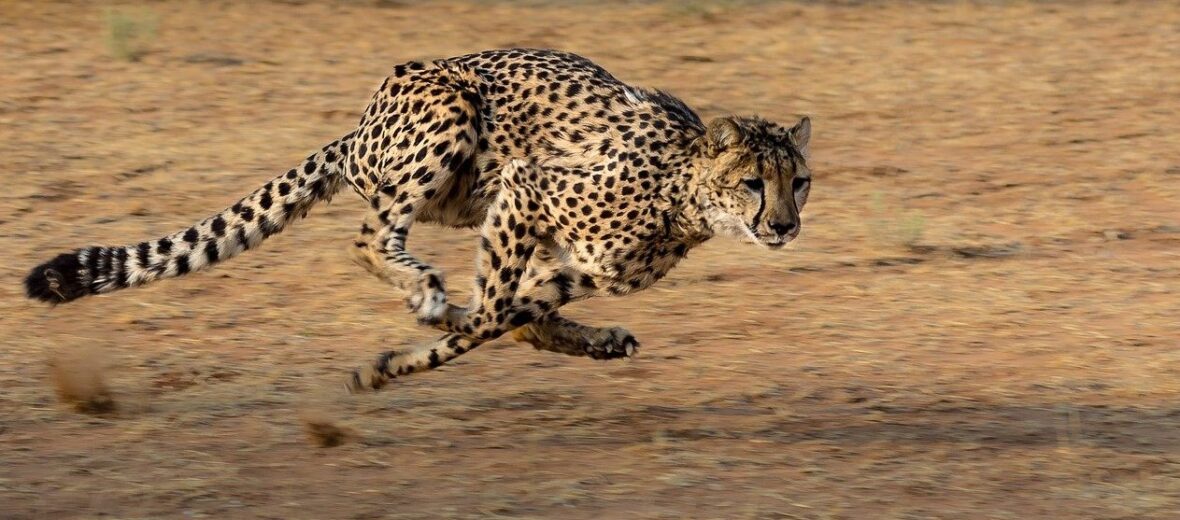
The fastest land animal on earth award goes to the cheetah! The cheetah hails from Africa and can be found mostly on the Savannah plains. They aren’t built for fighting, but rather for running. When running flat out, nothing can outrun these amazing cats. They are so quick and agile that they can even change directions in mid air. With only 6,600+/- individuals remaining in the wild, the IUCN lists African cheetahs are Vulnerable. Their populations are also decreasing. The threats they face are: habitat destruction, hunting, human interference, and diseases caused by invasive species.

First the Stats…

Scientific name: Acinonyx jubatus
Weight: Up to 160 lbs.
Length: Up to 4.9 feet, plus a 3 foot long tail
Height: Up to 3.1 feet, at the shoulder
Lifespan: Up to 12 years

Now on to the Facts!

1.) The cheetah hunts warthogs, gazelles, rabbits, and birds, among other animals.

2.) These cats are diurnal (awake during the day) hunters so as to avoid nocturnal (awake at night) competition. However, on full moon nights, they have been documented hunting at night.

3.) Cheetahs are found in sub-Saharan Africa. They inhabit open, grassy Savannah plains and open forest expanses.

4.) The word cheetah is derived from the Hindi word chita meaning “spotted one”.

5.) It has been documented that cheetahs have been in captivity for approximately 5,000 years and were first tamed by the Sumerians!

But wait, there’s more on the cheetah!

6.) 90% of Cheetahs die with in the first 3 months, 50% of which are taken by predators like lions and hyenas. The other 40% fail to survive due to inbreeding. Inbreeding causes, in part, a weakened immune system and the cubs just can’t fight off disease.

7.) After a 90 – 95 day gestation a female Cheetah will give birth to a litter of 3 – 5 cubs. The male doesn’t participate in the rearing of young. And the female will leave her cubs for up to 48 hours while looking for food; hence, in part, the high mortality rate.

Did you know…?
They can accelerate from 0 – 70 mph in just 3 seconds!

8.) Running at speeds of up to 70 mph only lasts about 60 seconds before they become exhausted due to overheating.

9.) These beautiful cats are solitary animals and communicate to each other via spraying urine or face rubbing saliva on things like trees and rocks. They can also vocalize via bleats, purrs, barks, hisses, growls, and even a high pitched chirping sound.

10.) The cheetah has a long, muscular, flat shaped tail. This tail functions as sort of a rudder. They use this ‘rudder’ to help control their sharp turns and keep their balance when running at top speeds.

Now a Short Cheetah Video!

Also, check out the Critter Science YouTube channel. Videos added frequently!

Want to suggest a critter for me to write about? Let me know here.

Learn more about all kinds of cool critters, right here!
Africabig catcatcheetahdiurnalfastfastesthuntingpredatorprey
Critterman

With over 50 years of critter experience to my credit and hundreds of zoology teaching hours to people around the world, I have amassed not only a continuing thirst for critter knowledge but a desire to teach others all I can about the majesty and wonder of our natural world. Critter Science is a culmination of such knowledge. I have hands on as well as book acquired intel on all kinds of critters. Whether they're on land, sea, or in the air. I will never say that I know everything about all animals. That's impossible, even for a savant. But, that being said, ask me any animal question and I'll answer it. If I don't know the answer, I'll get an answer for you!

The Fast and Ferocious Baboon
Africa’s Striped Wonders, the Zebra
Related Posts
  • little raven
    The Little Raven 20 January, 2026
  • African wolf
    The African Wolf 19 January, 2026
  • Atlantic sturgeon
    The Atlantic Sturgeon 16 January, 2026
  • Daily Critter Facts
  • Guest Articles
  • BYET
  • Teachers
  • Study Guides
  • Contact

Copyright © 2025, Critter Science. All Rights Reserved.