
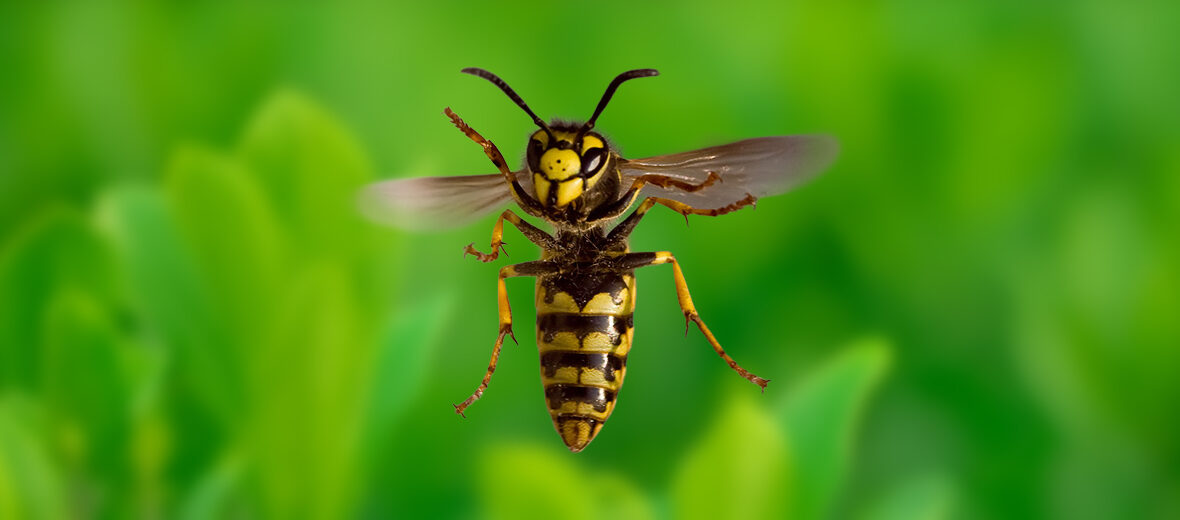
The European wasp, aka German wasp, or German yellowjacket, hails from Europe, Northern Africa, and temperate Asia. They have spread to Australia, North America, South America, South Africa, and New Zealand. Due to the fact that they are widely recognized as a successful and destructive invasive species in many parts of the world, and have a stable and growing population, the IUCN has not categorized these wasps. Their population trend is listed as increasing.
First the Stats…
Scientific name: Vespula germanica
Weight: Up to 0.0003 ounce
Length: Up to .8 inch
Wingspan: Up to .63 inch
Lifespan: Up to 1 year, for the queen | Up to 3+ months, for workers
Now on to the Facts!
1.) European wasps are part of the family Vespidae and are often mistakenly referred to as paper wasps due to the fact that they build grey paper nests.
2.) They were first described scientifically in 1791 by Johann Ludwig Christ.
3.) The usual order of tasks carried out by workers is nest work, pulp foraging, carbohydrate foraging, and protein foraging.
4.) About 60% of the wasps observed perform more than 2 of these tasks throughout the course of their lifespan.
5.) Up to 40% of the wasps specialize in only 1 task per day.
But wait, there’s more on the European wasp!
6.) Their nests are made from chewed plant fibers, mixed with saliva. The vast majority of nests are found in the soil below ground. A decent amount of nests are found in artificial structures like attics, and a small portion are found above ground in trees and shrubs.
7.) Their stings are painful, cause burning & swelling, and can be administered repeatedly do to the fact that their stinger isn’t barbed.
Did you know…?
The venom (an alkaline mixture of amines, peptides, & proteins like serotonin and phospholipase) causes intense localized pain, redness, and inflammation, with the risk of severe allergic (anaphylactic) reactions upon delivery of multiple stings.
8.) Queens mate with a fair number of males, typically between 1 – 7, with no set number of mates.
9.) Workers are known for their opportunistic predatory and scavenger behaviors. They are quite efficient at hunting for small, live food sources and at collecting from large stationary sources of food.
10.) Due to their adaptability, they are able to easily colonize new locales very rapidly.
But wait, there’s still more on the European wasp!
11.) In a testament to their intelligence, they may continue to visit a feeder after the food is gone, but are able to rapidly remove associations that no longer provide a reward. Meaning that they will quickly learn that when the food is gone, it is time to move on.
12.) Due to the fact that the queen mates with multiple males, the workers are more closely related to the queen’s sons rather than to the sons of other workers.
13.) Carrion (dead animals), insects, spiders, fruit, honeydew, processed human food, and even garbage are all on the menu.
14.) Female bee moths have been known to lay eggs in the nests of these wasps. Hatched larvae will feed on the eggs, larvae, and pupae left unattended by the wasps, often times destroying large parts of the nest as they burrow through looking for food.
Now a Short European Wasp Video!
Be sure to share & comment below! Also, check out the Critter Science YouTube channel. Videos added regularly!

Want to suggest a critter for me to write about? Let me know here.
Some source material acquired from: Wikipedia
Photo credit: Maciej Skorecki