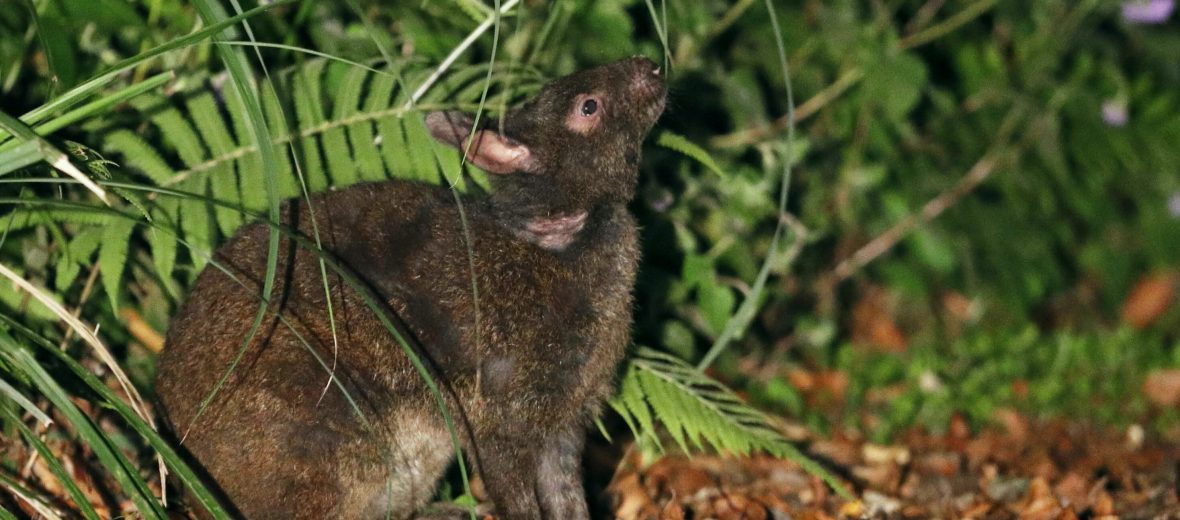
The Amami rabbit, aka Ryukyu rabbit, is only found on Amami Ōshima and Tokunoshima, 2 small islands between southern Kyūshū and Okinawa in Japan. These rabbits are frequently called a living fossil. The Amami rabbit is a living remnant of ancient rabbits that once dwelled on the Asian mainland, where they eventually died out, remaining only on the 2 small Japanese islands where they reside currently. They face the threats of tourism, that interrupts their breeding; habitat loss and destruction at the hands of logging, wood pulp plantations, and wood collecting; roads and railroads, that can result in habitat division and vehicle strike (being hit by vehicles); dams, that cut off water supplies and flood their territories; and invasive species, that bring about excessive predation via Asian mongooses and feral cats. The IUCN lists these bunnies as Endangered. There population trend is listed as decreasing.
First the Stats…
Scientific name: Pentalagus furnessi
Weight: Up to 6.6 lbs.
Length: Up to 20 inches, plus up to a 1.4 inch tail
Lifespan: Up to 10 years
Now on to the Facts!
1.) A living remnant of the ancient rabbits that once thrived on the Asian mainland, where they eventually died out, these rabbits are referred to as living fossils.
2.) There are only an estimated 5,100 wild specimens remaining on the 2 islands.
3.) Amami rabbits are nocturnal (active at night).
4.) These rabbits, while typically silent, can produce a call that sounds like that of a pika.
5.) They are preyed on by Asian mongooses, dogs, cats, owls, and snakes.
But wait, there’s more on the Amami rabbit!
6.) The Amami rabbit consumes the young shoots, sprouts, and acorns of approximately 29 species of plants.
7.) These rabbits reproduce up to 2 times a year.
Did you know…?
In 1921, Japan officially declared the Amami rabbit as a “natural monument” which prevented it from being legally hunted.
8.) Females undergo up to an estimated 39 day gestation (pregnancy).
9.) The female births up to 3 kits each breeding session.
10.) These rabbits are known to be promiscuous (males and females have multiple partners).
Now a Short Amami Rabbit Video!
Be sure to share & comment below! Also, check out the Critter Science YouTube channel. Videos added regularly!
Want to suggest a critter for me to write about? Let me know here.