
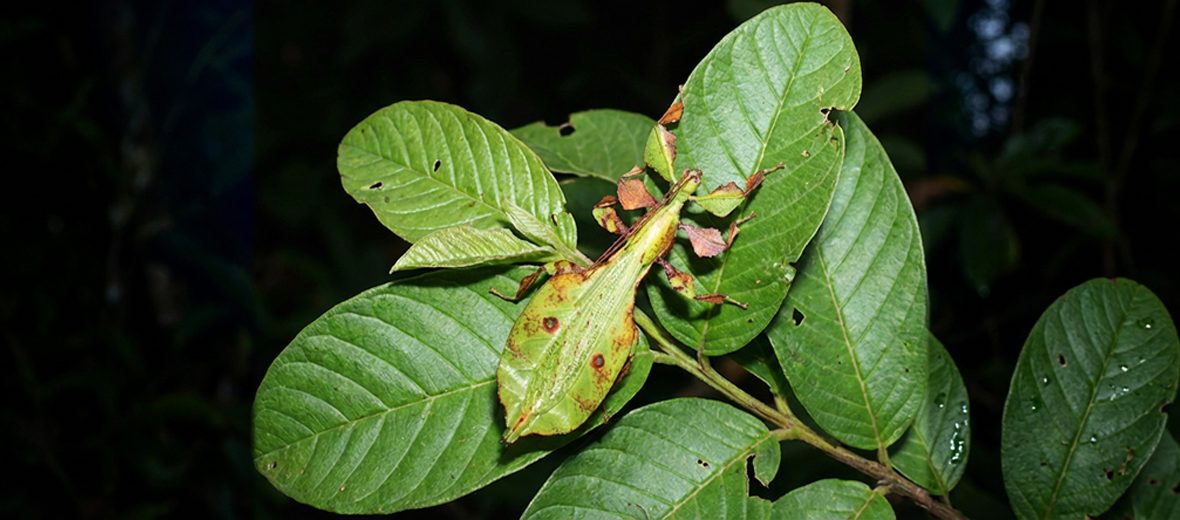
The Gray’s leaf insect hails from Sumatra and the southern part of Malay Peninsula. Their specific epithet bioculatum means “2-eyed” in Latin and refers to the 2 dots located on the abdomen in these insects. These critters face the threats of habitat loss and destruction at the hands of deforestation; and climate change, that can cause severe weather, high temperatures, and drier weather. However, they are abundant enough to be listed as Least Concern by the IUCN. Their population trend is listed as stable, for now.
First the Stats…
Scientific name: Pulchriphyllium bioculatum
Weight: Up to .70 ounce
Length: Up to 3.7 inches
Lifespan: Up to 7 months
Now on to the Facts!
1.) These insects molt up to 6 times in their lifetime.
2.) They were first described in 1832 by George Robert Gray.
3.) Being slow-moving herbivores (eat plant matter), they rely on their camouflage and fore wings for defense against predators.
4.) Birds, numerous amphibians, and various reptiles all prey on these insects.
5.) Their preferred habitats are tropical rainforests that provide ample edible vegetation.
But wait, there’s more on the Gray’s leaf insect!
6.) The preferred plant species are mangos, guavas, Rambutans, Quercus (oaks), and Rubus’ (dewberries, raspberries, and blackberries).
7.) Females lay up to 500 eggs in their lifetime that hatch in up to 4 months. Unfertilized eggs take up to 6 months to hatch.
Did you know…?
The females are capable of parthenogenesis, a form of asexual reproduction where females lay eggs without fertilization. This species is typically facultatively parthenogenetic, meaning females can shift between sexual reproduction and asexual reproduction.
8.) When the eggs are laid, each 1 is catapulted by the abdomen to disperse them.
9.) The larvae are red when they hatch, but green within 3 – 7 days. These insects hatch from eggs laid at a rate of 3 per day per female.
10.) When keeping these insects in a terrarium, care must be taken to keep the daytime temps from 75ºF – 80ºF and nighttime temps no more than 5ºF cooler. The crucial element of humidity also needs to be heeded, as if the humidity drops below 75%, they will suffer from desiccation (drying out) and death.
Now a Short Gray’s Leaf Insect Video!
This video talks about leaf insects in general.
Be sure to share & comment below! Also, check out the Critter Science YouTube channel. Videos added regularly. Be sure to like and subscribe!

Want to suggest a critter for me to write about? Let me know here.
Some source material acquired from: Wikipedia & IUCN

Leave a Reply