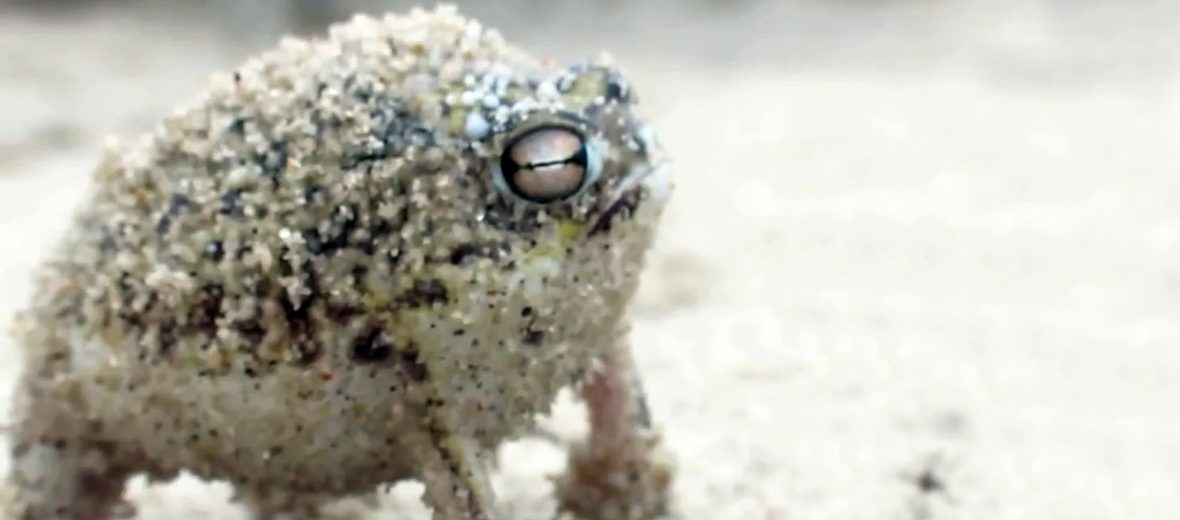
The desert rain frog, Boulenger’s short-headed frog, or web-footed rain frog is a species of frog found in Namibia and South Africa. Its natural habitat is the small strip of sandy shores between the sea and the sand dunes. It is severely threatened by habitat loss and destruction. They also have quite a fierce war cry and angry posture when they feel threatened. The IUCN lists these frogs as Near Threatened. Their population trend is listed as unknown.
First the Stats…
Scientific name: Breviceps macrops
Weight: .4 ounces
Length: Up to 2.4 inches
Lifespan: Up to 15 years
Now on to the Facts!
1.) Their name is almost oxymoronic, in that it barely ever rains where these little critters live. But they do come out when it rains, so it kind of fits.
2.) Similar to the glass frog, the rain frog has a transparent patch making its internal organs visible.
3.) Spending the day buried in sand, this nocturnal (active at night) frog comes out at night to feed and mate.
4.) These frogs use their paddle shaped feet to dig its burrows.
5.) Mating season last from late summer to early fall.
But wait, there’s more on the desert rain frog!
6.) After mating, the female Desert Rain Frog lays around 12 – 40 eggs.
7.) They eat beetles, insects, and their larvae.
Did you know…?
The desert rain frog develops directly from the egg to adult; passing over the tadpole phase unlike other species of frogs.
8.) Even though it doesn’t really rain much at all where they live, it does routinely get very foggy at night. This adds moisture to the sand in which these frogs dig and live.
9.) Humans are their greatest threat and are at risk of extinction due to human encroachment.
10.) Due to their short legs, they cannot hop or jump. They instead have to walk.
11.) The breeding season runs from June – October.
Now a Short Desert Rain Frog Video!

Want to suggest a critter for me to write about? Let me know here.
Some source material acquired from: Wikipedia & IUCN